Teaching & Learning
- Yale frames student use of generative AI for coursework as governed by school academic integrity policies and, for specific coursework expectations, by individual instructors’ guidelines
- The Poorvu Center notes that using AI to write papers or complete homework is more likely to be restricted by course policies, and instructs students to consult instructor policies when unclear
All students and faculty are expected to know and adhere to their school’s academic integrity policies. Faculty members are expected to provide clear instructions on the permitted use of generative AI tools for academic work and requirements for attribution. Likewise, students are expected to follow their instructors’ guidelines about permitted use of AI for coursework.
When compared to using AI tools for learning content, using them to write papers or to complete homework assignments is more likely to be restricted by course policies.
AI policies vary by instructor, course, and assignment. These policies are designed to support you as you learn fundamental and higher skills within each discipline.
Ask your instructor if policies aren’t clear.
- Yale’s provided sources do not define a university-wide rule specific to using generative AI during examinations or formal assessments
- The provost guidance instead directs that students follow school academic integrity policies and instructors’ guidelines for coursework, but it does not specifically address exams
Always follow academic integrity guidelines and institutional standards of conduct. All students and faculty are expected to know and adhere to their school’s academic integrity policies. Faculty members are expected to provide clear instructions on the permitted use of generative AI tools for academic work and requirements for attribution. Likewise, students are expected to follow their instructors’ guidelines about permitted use of AI for coursework.
- This guidance is presented as study support rather than a graded-work policy
- Yale’s Poorvu Center provides study-oriented guidance that encourages using LLMs for practice and active learning, while warning against relying solely on AI summaries and recommending cross-referencing important information with reliable sources
Retrieval Practice also teaches more than reviewing notes or summaries. Consider using AI to quiz you after you read rather than relying solely on AI-summaries to begin with.
Interactive Quizzing. Instead of relying solely on AI-generated summaries, use LLMs to create practice questions based on your study material.
Supplementary not Primary Source. Use LLMs as a complement to, not a replacement for, primary study methods and materials. Cross-reference important information with reliable sources.
- Yale’s Poorvu Center provides learning guidance cautioning that reliance on generative AI for coding can hinder development of deeper programming understanding
- It does not establish a uniform permission/prohibition rule for coding assignments, and separately states that AI course policies vary by instructor, course, and assignment
Many people would say that generative AI programs are even better at coding than at writing. But research shows that relying on these systems prevents you from developing the deeper understanding of programming you will need to invent new solutions or to code at higher levels.
AI policies vary by instructor, course, and assignment. These policies are designed to support you as you learn fundamental and higher skills within each discipline.
Research
- The Yale Library directs researchers to a guide that includes citation practices and tool evaluation, but the provided page does not itself specify manuscript drafting rules
- Yale’s staff AI guidelines flag that some academic publications prohibit generative AI tools in manuscripts, and direct investigators to follow publication guidelines to ensure compliance
Investigators are individually responsible for maintaining research integrity, rigor and reproducibility of their work. Some academic publications have prohibited the use of generative AI tools in manuscripts, and federal granting agencies have emerging regulations prohibiting their use in submissions and reviews. In this rapidly evolving landscape, familiarize yourself with funding agency and publication guidelines to ensure compliance.
Researchers interested in using AI in their research may wish to refer to the library’s Generative AI for Research Guide, which offers brief overviews of topics ranging from data privacy to citation practices to tool evaluation.
- Yale’s provost guidance instructs the community not to enter confidential or legally restricted data, or data classified as moderate or high-risk, into an AI tool
- Yale’s staff AI guidelines further recommend anonymizing PII where possible and especially avoiding entering personal information such as patient data or academic details of a student, citing FERPA protections for student education records
Protect Yale’s confidential information and your own. Do not enter confidential or legally restricted data or any data that Yale’s data classification policy identifies as moderate or high-risk into an AI tool.
In general, it is best to anonymize personally identifiable information (PII) and if possible, use settings that ensure inputs are not retained by the AI.
It is especially important to avoid entering personal information, such as patient data or academic details of a student – for instance student education records are protected by FERPA.
- Yale’s provost guidance also emphasizes personal responsibility for content and instructs users to review and verify AI outputs, especially before publication
- Yale’s staff AI guidelines state that investigators are individually responsible for research integrity, rigor, and reproducibility, and note that publications and federal granting agencies may prohibit generative AI use in submissions and reviews, directing investigators to comply with funder and publication rules
Investigators are individually responsible for maintaining research integrity, rigor and reproducibility of their work. Some academic publications have prohibited the use of generative AI tools in manuscripts, and federal granting agencies have emerging regulations prohibiting their use in submissions and reviews. In this rapidly evolving landscape, familiarize yourself with funding agency and publication guidelines to ensure compliance.
We are each responsible for the content of our work product. Always review and verify outputs generated by AI tools, especially before publication.
Academic Integrity
- Yale’s student guidance further states that Yale College regulations require citing the source for any material submitted as coursework, including language, images, and ideas sourced from AI
- Yale’s provost guidance states that faculty are expected to provide clear instructions on permitted AI use and requirements for attribution, and that students are expected to follow instructor guidelines
Faculty members are expected to provide clear instructions on the permitted use of generative AI tools for academic work and requirements for attribution.
Yale College regulations require that you cite the source for any material you submit as part of your course work, including language, images, and ideas that you source from AI.
- The student guidance notes that AI detectors are unreliable but that some organizations still use them to review materials, which is advisory rather than an enforcement procedure
- Yale’s undergraduate admissions policy separately states that submitting substantive AI output constitutes application fraud and that it may result in admission revocation or expulsion
- Yale provides Turnitin as an optional tool in Canvas that produces similarity reports and is described as having limited value as a plagiarism detector; the provided Turnitin page does not describe AI-detection enforcement
Turnitin generates a “similarity report” by comparing an uploaded paper to a database of web pages, articles, books, and other uploaded files.
Though Turnitin is sometimes perceived as a “plagiarism detector,” it has limited value in this capacity, and the incidence of plagiarism at Yale is generally quite low.
Although research shows that AI detectors are unreliable, some organizations (including potential employers) will still use them to review submitted materials.
As detailed in the above statements, it is Yale’s policy that submitting “the substantive content or output of an artificial intelligence platform, technology, or algorithm” constitutes application fraud. Submitting personal statements or other written application responses composed by text-generating software may result in admission revocation or expulsion.
Institutional & Administrative
- Yale’s provost guidance expects faculty to provide clear instructions on permitted AI use and attribution requirements for academic work
- Poorvu also states that instructors’ classroom use of AI tools must comply with FERPA and that instructors cannot require students to create external accounts for tools Yale does not directly license
- Yale’s staff AI guidelines include examples of staff/faculty uses (e.g., drafting recommendations, announcements, interview questions, and grant proposal refinement) and advise close monitoring of outputs and use of judgment
Faculty members are expected to provide clear instructions on the permitted use of generative AI tools for academic work and requirements for attribution.
Write a 250-word recommendation for my top student who is applying to graduate programs in [field].
I’m working on a grant proposal. Can you help me refine my project goals and objectives?
Closely monitor output from AI tools and be aware that responses sometimes contain subtle but meaningful hallucinations, uncited intellectual property, factual errors and biased or inappropriate statements. Always use your judgment when analyzing AI responses.
Your use of AI tools in the classroom must comply with the Family Educational Rights and Privacy Act (FERPA), which protects the privacy of student educational records. In particular, you cannot require students to create external accounts for tools Yale does not directly license.
- Yale’s Privacy Office notice states that AI assistants not approved for handling Yale data must not be used in meetings where confidential data is discussed and lists approved tools for transcription needs
- Yale’s provost guidance instructs community members not to enter confidential or legally restricted data, or moderate/high-risk data per Yale’s data classification policy, into an AI tool, and to treat all AI-shared information as if it will become public
- Yale’s staff AI guidelines recommend anonymizing PII where possible, avoiding entry of personal information (including FERPA-protected student education records), and note that supplier-hosted tools are higher risk, with a presumption that the supplier’s tool is using Yale data to train itself
Do not enter confidential or legally restricted data or any data that Yale’s data classification policy identifies as moderate or high-risk into an AI tool.
Treat all information shared with an AI tool as if it will become public. Do not share information that is personal or sensitive, and be mindful that the information you input into an AI tool may be retained.
AI tools that have not been approved for Yale data must not be used in Zoom, Teams, or Google meetings, where confidential data such as HIPAA PHI, proprietary information, financial, or student data is discussed.
Approved Tools: To meet your transcription needs securely, Yale offers several approved tools:
• ZoomAI Companion
• Teams Premium
• Microsoft 365 Copilot
In general, it is best to anonymize personally identifiable information (PII) and if possible, use settings that ensure inputs are not retained by the AI.
It is especially important to avoid entering personal information, such as patient data or academic details of a student – for instance student education records are protected by FERPA.
These supplier relationships are higher risk; Presume that the supplier’s tool is using the Yale data to train itself.
- The Poorvu Center student guidance also describes a university investment in AI, but the provided sources do not set out a single consolidated governance framework beyond these statements and linked resources
- Yale’s provided sources include statements indicating institutional support for AI adoption and risk management, including a commitment to safety, security, and academic integrity, and references to procurement coordination to minimize institutional risk
As you explore AI’s potential, please adhere to the following general guidelines, which align with existing university policies and uphold our institutional commitment to safety, security, and academic integrity.
The university is working to support procurement practices that coordinate shared interests and minimize institutional risk.
The University has made a substantial $150 million investment to encourage exploration of AI by both faculty and students.
DocuMark: Responsible AI Use for Academic Integrity
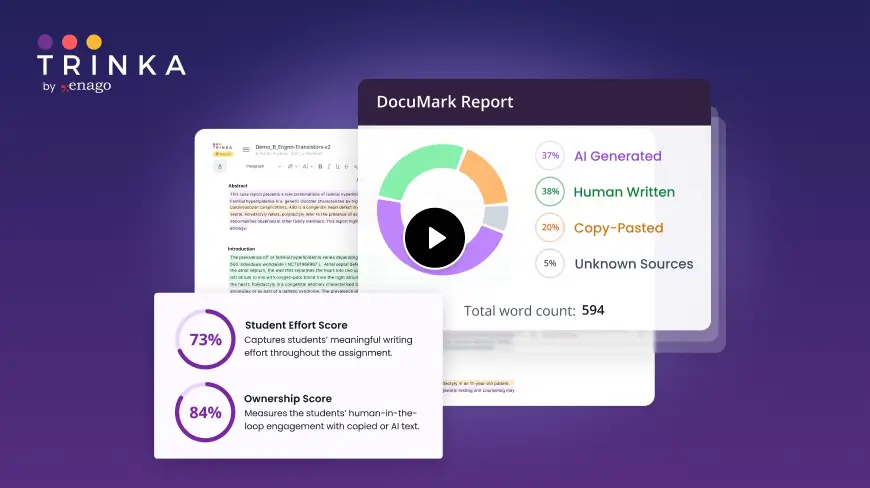
Knowing your institution's AI policy is step one. DocuMark helps enforce it fairly by empowering universities to manage AI-generated content, prevent cheating, and support student writing through responsible AI use.
Common Questions About Yale University's AI Policies
Yale University has defined AI policies in 12 of 12 categories, with an overall coverage score of 100%.
Yale’s provost guidance states that faculty are expected to provide clear instructions on permitted AI use and requirements for attribution, and that students are expected to follow instructor guidelines. Yale’s student guidance further states that Yale College regulations require citing the source for any material submitted as coursework, including language, images, and ideas sourced from AI.
Yale provides Turnitin as an optional tool in Canvas that produces similarity reports and is described as having limited value as a plagiarism detector; the provided Turnitin page does not describe AI-detection enforcement. The student guidance notes that AI detectors are unreliable but that some organizations still use them to review materials, which is advisory rather than an enforcement procedure. Yale’s undergraduate admissions policy separately states that submitting substantive AI output constitutes application fraud and that it may result in admission revocation or expulsion.
Yale’s provost guidance instructs community members not to enter confidential or legally restricted data, or moderate/high-risk data per Yale’s data classification policy, into an AI tool, and to treat all AI-shared information as if it will become public. Yale’s Privacy Office notice states that AI assistants not approved for handling Yale data must not be used in meetings where confidential data is discussed and lists approved tools for transcription needs. Yale’s staff AI guidelines recommend anonymizing PII where possible, avoiding entry of personal information (including FERPA-protected student education records), and note that supplier-hosted tools are higher risk, with a presumption that the supplier’s tool is using Yale data to train itself.