Teaching & Learning
- The university-level guidance defers detailed permissions to individual course instructors, who may allow or disallow some or all uses and are expected to communicate their policy in the syllabus
- Stanford’s Office of Community Standards guidance states that, unless an instructor explicitly says otherwise, using or consulting generative AI is treated like getting assistance from another person, and using it to substantially complete coursework is not permitted
Absent a clear statement from a course instructor, use of or consultation with generative AI shall be treated analogously to assistance from another person.
In particular, using generative AI tools to substantially complete an assignment or exam (e.g. by entering exam or assignment questions) is not permitted.
Individual course instructors are free to set their own policies regulating the use of generative AI tools in their courses, including allowing or disallowing some or all uses of such tools. Course instructors should set such policies in their course syllabi and clearly communicate such policies to students.
- The guidance indicates instructors may set their own course policies in the syllabus, which can allow or disallow AI use in assessments
- Stanford’s Office of Community Standards guidance states that, absent a clear instructor statement, generative AI use is treated like assistance from another person, and using generative AI tools to substantially complete an exam is not permitted (including entering exam questions)
Absent a clear statement from a course instructor, use of or consultation with generative AI shall be treated analogously to assistance from another person.
In particular, using generative AI tools to substantially complete an assignment or exam (e.g. by entering exam or assignment questions) is not permitted.
Individual course instructors are free to set their own policies regulating the use of generative AI tools in their courses, including allowing or disallowing some or all uses of such tools. Course instructors should set such policies in their course syllabi and clearly communicate such policies to students.
- The guidance indicates students should talk with the instructor if they are uncertain whether a generative AI source is permitted aid for a particular assignment
- Stanford’s Office of Community Standards acknowledges that generative AI tools can support student learning and understanding, but its Honor Code guidance focuses on coursework boundaries rather than granting a general, university-wide permission for study assistance
While these tools have applications that foster student learning and understanding, these tools can also be used in ways that bypass key learning objectives.
If you are in doubt about whether a generative AI source (or any source) is permitted aid in the context of a particular assignment, talk with the instructor.
- Separately, Stanford IT guidance flags risks in AI-generated code (e.g., insecure construction and IP risks), but does not set coursework permissions for programming beyond the instructor-discretion model in the Honor Code guidance
- Stanford’s Office of Community Standards Honor Code guidance treats generative AI consultation like assistance from another person absent instructor direction, and prohibits using generative AI tools to substantially complete assignments (which can include programming work) unless a course policy states otherwise
Absent a clear statement from a course instructor, use of or consultation with generative AI shall be treated analogously to assistance from another person.
In particular, using generative AI tools to substantially complete an assignment or exam (e.g. by entering exam or assignment questions) is not permitted.
Individual course instructors are free to set their own policies regulating the use of generative AI tools in their courses, including allowing or disallowing some or all uses of such tools.
This can also apply to using AI to generate code, which could be badly constructed, insecure, create backdoors, and even risk intellectual property infringement.
Research
- Stanford’s marketing and communications AI guidelines also state that the Stanford AI Playground is not approved for high-risk data (as of the writing of that guidance)
- Stanford’s University IT service documentation restricts some Stanford-provided generative AI services based on data risk level, including explicitly noting that certain services are approved only for Low and Moderate-Risk Data and not approved for PHI and other High Risk Data
The AI API Gateway is approved for use with Low and Moderate-Risk Data. It is not yet approved for use with Protected Health Information (PHI) and other High Risk Data.
Microsoft Copilot Chat (free) is approved for Low and Moderate Risk Data ONLY. Do not input High Risk Data into the free Copilot Chat window.
Prohibited data for the free Microsoft Copilot Chat includes:
High-risk research data
As of this writing, the Stanford AI Playground is not approved for high-risk data.
- Stanford’s University IT responsible-AI guidance recommends transparency for generative AI use in content creation when it is permitted at all
- Separately, Stanford’s marketing and communications AI guidelines require that AI content generation be done ethically and with human oversight, and require adherence to university Code of Conduct, Information Security, and Privacy Policies when using AI technologies
Recommended Best Practices For content creation: If use of generative AI is permitted at all, one should always transparently cite its use.
In this context, the university expects that content generation using AI will be done ethically and with human oversight.
Irrespective of the application, you must adhere to the University Code of Conduct, Information Security, and Privacy Policies when using AI technologies.
Academic Integrity
- Separately, Stanford IT responsible-AI guidance recommends transparent citation of generative AI use for content creation when it is permitted at all
- Stanford’s Office of Community Standards guidance states that students should acknowledge generative AI use (beyond incidental use) and default to disclosing AI assistance when in doubt
Students should acknowledge the use of generative AI (other than incidental use) and default to disclosing such assistance when in doubt.
Recommended Best Practices For content creation: If use of generative AI is permitted at all, one should always transparently cite its use.
- Stanford’s Office of Community Standards guidance recommends that instructors provide clear advance notice if they may use detection software to review submitted work for generative AI use
- In a program-level policy, Stanford’s Program in Writing and Rhetoric (PWR) states that violation of its AI policy is considered an Honor Code violation and will result in the involvement of the Office of Community Standards
NOTE: As part of the BCA’s guidance on clear communication of a course’s generative AI policy, OCS recommends course instructors provide clear advance notice that they may use detection software to review work submitted for use of generative AI.
Violation of PWR’s AI policy is considered an Honor Code violation and will result in the involvement of Stanford’s Office of Community Standards (OCS).
Institutional & Administrative
- The guidelines also require adherence to the university’s Code of Conduct, Information Security, and Privacy Policies when using AI technologies
- Stanford’s marketing and communications AI guidelines apply to staff (and related roles) and state that the university expects AI content generation in this function to be done ethically and with human oversight
The university expects that content generation using AI will be done ethically and with human oversight.
These guidelines apply to all regular staff, interns, casual employees, and consultants.
Irrespective of the application, you must adhere to the University Code of Conduct, Information Security, and Privacy Policies when using AI technologies.
- Stanford’s risk-classification guidance also states that applications not evaluated by the university that require access to Stanford email are not permitted due to security, privacy, and compliance concerns
- Stanford IT guidance restricts use of some Stanford-provided AI services by data risk classification (e.g., certain tools are approved for Low and Moderate-Risk Data only and not for PHI/other High Risk Data)
- Stanford’s marketing and communications AI guidelines additionally state that confidential or legally privileged information may not be provided to generative AI tools and that (as of that guidance) the Stanford AI Playground is not approved for high-risk data
The AI API Gateway is approved for use with Low and Moderate-Risk Data. It is not yet approved for use with Protected Health Information (PHI) and other High Risk Data.
Microsoft Copilot Chat (free) is approved for Low and Moderate Risk Data ONLY. Do not input High Risk Data into the free Copilot Chat window.
Due to security, privacy, and compliance concerns, applications that have not been evaluated by the university and require access to Stanford email, such as Superhuman, are not permitted.
You may not provide any confidential or legally privileged information of Stanford or a third party to generative AI tools.
As of this writing, the Stanford AI Playground is not approved for high-risk data.
- Stanford’s Office of Community Standards guidance notes that the Board on Conduct Affairs will monitor developments in generative AI tools and may update its Honor Code-related guidance
- Stanford’s marketing and communications AI guidelines reference a committee report and state that readers are encouraged to familiarize themselves with its full content, but the provided sources do not define a single university-wide AI governance structure or strategy beyond these statements
The BCA will continue to monitor developments in these tools and their use in academic settings and may update this guidance.
Readers of these guidelines are strongly encouraged to familiarize themselves with the full content of the committee report.
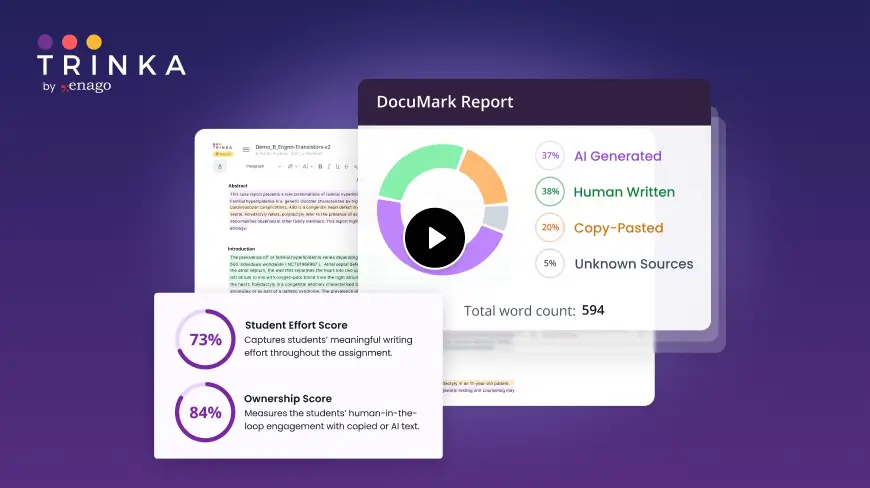
DocuMark: Responsible AI Use for Academic Integrity
Knowing your institution's AI policy is step one. DocuMark helps enforce it fairly by empowering universities to manage AI-generated content, prevent cheating, and support student writing through responsible AI use.
Common Questions About Stanford University's AI Policies
Stanford University has defined AI policies in 11 of 12 categories, with an overall coverage score of 92%.
Stanford’s Office of Community Standards guidance states that students should acknowledge generative AI use (beyond incidental use) and default to disclosing AI assistance when in doubt. Separately, Stanford IT responsible-AI guidance recommends transparent citation of generative AI use for content creation when it is permitted at all.
Stanford’s Office of Community Standards guidance recommends that instructors provide clear advance notice if they may use detection software to review submitted work for generative AI use. In a program-level policy, Stanford’s Program in Writing and Rhetoric (PWR) states that violation of its AI policy is considered an Honor Code violation and will result in the involvement of the Office of Community Standards.
Stanford IT guidance restricts use of some Stanford-provided AI services by data risk classification (e.g., certain tools are approved for Low and Moderate-Risk Data only and not for PHI/other High Risk Data). Stanford’s risk-classification guidance also states that applications not evaluated by the university that require access to Stanford email are not permitted due to security, privacy, and compliance concerns. Stanford’s marketing and communications AI guidelines additionally state that confidential or legally privileged information may not be provided to generative AI tools and that (as of that guidance) the Stanford AI Playground is not approved for high-risk data.