Teaching & Learning
- Adams State's AI policy for coursework is at the discretion of the individual instructor
- The university provides a library guide stating that policies will vary by course and that students must clarify expectations
- The guide also provides a sample syllabus statement that prohibits generative AI use, treating it as unauthorized assistance and a violation of the university’s Academic Integrity Policy
The policies on if, when, and how you can use ChatGPT and other generative artificial intelligence (AI) in your coursework at Adams State will vary by course, at the discretion of the instructor. Be sure you understand the expectations for each of your classes. If you're not sure, ask! ... Sample Syllabus Statement: Students may not use generative AI, such as ChatGPT, to produce material for this course. Any use of these tools is considered unauthorized assistance and, as such, constitutes a violation of the university’s Academic Integrity Policy.
- The university treats cheating on exams as academic dishonesty and lists multiple exam-related violations
- It also provides faculty support for online proctoring through Honorlock, but the sources do not give an AI-specific exam rule
• Copying from another student’s exam
• Feigned illness to avoid an exam
• Study of a copy of an exam prior to taking a make-up exam
• Providing another student answers during an exam
• Use of notes or book during the exam when prohibited
*
- It also clarifies that AI use in coursework is at the discretion of the instructor
- The university library provides a detailed informational guide on AI and ChatGPT for students and faculty
- This guide serves as a resource for understanding generative AI, learning how to cite AI tools, and finding further reading on the topic
Welcome! This guide provides information and resources on ChatGPT and other generative artificial intelligence (AI) tools. In this guide, you will find information about: What is Generative AI? How Can I Use ChatGPT and Other Generative AI? How to Cite ChatGPT & Other Generative AI... Further Reading on AI.
Research
Academic Integrity
- The AI and ChatGPT guide offers formatting examples for both APA and MLA citation styles
- The university provides specific guidance on how to cite generative AI tools through its library
How to Cite ChatGPT & Other Generative AI. APA Style: In-text citation: (OpenAI, 2023); Reference list citation: OpenAI. (2023). ChatGPT (Mar 14 version) [Large language model]. https://chat.openai.com/chat ... MLA Style: In-text citation: ("Title of Short Work"); Works Cited list citation: "Title of short work." Title of "container," name of AI tool, version, date, URL.
- The sources do not state a university position on AI detection tools specifically
- The university has an enforcement process for academic dishonesty: instructors may assign a failing grade, must provide documentation to the Vice President for Academic Affairs, and repeated violations are tracked in a confidential file and forwarded for further action
In the event an instructor discovers that a student has intentionally violated the academic integrity provision of the ASU General Catalog and ASU Student Handbook, the instructor may assign a failing grade for the assignment or course. If a failing grade is assigned on an assignment or for the course, the instructor will provide supporting documentation to the Vice President for Academic Affairs. The VPAA will create a confidential file concerning the matter. In the unfortunate event that a student has violated the academic integrity policy on more than one occasion, the file will reflect all additional episodes. The VPAA will forward the case to the VPSA for action according to the procedures outlined below:
D. All cases of academic dishonesty are to be reported to the VPAA, who will keep a confidential file concerning the case.
In instances where a student has violated academic integrity on more than one occasion the file will reflect all additional instances.
Institutional & Administrative
- The sources do not define rules for faculty use of AI in grading, recommendation letters, or administrative communications
- Faculty resources explicitly include AI-related teaching support materials for creating assessments and classroom activities
AI & Teaching at Adams. Artificial intelligence tools like ChatGPT can impact teaching and learning. Below are some links to help you navigate this new world. ... How can educators use ChatGPT for assessments and classroom activiies? (Article) ... Using AI to Make Teaching More Efficient and Effective (Article)
- The university provides students and employees access to Microsoft Office 365 Education and Microsoft 365 Copilot through their Adams State email accounts
- The provided sources identify these platforms as available resources, but they do not define data-classification rules, privacy restrictions, or prohibited AI platforms
Computing Services is excited to announce that Microsoft Office 365 Education is available to Adams State University students and employees online through Microsoft CoPilot for free!
You will need a valid username@adams.edu email address to qualify.
Microsoft 365 Apps for Free on the Web:
This link above offers the following:
* Sign-in to Microsoft 365 Copilot site (Sign-in with ASU email)
* Mobile Microsoft 365 Copilot download (Free) - Scan QR code below.
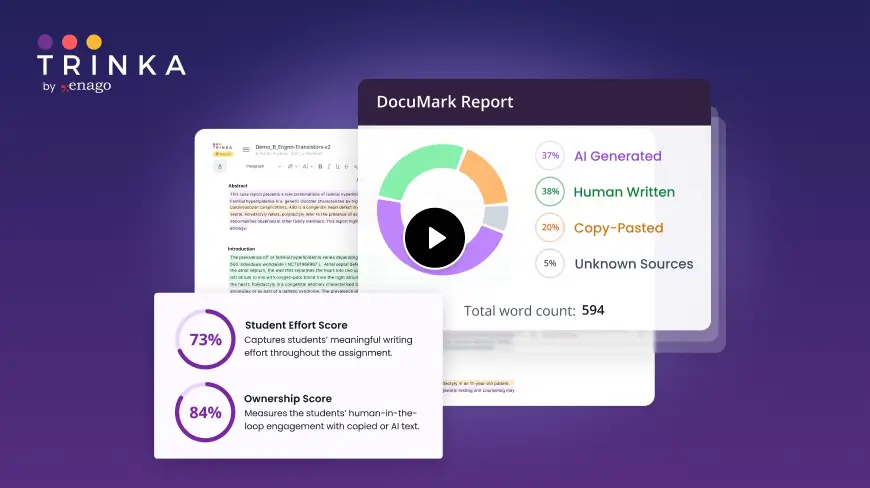
DocuMark: Responsible AI Use for Academic Integrity
Knowing your institution's AI policy is step one. DocuMark helps enforce it fairly by empowering universities to manage AI-generated content, prevent cheating, and support student writing through responsible AI use.
Common Questions About Adams State College's AI Policies
Adams State College has defined AI policies in 7 of 12 categories, with an overall coverage score of 58%.
The university provides specific guidance on how to cite generative AI tools through its library. The AI and ChatGPT guide offers formatting examples for both APA and MLA citation styles.
The university has an enforcement process for academic dishonesty: instructors may assign a failing grade, must provide documentation to the Vice President for Academic Affairs, and repeated violations are tracked in a confidential file and forwarded for further action. The sources do not state a university position on AI detection tools specifically.
The university provides students and employees access to Microsoft Office 365 Education and Microsoft 365 Copilot through their Adams State email accounts. The provided sources identify these platforms as available resources, but they do not define data-classification rules, privacy restrictions, or prohibited AI platforms.