Teaching & Learning
- Graduate nursing also states that use of AI resources is highly discouraged and may lead to a zero and dismissal in that program
- In the graduate nursing, PA, and RN-BSN materials, AI use in submitted coursework is prohibited unless the course faculty explicitly allows it
- Where faculty permission is not given, submitted work must be the student’s own original work, and AI-assisted submissions are treated as academic misconduct
These tools should be used only with explicit and clear permission from the course faculty, and then only in the ways allowed by the instructor.
All submissions, unless otherwise specified by the course faculty, must be the student’s own, original work. This includes but is not limited to draft or final assignments, papers, projects, exams/quizzes, oral presentations, discussion boards, or other work. Use of any other person, or AI for submitted work it will be treated as non-original work and is considered academic misconduct and is subject to appropriate penalties.
The use of assistive websites is highly discouraged including but not limited to Course Hero, Quizlet, Chegg, Brainly, and any artificial intelligence (AI) resources. Academic dishonesty will not be tolerated in any graduate nursing program. Students who exhibit academic dishonesty on exams, assignments, projects, or research will receive a zero and will be dismissed from the graduate nursing program.
AHU encourages the adoption and responsible use of AI tools as aids to enhance learning and productivity. It is important to understand that AI tools are intended to support student work, and not to replace original thought or effort. These tools should be used only with explicit and clear permission from the course faculty, and then only in the way allowed by the instructor.
All submissions, unless otherwise specified by the course faculty, must be the student’s own, original work. This includes but is not limited to draft or final assignments, papers, projects, exams/quizzes, oral presentations, discussion boards, or other work. The use of any other person’s ideas or use of artificial intelligence (AI) is not to be used unless otherwise indicated by the course faculty. Use of any other person, or AI, for submitted work will be treated as non-original work and is considered academic misconduct and is subject to appropriate actions.
All submissions, unless otherwise specified by the course faculty, must be the student’s own, original work. This includes but is not limited to draft or final assignments, papers, projects, exams/quizzes, oral presentations, discussion boards, or other work. The use of any other person’s ideas or use of artificial intelligence (AI) is not to be used unless otherwise indicated by the course faculty. Use of any other person, or AI, for submitted work will be treated as non-original work and is considered academic misconduct and is subject to appropriate penalties. Using AI is strongly discouraged and doing so will result in disciplinary action per AHU’s Academic Misconduct Policy (ACD 101.005).
- For exams and quizzes, AI use is prohibited unless the instructor or course faculty specifically authorizes it
- Graduate nursing states that academic dishonesty on exams involving AI can result in a zero and dismissal from the program
- The PA manual also applies academic integrity standards to online exams and prohibits unauthorized external aids in examinations
All submissions, unless otherwise specified by the course faculty, must be the student’s own, original work. This includes but is not limited to draft or final assignments, papers, projects, exams/quizzes, oral presentations, discussion boards, or other work. Use of any other person, or AI for submitted work it will be treated as non-original work and is considered academic misconduct and is subject to appropriate penalties.
The use of assistive websites is highly discouraged including but not limited to Course Hero, Quizlet, Chegg, Brainly, and any artificial intelligence (AI) resources. Academic dishonesty will not be tolerated in any graduate nursing program. Students who exhibit academic dishonesty on exams, assignments, projects, or research will receive a zero and will be dismissed from the graduate nursing program.
All academic integrity standards apply to online courses, including exams, as they do in traditional campus courses.
All submissions, unless otherwise specified by the course faculty, must be the student’s own, original work. This includes but is not limited to draft or final assignments, papers, projects, exams/quizzes, oral presentations, discussion boards, or other work. The use of any other person’s ideas or use of artificial intelligence (AI) is not to be used unless otherwise indicated by the course faculty.
Cheating is using or attempting to use materials, information, notes, study aids or other assistance in any type of examination or evaluation which has not been authorized by the instructor.
Students completing any type of examination or evaluation are prohibited from looking at another student’s materials and from using external aids of any sort (e.g., books, notes, calculators, electronic resources, or conversation with others), unless the instructor has indicated specifically in advance that this will be allowed.
All submissions, unless otherwise specified by the course faculty, must be the student’s own, original work. This includes but is not limited to draft or final assignments, papers, projects, exams/quizzes, oral presentations, discussion boards, or other work. The use of any other person’s ideas or use of artificial intelligence (AI) is not to be used unless otherwise indicated by the course faculty.
- Graduate nursing separately says use of AI resources is highly discouraged
- The university materials permit AI as a learning aid only when course faculty explicitly authorize it
- Graduate nursing and PA documents say AI tools are intended to support student work and enhance learning and productivity, but not replace original thought or effort
AHU encourages the adoption and responsible use of AI tools as aids to enhance learning and productivity. It is important to understand that AI tools are intended to support student work, and not to replace original thought or effort. These tools should be used only with explicit and clear permission from the course faculty, and then only in the ways allowed by the instructor.
The use of assistive websites is highly discouraged including but not limited to Course Hero, Quizlet, Chegg, Brainly, and any artificial intelligence (AI) resources.
AHU encourages the adoption and responsible use of AI tools as aids to enhance learning and productivity. It is important to understand that AI tools are intended to support student work, and not to replace original thought or effort. These tools should be used only with explicit and clear permission from the course faculty, and then only in the way allowed by the instructor.
Research
- Graduate nursing also says academic dishonesty involving research can result in a zero and dismissal from the graduate nursing program
- The provided documents do not set a separate research-manuscript AI policy, but graduate nursing states that generative AI must be properly cited like any other source
Though generative AI changes many things, it does not change the fundamental expectation of ethical student behavior. AHU’s Academic Misconduct Policy (ACD 101.005) still applies. Generative AI must be properly cited like any other source pursuant to the AHU plagiarism requirements.
The use of assistive websites is highly discouraged including but not limited to Course Hero, Quizlet, Chegg, Brainly, and any artificial intelligence (AI) resources. Academic dishonesty will not be tolerated in any graduate nursing program. Students who exhibit academic dishonesty on exams, assignments, projects, or research will receive a zero and will be dismissed from the graduate nursing program.
- No separate IRB, grant, or ethics-form AI policy is defined in the provided documents
- It also lists misconduct in research assignments among intolerable forms of academic misconduct
- Graduate nursing states that the academic misconduct policy still applies to generative AI and that misuse affecting research is not tolerated
Though generative AI changes many things, it does not change the fundamental expectation of ethical student behavior. AHU’s Academic Misconduct Policy (ACD 101.005) still applies.
With each course, students must adhere to academic integrity and the code of conduct outlined in AHU’s catalog. Academic misconduct, including but not limited to, cheating on examinations, plagiarism, fabrication, forgery, obstruction, multiple submissions, complicity, misconduct research assignments, computer misuse, and the misuse of intellectual property will not be tolerated.
The use of assistive websites is highly discouraged including but not limited to Course Hero, Quizlet, Chegg, Brainly, and any artificial intelligence (AI) resources. Academic dishonesty will not be tolerated in any graduate nursing program. Students who exhibit academic dishonesty on exams, assignments, projects, or research will receive a zero and will be dismissed from the graduate nursing program.
Academic Integrity
- Graduate nursing and RN-BSN require AI to be properly cited like any other source under AHU plagiarism rules
- The PA manual does not state a citation rule in the located AI language, but it encourages students to self-check written work with an AI detector before submission to support transparency and academic honesty
Generative AI must be properly cited like any other source pursuant to the AHU plagiarism requirements.
AI must be properly cited like any other source pursuant to the AHU plagiarism requirements.
To support transparency and academic honesty, students are encouraged to self-check their written work through an AI detector prior to submission, such as AI Detector & Content Checker - Copyleaks.
- The documents use Turnitin and AI detection as enforcement tools in some programs
- Graduate nursing requires all written assignments to be submitted to Turnitin, with faculty setting an acceptable similarity threshold up to 15%
- RN-BSN requires Turnitin submission, rejects assignments above its similarity range, imposes a zero for Turnitin AI scores above 30%, and states AI misuse can trigger disciplinary action; PA encourages students to self-check with an AI detector, and AI misuse is treated as academic misconduct
All written assignments must be submitted to Turnitin per each course syllabus and in each course, faculty will determine the similarity percentage acceptable for course assignments with the maximum being no higher than 15 percent similarity.
A student who violates standards of academic and professional integrity may receive a failing grade for the assignment or the course. The student will not have the option of a grade of “W” in the course and depending on the nature of the offense, may be subject to warning, academic probation, suspension, or immediate dismissal from the program and/or the University.
Written assignments will be submitted via Turnitin to validate authenticity. An acceptable Turnitin result ranges within the blue to green zones (less than 24% non-original). No assignment will be accepted outside of this zone for any reason.
Any assignment that is submitted with a Turnitin AI score greater than 30% will receive a grade of zero (0) without an opportunity to resubmit the assignment.
Using AI is strongly discouraged and doing so will result in disciplinary action per AHU’s Academic Misconduct Policy (ACD 101.005).
To support transparency and academic honesty, students are encouraged to self-check their written work through an AI detector prior to submission, such as AI Detector & Content Checker - Copyleaks.
Use of any other person, or AI, for submitted work will be treated as non-original work and is considered academic misconduct and is subject to appropriate actions.
Institutional & Administrative
- The located materials do not define an institutional AI governance structure, committee, or strategy roadmap
- They do, however, state in course-policy language that AHU encourages responsible adoption of AI tools as aids to enhance learning and productivity, subject to faculty permission and academic integrity rules
AHU encourages the adoption and responsible use of AI tools as aids to enhance learning and productivity. It is important to understand that AI tools are intended to support student work, and not to replace original thought or effort.
AHU encourages the adoption and responsible use of AI tools as aids to enhance learning and productivity. It is important to understand that AI tools are intended to support student work, and not to replace original thought or effort.
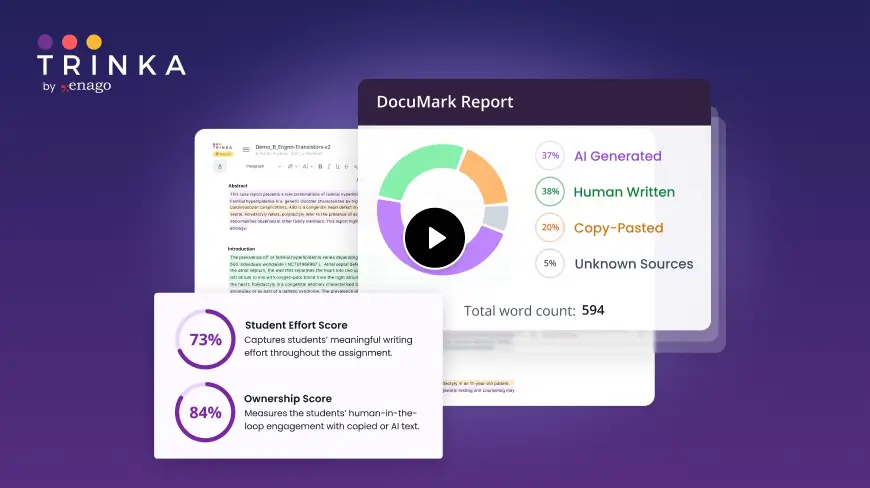
DocuMark: Responsible AI Use for Academic Integrity
Knowing your institution's AI policy is step one. DocuMark helps enforce it fairly by empowering universities to manage AI-generated content, prevent cheating, and support student writing through responsible AI use.
Common Questions About Adventist University of Health Sciences's AI Policies
Adventist University of Health Sciences has defined AI policies in 8 of 12 categories, with an overall coverage score of 67%.
Graduate nursing and RN-BSN require AI to be properly cited like any other source under AHU plagiarism rules. The PA manual does not state a citation rule in the located AI language, but it encourages students to self-check written work with an AI detector before submission to support transparency and academic honesty.
The documents use Turnitin and AI detection as enforcement tools in some programs. Graduate nursing requires all written assignments to be submitted to Turnitin, with faculty setting an acceptable similarity threshold up to 15%. RN-BSN requires Turnitin submission, rejects assignments above its similarity range, imposes a zero for Turnitin AI scores above 30%, and states AI misuse can trigger disciplinary action; PA encourages students to self-check with an AI detector, and AI misuse is treated as academic misconduct.
No explicit data protection or approved AI platform policy is currently defined in the available policy sources.