Teaching & Learning
- The broader academic honesty policy also treats taking credit for others’ work and plagiarism as violations, with sanctions imposed based on the seriousness of the violation
- Student assignment submissions using tools such as ChatGPT are prohibited by the Department of English and Modern Languages unless the AI-generated content is appropriately documented
"Students should generate work that reflects original thought. As such, the use of tools such as ChatGPT, iA Writer, etc. is prohibited in student assignment submissions. Submissions that contain AI generated content (text, video, audio and images) without appropriate documentation will be considered a violation of AAMU's Academic Honesty Policy."
"It is the policy of AAMU to impose sanctions on students who misrepresent their academic work."
"Examples of academic dishonesty include but are not limited to:
1. Plagiarism, taking someone else’s intellectual work and presenting it as one’s own (which covers published and unpublished sources)."
"Students who (cooperate or in other ways promote) participate in promoting cheating or plagiarism by others (or who take credit for the work of others) will also be in violation of this policy."
- The university does not state an AI-specific exam rule in the provided sources
- However, its academic honesty policy prohibits unauthorized consultation of materials during tests, substitution on exams, receipt of exam questions or answers, and other cheating in graded activities
"Cheating is unacceptable in any form.
Examples include consultation of books, library materials or notes during tests without the instructor’s permission; use of crib sheets or hidden notes; intentional observation of another student’s test; receipt of a copy of an exam or questions or answers from an exam to be given or in progress; substitution of another person for the student on an exam or another graded activity; deliberate falsification of lab results; submission of falsified data; alteration of exams or other academic exercises; and collaboration on projects where collaboration is forbidden."
"Falsification, forgery or alteration of any documents pertaining to assignments and examinations."
- This is an institutional operational rule, not a student coursework rule in the provided sources
- The university’s general AI policy for faculty, staff, contractors, and other representatives allows AI to be used as a tool for coding only when the user has subject-matter expertise and the AI-generated code is documented and reviewed
"Individuals using an AI system must have expertise in the subject matter for which the AI is used. AI is to be utilized as a tool and is not a substitute for expertise. For example, if using AI for coding, the individual deploying the AI must have expertise in coding."
"All AI-generated content (writing, datasets, graphs, pictures, etc.) must be thoroughly reviewed by an individual with expertise to evaluate such content for accuracy as well as general proofing and editing. AI-generated content should be viewed as a starting point, not the finished product."
"The use of an AI system must be documented to capture institutional knowledge. For example, if AI is used to create code and included in a larger section of code, there must be documentation as to which code section is AI-derived and who reviewed it."
Research
- The general AI policy applies to AAMU representatives and requires expert review of AI-generated writing and honesty about how AI assisted the work
- For graduate students, the provided sources require training in academic integrity and the responsible conduct of research, but they do not set an AI-specific rule for drafting or editing research papers, theses, dissertations, or manuscripts
"All students admitted to the graduate programs must complete training designed to inculcate an awareness and understanding of the fundamental issues of academic integrity and the responsible conduct of research (RCR) in a manner that is consistent with federal regulations."
"All AI-generated content (writing, datasets, graphs, pictures, etc.) must be thoroughly reviewed by an individual with expertise to evaluate such content for accuracy as well as general proofing and editing. AI-generated content should be viewed as a starting point, not the finished product."
"Integrity in Use: All users of AI systems should be honest about how AI assisted in getting work done."
- The general AI policy permits AI use for tasks such as analyzing datasets only with consultation and caution, and it requires accurate datasets, expert review, bias review, and documentation
- It also prohibits entering non-public university information into open AI systems, entering any sensitive information into any AI system, and treats falsified data as academic dishonesty in the student honesty policy
"Before using any A —whether for personal business tasks such as writing an email or more complex business processes such as analyzing datasets - you should consult with your department head and seek guidance."
"Any use of an AI system must have clear objectives for use as a tool and business-accepted data sets from which the AI draws. If the data sets that the AI is using are not accurate, then the information AI provides will not be accurate."
"All AI-generated content (writing, datasets, graphs, pictures, etc.) must be thoroughly reviewed by an individual with expertise to evaluate such content for accuracy as well as general proofing and editing."
"AI systems are trained on data that may contain inherent bias. Users of these systems are responsible for reviewing any AI-produced content for bias and correcting it, as necessary."
"Non-public University information must never be put into an open AI system."
"Entering any sensitive information about an individual into any AI system."
"Cheating is unacceptable in any form.
Examples include ... deliberate falsification of lab results; submission of falsified data; ..."
- Graduate students are required to complete academic integrity and responsible conduct of research training consistent with federal regulations, and failure to complete it blocks advancement to candidacy and graduation clearance
- The provided sources do not state AI-specific rules for grant proposals, IRB applications, or ethics declarations, but the general AI policy requires honesty about AI assistance and compliance with legal, ethical, privacy, and contractual requirements
"All students admitted to the graduate programs must complete training designed to inculcate an awareness and understanding of the fundamental issues of academic integrity and the responsible conduct of research (RCR) in a manner that is consistent with federal regulations."
"All academic integrity/RCR training requirements must be completed prior to a student’s advancement to candidacy."
"A graduate student who has not completed the required training in academic integrity and the responsible conduct of research will not be advanced to candidacy or cleared for graduation."
"AAMU is committed to full compliance with applicable laws related to the use of artificial intelligence. Additionally, AAMU is committed to the ethical use of artificial intelligence."
"Integrity in Use: All users of AI systems should be honest about how AI assisted in getting work done."
Academic Integrity
- For AAMU representatives under the general AI policy, use of AI systems must be documented, users should be honest about AI assistance, and AI-derived code must be identified along with who reviewed it
- The university requires documentation of AI-generated content in student submissions under the English and Modern Languages statement, and undocumented AI-generated content is treated as an academic honesty violation
"Submissions that contain AI generated content (text, video, audio and images) without appropriate documentation will be considered a violation of AAMU's Academic Honesty Policy."
"AAMU Representatives must document all AI systems they are utilizing and for what functions. Tracking the use of AI is not optional and is part of your job."
"The use of an AI system must be documented to capture institutional knowledge. For example, if AI is used to create code and included in a larger section of code, there must be documentation as to which code section is AI-derived and who reviewed it."
"Integrity in Use: All users of AI systems should be honest about how AI assisted in getting work done."
"Do not pass off AI-generated work as done by you solely."
- The provided sources do not mention AI detection tools
- Enforcement is addressed through the academic honesty policy: undocumented AI-generated content in student submissions is treated as a violation, sanctions are imposed for misrepresented academic work, and penalties can range from warnings and grade penalties to suspension or dismissal
"Submissions that contain AI generated content (text, video, audio and images) without appropriate documentation will be considered a violation of AAMU's Academic Honesty Policy."
"It is the policy of AAMU to impose sanctions on students who misrepresent their academic work. These sanctions will be selected by appropriate classroom instructors or other designated persons consistent with the seriousness of the violation and related considerations."
"Academic sanctions may include but not be limited to any of the following:
* verbal or written warning
* lowering of grade for assignment/activity
* lowering of term grade
* failure of class assignment"
"Administrative sanctions may include but not be limited to either of the following:
* suspension from the University
* dismissal from the University"
Institutional & Administrative
- The general AI policy applies to faculty, staff, officers, board members, contractors, affiliates, agents, and others acting on behalf of the university
- New AI systems generally require approval by the AI Steering Committee and/or CIO, users must have subject-matter expertise, AI output must be thoroughly reviewed, department heads should be consulted and informed, and permission should be sought for certain tasks such as performance evaluations
"This Policy is applicable to all AAMU faculty and staff, officers, board members, contractors, representatives, affiliates, agents, and any person or entity performing services for or on behalf of AAMU."
"Except for the use of an Embedded AI Tool in a software system approved for use at the University, any use of a new AI System must be approved by the AI Steering Committee and/or CIO."
"Individuals using an AI system must have expertise in the subject matter for which the AI is used. AI is to be utilized as a tool and is not a substitute for expertise."
"All AI-generated content (writing, datasets, graphs, pictures, etc.) must be thoroughly reviewed by an individual with expertise to evaluate such content for accuracy as well as general proofing and editing."
"you should ensure that your department head is aware of the use of the AI system and has approved any use of the AI system, particularly for AI-generated content that will be relayed externally."
"For example, you should ask your department head and/or HR representative if you may use an AI system to assist in writing a performance evaluation."
- The university permits embedded AI tools within already approved software, but new AI systems must be approved
- It prohibits putting non-public university information into open AI systems, prohibits entering trade secrets, confidential information, personal data, or any sensitive information into prohibited contexts, requires informed consent before inputting personal information into a closed AI system, and requires legal and internal review of AI systems and their terms of use
"Embedded AI Tools means AI tools embedded in existing software tools approved and used at AAMU and which do not require approval for use from the AI Steering Committee and/or CIO."
"The use of Embedded AI Tools in approved software at AAMU is permitted, provided those software tools are aligned with previous general business uses."
"Except for the use of an Embedded AI Tool in a software system approved for use at the University, any use of a new AI System must be approved by the AI Steering Committee and/or CIO."
"Non-public University information must never be put into an open AI system."
"Entering trade secrets, confidential information, or personal data about any individual into an open AI system."
"Entering any sensitive information about an individual into any AI system."
"Prior to inputting personal information into a closed AI system, ensure that you have obtained informed consent from the individual(s) whose personal information will be input."
"University Representatives should have all terms of use or contracts for AI systems reviewed by the Legal Department to ensure compliance with contractual obligations in using an AI system."
"Approval of an AI system does not eliminate the need for other internal approvals required at the University for the use of technology, such as a security review, privacy review, cost review and spend approval, legal review, human resources review, etc."
- The university has a formal institutional AI policy effective June 27, 2025, centered on legal compliance, ethical use, and risk management
- Governance is assigned to Information Technology Services and the CIO, with an internal AI Steering Committee responsible for reviewing and approving AI uses across the university
"Policy 5.10: General Artificial Intelligence Use Policy"
"Effective Date: June 27, 2025"
"Managing Office: Information Technology Services (ITS)"
"Alabama A&M University (AAMU) is committed to full compliance with applicable laws related to the use of artificial intelligence. Additionally, AAMU is committed to the ethical use of artificial intelligence. This Artificial Intelligence Use Policy (“Policy”) outlines AAMU’s requirements with respect to the adoption of all forms of artificial intelligence at AAMU. Such artificial intelligence adoption includes use for business efficiencies and operations."
"The Chief Information Officer (CIO) at AAMU is responsible for the enforcement of this Policy."
"Artificial Intelligence Steering Committee” or “AI Steering Committee” is an internal AAMU committee tasked with reviewing and approving uses of AI at the University."
"The intent of this Policy is to provide general guidance on the use of AI at AAMU so that AAMU can leverage the use of AI as a tool while ensuring it continues to meet legal obligations and act in an ethical manner. The use of AI at AAMU should never compromise the University’s core values or introduce undue risk to the University."
DocuMark: Responsible AI Use for Academic Integrity
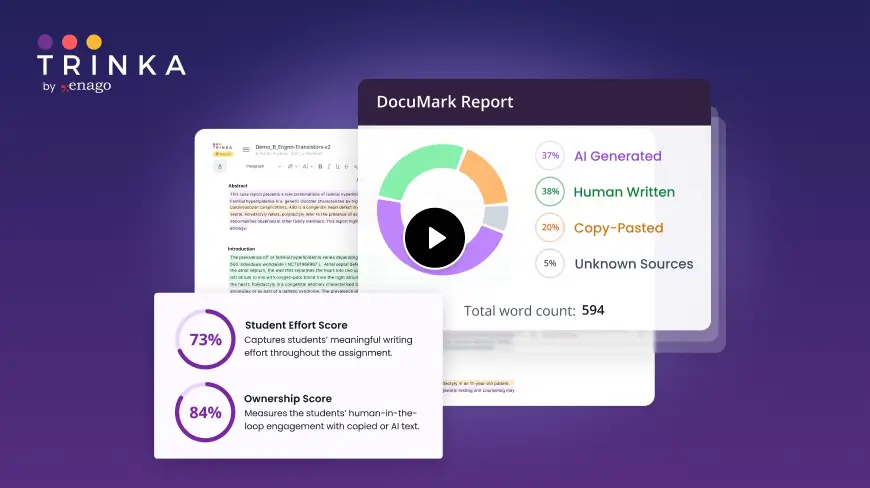
Knowing your institution's AI policy is step one. DocuMark helps enforce it fairly by empowering universities to manage AI-generated content, prevent cheating, and support student writing through responsible AI use.
Common Questions About Alabama Agricultural and Mechanical University's AI Policies
Alabama Agricultural and Mechanical University has defined AI policies in 11 of 12 categories, with an overall coverage score of 92%.
The university requires documentation of AI-generated content in student submissions under the English and Modern Languages statement, and undocumented AI-generated content is treated as an academic honesty violation. For AAMU representatives under the general AI policy, use of AI systems must be documented, users should be honest about AI assistance, and AI-derived code must be identified along with who reviewed it.
The provided sources do not mention AI detection tools. Enforcement is addressed through the academic honesty policy: undocumented AI-generated content in student submissions is treated as a violation, sanctions are imposed for misrepresented academic work, and penalties can range from warnings and grade penalties to suspension or dismissal.
The university permits embedded AI tools within already approved software, but new AI systems must be approved. It prohibits putting non-public university information into open AI systems, prohibits entering trade secrets, confidential information, personal data, or any sensitive information into prohibited contexts, requires informed consent before inputting personal information into a closed AI system, and requires legal and internal review of AI systems and their terms of use.