Teaching & Learning
- AI use in coursework is governed by instructor direction and assignment-level rules
- Institution-wide guidance allows limited assistance such as brainstorming and outlining, but prohibits using AI to generate entire assignments; nursing handbooks further state that AI use for assignments requires citations and documentation, and unapproved use may be treated like plagiarism
Students should refer to the acceptable use scale (example below) provided by their instructor to determine the level of AI usage allowed in their course or on a particular assignment
Writing and Presentations – AI may assist with brainstorming and outlining but must not generate entire assignments. AI use must be documented.
Artificial Intelligence (AI) is a source just like books or journal articles because the ideas did not come from your own mind. If you use AI for assignments, it is important that you include citations and documentation. Be sure to discuss with your instructor where and how you may use AI for a particular course. Using AI in a manner unapproved by your instructor and/or attempting to pass the results off as your own work may receive the same penalty as other forms of plagiarism.
- AI use during exams is prohibited unless an instructor explicitly allows it
- The acceptable-use scale also includes a no-AI assessment level, and the nursing handbooks prohibit unapproved sources or additional resources during testing and virtually proctored examinations
Exams – AI use is prohibited unless explicitly allowed by the instructor.
This assessment is completed entirely without Al assistance.
Al Must not be used at any point during the assessment.
using unapproved sources (print, electronic, or web materials, etc.) during tests
During ATI practice and virtually proctored examinations, students are expected to uphold academic integrity and not use additional resources while testing (see Academic Integrity).
- The college permits AI to support learning and productivity, provided it does not replace critical thinking or personal effort
- The acceptable-use scale also allows AI for brainstorming, structuring, and improving student-created work when the instructor permits it
AI tools can enhance learning, research, and productivity but should not replace critical thinking and personal effort.
AI may assist with brainstorming and outlining but must not generate entire assignments.
AI-Assisted Idea Generation and Structuring
No AI content is allowed in the final submission. AI can be used in the assessment for brainstorming, creatingstructures, and generating ideas for improving work.
AI-Assisted Editing
No new content can be created using Al. Al can be used to make improvements to the clarity or quality of student created work to improve the final output.
- The college’s AI guide includes code among the kinds of content generative AI can produce, but it does not set a separate programming-specific rule
- Code-related use appears to fall under the instructor-set acceptable-use scale and the general requirement for human oversight and disclosure where AI is allowed
Generative Al refers to any of the thousands of Artificial Intelligence tools in which the model generates new content (text, images, audio, video, code,etc)
Students should refer to the acceptable use scale (example below) provided by their instructor to determine the level of AI usage allowed in their course or on a particular assignment
You are responsible for providing human oversight and evaluation of all AI generated content.
Research
- The guide also requires AI use in research to be explicitly stated, appropriately cited, and fact-checked by students and faculty
- For research-related writing, the college allows AI for topic brainstorming and source evaluation but not as a substitute for critical analysis
AI tools can enhance learning, research, and productivity but should not replace critical thinking and personal effort.
AI-generated content must be cited appropriately.
Students and faculty are responsible for verifying AI-generated facts and sources.
The use of AI must be explicitly stated in assignments and research.
Research – AI can help with topic brainstorming and source evaluation but cannot be used as a substitute for critical analysis.
- No separate grant, IRB, or research-ethics application rule is stated
- The college sets general research-integrity expectations for AI use: users must critically evaluate AI output, remain accountable for accuracy and integrity, be transparent about AI use in research, and avoid entering confidential or personal data into AI tools
Users must critically evaluate AI-generated content and be accountable for the accuracy and integrity of their work.
Any use of AI must be transparent and properly documented.
The use of AI must be explicitly stated in assignments and research.
Confidential or personal data should never be entered into AI tools.
Academic Integrity
- Disclosure and attribution are required when AI is used
- The college requires AI-generated content to be cited, AI use to be explicitly stated, and provides required disclosure statements; depending on the instructor’s assigned AI-use level, students may also need to submit links to AI chats and use MLA or APA citation
AI-generated content must be cited appropriately.
The use of AI must be explicitly stated in assignments and research.
Students and faculty must disclose AI usage in academic work using one of the following statements:
“I attest that this project did not use AI at any stage in its development.”
“I attest that this project made use of AI in the following ways: [describe specific use].”
AI disclosure statement must be included disclosing how Al was used. Link(s) to Al chat(s) must be submitted with final submission.
All Al created content must be cited using proper MLA citation. Link(s) to Al chat(s) must be submitted with final submission.
You must cite the use of Al using proper MLAor APA citation. Link(s) to Al chat(s) must be submitted with final submission.
If you use AI for assignments, it is important that you include citations and documentation.
- The sources do not state a position on AI detection software
- They do state that failure to follow AI guidelines may be treated as an academic integrity violation, and in the nursing programs unapproved AI use may receive plagiarism penalties, with specified sanctions for academic dishonesty ranging from a zero on coursework to dismissal after a second offense
Failure to comply with these guidelines may be considered an academic integrity violation.
Using AI in a manner unapproved by your instructor and/or attempting to pass the results off as your own work may receive the same penalty as other forms of plagiarism.
If a student commits an act of academic dishonesty, the consequences within the Nursing program includes:
o First offense: Student will receive a grade of zero (0) for the course work and formal counseling
o Second offense: Student will receive a grade of “F” for the course and be immediately dismissed from the Nursing program.
Institutional & Administrative
- Faculty are included in the college’s AI guidance and disclosure requirements for academic work
- The guide states that students and faculty must verify AI-generated facts and sources, disclose AI usage in academic work, and may use the provided guidance to navigate AI use, but it does not set specific rules for grading, recommendation letters, or administrative communications
This guide is adapted from the University of North Carolina at Chapel Hill’s Generative AI framework and is intended to help students and faculty navigate AI use in academic work.
Students and faculty are responsible for verifying AI-generated facts and sources.
Students and faculty must disclose AI usage in academic work using one of the following statements:
- The college prohibits entering confidential or personal data into AI tools
- The sources do not identify approved institutional AI platforms or provide a tiered data-classification scheme specific to AI
Confidential or personal data should never be entered into AI tools.
- The sources do not mention an AI committee, formal governance body, or adoption roadmap
- Alamance Community College states an overall AI usage philosophy centered on responsible, ethical, transparent use with human critical thinking and accountability
Alamance Community College (ACC) recognizes the benefits and challenges of AI technologies and aims to provide clear guidelines for their responsible and ethical use.
At ACC, our guiding principle is: AI should help you think, not think for you.
Users must critically evaluate AI-generated content and be accountable for the accuracy and integrity of their work.
Any use of AI must be transparent and properly documented.
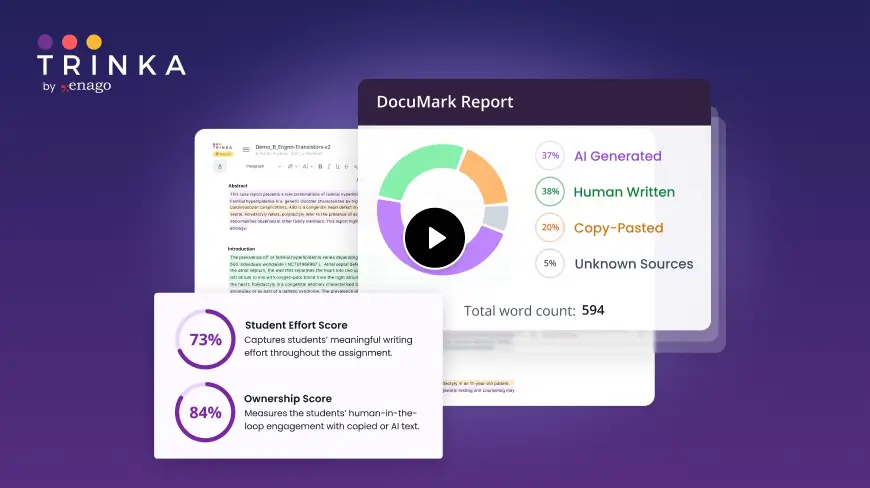
DocuMark: Responsible AI Use for Academic Integrity
Knowing your institution's AI policy is step one. DocuMark helps enforce it fairly by empowering universities to manage AI-generated content, prevent cheating, and support student writing through responsible AI use.
Common Questions About Alamance Community College's AI Policies
Alamance Community College has defined AI policies in 11 of 12 categories, with an overall coverage score of 92%.
Disclosure and attribution are required when AI is used. The college requires AI-generated content to be cited, AI use to be explicitly stated, and provides required disclosure statements; depending on the instructor’s assigned AI-use level, students may also need to submit links to AI chats and use MLA or APA citation.
The sources do not state a position on AI detection software. They do state that failure to follow AI guidelines may be treated as an academic integrity violation, and in the nursing programs unapproved AI use may receive plagiarism penalties, with specified sanctions for academic dishonesty ranging from a zero on coursework to dismissal after a second offense.
The college prohibits entering confidential or personal data into AI tools. The sources do not identify approved institutional AI platforms or provide a tiered data-classification scheme specific to AI.