Teaching & Learning
- In the Counseling Psychology graduate program, generative AI is not allowed for assignments by default
- Students may use it only if they first discuss it with their professor and obtain explicit written approval; otherwise, undisclosed use can be treated as plagiarism and disciplinary action may follow
Examples of prohibited conduct include cheating on examinations and submitting the work of others as one's own, including AI-generated content. Students who engage in such activities will be subject to disciplinary measures, which may include failure in the course or expulsion from the university.
The use of AI as an adjunctive tool is still being explored. The default assumption will be that Generative AI will not be used for assignments. If the use of any tool is being considered, students should discuss with their professor and receive written approval (inclusion in syllabus, BB, etc. for use of Generative AI such as ChatGPT or other products (including Grammarly). In general, students should include the use of these tools in their bibliography or notes for classroom projects including papers, reports, etc. Failure to receive explicit written permission from the instructor and to disclose the use of any adjunctive tools could be seen as plagiarism and subject you to academic integrity review or other disciplinary actions (see the section on formal review).33
- However, it does not provide a specific AI rule for exam use beyond that academic honesty standard
- The graduate handbook treats AI-generated content as prohibited when students submit the work of others as their own, and it separately lists cheating on examinations as prohibited conduct
Examples of prohibited conduct include cheating on examinations and submitting the work of others as one's own, including AI-generated content. Students who engage in such activities will be subject to disciplinary measures, which may include failure in the course or expulsion from the university.
- The Counseling Psychology graduate program says AI may be considered only as an adjunctive tool and that its use is still being explored
- Students must discuss proposed use with their professor and obtain written approval before using generative AI tools, including for course-related work
The use of AI as an adjunctive tool is still being explored. The default assumption will be that Generative AI will not be used for assignments. If the use of any tool is being considered, students should discuss with their professor and receive written approval (inclusion in syllabus, BB, etc. for use of Generative AI such as ChatGPT or other products (including Grammarly).
Research
- But users are told to use AI ethically, watch for grant-funder restrictions, and ensure humans review and proofread all outputs because AI must not be the final product
- For grant proposal preparation, the university says AI tools may be used to assist with drafting, feedback, suggestions, formatting, outlining, rewriting sections, and related proposal-development tasks
When preparing a grant proposal, AI tools can save you time and provide extra feedback, suggestions, and formatting aid. They can find funding opportunities, review RFP and build a proposal outline, read your narrative to suggest keywords, rewrite sections to fit source/character limit, draft a letter of commitment, build a table of acronyms based on a narrative, or review a narrative for title suggestions.
Use AI ethically; Passing off AI as your own work or using AI to formulate your entire proposal poses risks with plagiarism. AI uses information from online databases and user input and has been known to repurpose content in its answers, so proceed with caution. Some grant organizations have restrictions or policies on AI use, such as the NIH, so always read grant instructions and rules for applications prior to using AI.
Never let AI be final; As a team lead it is your responsibility to proofread and review all information to ensure it is correct and makes sense within the context of your work.
- The university strongly recommends that users not enter proprietary or private research-related information into AI systems
- The examples expressly include data sets and researchers' private information, because such information could become available to application developers or other parties
Keep private information private; Because AI builds itself from user input, it is strongly recommended to never feed an AI system proprietary information. For example, your data sets, researchers’ private information, descriptions of new technology, or APU information should never be fed to an AI program, as it could make that information available to application developers and other parties.
- For research grant proposals, the university instructs users to follow funder-specific AI restrictions and warns against presenting AI-produced material as one's own
- The page also states that NIH will not consider applications substantially developed by AI to be original and that post-award detection may trigger referral for research misconduct and enforcement actions
Use AI ethically; Passing off AI as your own work or using AI to formulate your entire proposal poses risks with plagiarism. AI uses information from online databases and user input and has been known to repurpose content in its answers, so proceed with caution. Some grant organizations have restrictions or policies on AI use, such as the NIH, so always read grant instructions and rules for applications prior to using AI.
NIH will not consider applications that are either substantially developed by AI, or contain sections substantially developed by AI, to be original ideas of applicants.
If the detection of AI is identified post award, NIH may refer the matter to the Office of Research Integrity to determine whether there is research misconduct while simultaneously taking enforcement actions including but not limited to disallowing costs, withholding future awards, wholly or in part suspending the grant, and possible termination.
Academic Integrity
- In the Counseling Psychology graduate program, students are generally expected to disclose AI tool use in their bibliography or notes for classroom projects
- The handbook also says students must obtain explicit written instructor permission for use of generative AI, and failing to disclose adjunctive tool use can be treated as plagiarism
In general, students should include the use of these tools in their bibliography or notes for classroom projects including papers, reports, etc. Failure to receive explicit written permission from the instructor and to disclose the use of any adjunctive tools could be seen as plagiarism and subject you to academic integrity review or other disciplinary actions (see the section on formal review).33
- The graduate handbook states that submitting AI-generated content as one's own is prohibited and may lead to failure in the course or expulsion
- It also says undisclosed use of adjunctive AI tools without explicit written permission may be treated as plagiarism and can trigger academic integrity review or other disciplinary actions; the research page separately notes NIH post-award enforcement for AI-detected grant applications
Examples of prohibited conduct include cheating on examinations and submitting the work of others as one's own, including AI-generated content. Students who engage in such activities will be subject to disciplinary measures, which may include failure in the course or expulsion from the university.
Failure to receive explicit written permission from the instructor and to disclose the use of any adjunctive tools could be seen as plagiarism and subject you to academic integrity review or other disciplinary actions (see the section on formal review).33
If the detection of AI is identified post award, NIH may refer the matter to the Office of Research Integrity to determine whether there is research misconduct while simultaneously taking enforcement actions including but not limited to disallowing costs, withholding future awards, wholly or in part suspending the grant, and possible termination.
Institutional & Administrative
- For grant work, the university places responsibility on the team lead to proofread and review AI-assisted content before it is finalized
- In the graduate program, faculty control student AI use by granting or withholding written approval, including through the syllabus or Blackboard
Never let AI be final; As a team lead it is your responsibility to proofread and review all information to ensure it is correct and makes sense within the context of your work.
If the use of any tool is being considered, students should discuss with their professor and receive written approval (inclusion in syllabus, BB, etc. for use of Generative AI such as ChatGPT or other products (including Grammarly).
- The university strongly recommends that proprietary and private information not be entered into AI systems
- It specifically warns against feeding AI with data sets, researchers' private information, descriptions of new technology, or APU information, and it lists several AI tools as available rather than naming an approved institutional platform
Keep private information private; Because AI builds itself from user input, it is strongly recommended to never feed an AI system proprietary information. For example, your data sets, researchers’ private information, descriptions of new technology, or APU information should never be fed to an AI program, as it could make that information available to application developers and other parties.
There are many AI tools available for free and paid use:
* ChatGPT
* MS CoPilot
* Perplexity.ai
* Notion.ai
* Google Gemini
* Jasper.ai
* Character.ai
* Claude
* Deepseek
* More!
- The grant training page also frames AI use around ethical caution, privacy protection, human review, and compliance with external funder rules
- The university does not set out an institution-wide AI strategy in the provided sources, but the Counseling Psychology graduate program states that AI use is still being explored
The use of AI as an adjunctive tool is still being explored.
Use AI ethically; Passing off AI as your own work or using AI to formulate your entire proposal poses risks with plagiarism. AI uses information from online databases and user input and has been known to repurpose content in its answers, so proceed with caution. Some grant organizations have restrictions or policies on AI use, such as the NIH, so always read grant instructions and rules for applications prior to using AI.
Keep private information private; Because AI builds itself from user input, it is strongly recommended to never feed an AI system proprietary information.
Never let AI be final; As a team lead it is your responsibility to proofread and review all information to ensure it is correct and makes sense within the context of your work.
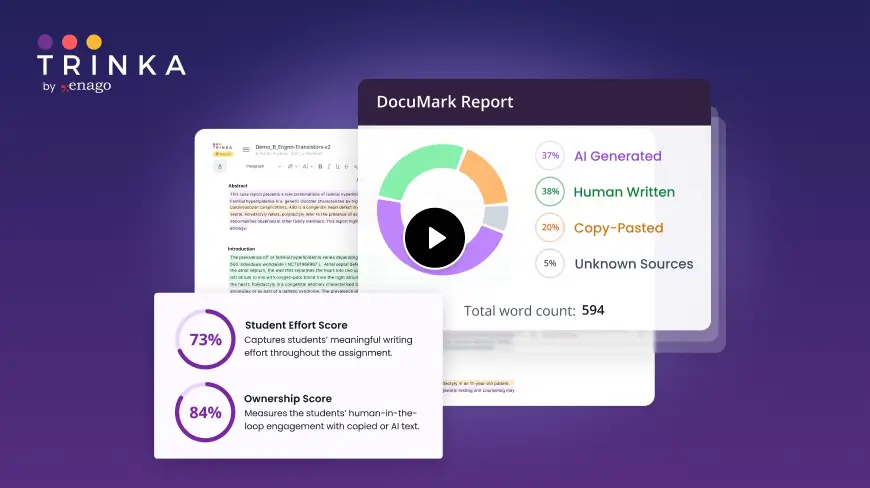
DocuMark: Responsible AI Use for Academic Integrity
Knowing your institution's AI policy is step one. DocuMark helps enforce it fairly by empowering universities to manage AI-generated content, prevent cheating, and support student writing through responsible AI use.
Common Questions About Alaska Pacific University's AI Policies
Alaska Pacific University has defined AI policies in 11 of 12 categories, with an overall coverage score of 92%.
In the Counseling Psychology graduate program, students are generally expected to disclose AI tool use in their bibliography or notes for classroom projects. The handbook also says students must obtain explicit written instructor permission for use of generative AI, and failing to disclose adjunctive tool use can be treated as plagiarism.
The graduate handbook states that submitting AI-generated content as one's own is prohibited and may lead to failure in the course or expulsion. It also says undisclosed use of adjunctive AI tools without explicit written permission may be treated as plagiarism and can trigger academic integrity review or other disciplinary actions; the research page separately notes NIH post-award enforcement for AI-detected grant applications.
The university strongly recommends that proprietary and private information not be entered into AI systems. It specifically warns against feeding AI with data sets, researchers' private information, descriptions of new technology, or APU information, and it lists several AI tools as available rather than naming an approved institutional platform.