Teaching & Learning
- The college treats submitting AI-generated or AI-assisted work as the student's own without acknowledgment as academic dishonesty
- Faculty are instructed to set course-specific AI expectations in their syllabi, so use on graded coursework is at instructor discretion and must follow assignment-specific rules
Academic dishonesty is the act of presenting as one’s own, for academic evaluation purposes, the ideas,representations, or words of another person or persons, including another student or a software package.
As a reminder from the syllabus statement approved for this year, “Do not use AI software such as ChatGPT or Google Bard to create your assignments or substantial portions of your assignments unless the instructor explicitly permits you to do so in this course. In some courses, AI software may be appropriate for specific assignments or for specific tasks associated with assignments. Elsewhere it is not. Consult your instructor or syllabus for guidance.”
The policy should be clearly explained to students in your course syllabus and highlighted when introducing assignments and activities in your course.
- The university does not provide a standalone institution-wide AI exam rule in the cited materials
- However, faculty are told to define AI expectations in the syllabus and for assignments and activities, so assessment use is governed by instructor or course-specific rules where stated
The policy should be clearly explained to students in your course syllabus and highlighted when introducing assignments and activities in your course.
Do not use AI software such as ChatGPT or Google Bard to create your assignments or substantial portions of your assignments unless the instructor explicitly permits you to do so in this course. In some courses, AI software may be appropriate for specific assignments or for specific tasks associated with assignments. Elsewhere it is not. Consult your instructor or syllabus for guidance.
- The college does not provide a university-wide policy on using AI for general learning or study assistance
- Guidance is limited to instructor discretion for specific assignments or course-related tasks, where unauthorized use is prohibited
In some courses, AI software may be appropriate for specific assignments or for specific tasks associated with assignments. Elsewhere it is not. Consult your instructor or syllabus for guidance.
Do not use AI software such as ChatGPT or Google Bard to create your assignments or substantial portions of your assignments unless the instructor explicitly permits you to do so in this course.
Research
- The research integrity policy permits AI use only as a tool that supports scholarly work under responsible human oversight
- Researchers remain fully responsible for accuracy, originality, and proper attribution, and generative AI cannot be credited as an author because it cannot take accountability
Researchers may use Artificial Intelligence (AI) as a tool to support scholarly activities, including data analysis, language refinement, literature review, and manuscript organization, provided such use aligns with disciplinary norms and with principles of responsible scholarship.
The use of AI must not compromise the accuracy, originality, or integrity of scholarly work. Researchers remain fully responsible for all content submitted for publication, funding, or institutional review.
Authors must provide transparent disclosure of AI use in manuscripts, proposals, and scholarly outputs when such tools have materially contributed to the work.
AI tools cannot be listed as authors or co-authors on scholarly works, as they cannot assume responsibility for the integrity, originality, or accountability required of authorship.
- The research integrity policy allows AI tools to support data analysis, but only within responsible scholarship standards
- Researchers must protect confidentiality and privacy, validate AI outputs, avoid undisclosed manipulation or fabrication, and remain accountable for all resulting work
Researchers may use Artificial Intelligence (AI) as a tool to support scholarly activities, including data analysis, language refinement, literature review, and manuscript organization, provided such use aligns with disciplinary norms and with principles of responsible scholarship.
Researchers using AI tools must ensure that:
• Confidential, proprietary, or personally identifiable data are not entered into systems without appropriate safeguards and permissions;
• AI-generated outputs are critically evaluated and validated by the researcher;
• The use of AI does not introduce plagiarism, fabrication, falsification, or misleading representation of sources, analyses, or conclusions.
The use of AI must not compromise the accuracy, originality, or integrity of scholarly work. Researchers remain fully responsible for all content submitted for publication, funding, or institutional review.
- The college has an explicit research AI policy requiring transparency, researcher accountability, and protection of sensitive data
- AI use must not undermine integrity, and material AI contributions must be disclosed in manuscripts, proposals, and other scholarly outputs
This policy governs the ethical and responsible use of Artificial Intelligence (AI) in research and scholarship at The College of Idaho.
The use of AI must not compromise the accuracy, originality, or integrity of scholarly work. Researchers remain fully responsible for all content submitted for publication, funding, or institutional review.
Authors must provide transparent disclosure of AI use in manuscripts, proposals, and scholarly outputs when such tools have materially contributed to the work.
Researchers using AI tools must ensure that:
• Confidential, proprietary, or personally identifiable data are not entered into systems without appropriate safeguards and permissions;
• AI-generated outputs are critically evaluated and validated by the researcher;
• The use of AI does not introduce plagiarism, fabrication, falsification, or misleading representation of sources, analyses, or conclusions.
Academic Integrity
- Faculty are also advised to tell students how AI may be used and cited in each course
- The college requires transparency when AI materially contributes to research outputs, and student work using AI must not be presented as the student's own without acknowledgment
Authors must provide transparent disclosure of AI use in manuscripts, proposals, and scholarly outputs when such tools have materially contributed to the work.
The use of AI should be accompanied by transparent acknowledgment where appropriate, and all sources generated or informed by AI must be verified and cited according to disciplinary or publication standards.
Academic dishonesty is the act of presenting as one’s own, for academic evaluation purposes, the ideas,representations, or words of another person or persons, including another student or a software package.
Explain to students how and when AI may be used in your class and if/how they should cite AI text or images.
- Undisclosed AI use can be enforced under the honor code as academic dishonesty when a student presents software-generated work as their own
- The faculty guidance also notes that AI-detector software may be used, but warns instructors not to rely on it alone because it can be inaccurate
Academic dishonesty is the act of presenting as one’s own, for academic evaluation purposes, the ideas,representations, or words of another person or persons, including another student or a software package.
Faculty may use AI-detector software in some cases to identify AI-generated text, but these tools can be flawed. They should not be relied on to prove AI use without additional evidence.
Institutional & Administrative
- The cited materials do not provide a broader staff-wide administrative AI policy for grading, letters, or communications
- Faculty are encouraged to set and communicate clear AI rules for their courses and may decide when AI is allowed in assignments
The policy should be clearly explained to students in your course syllabus and highlighted when introducing assignments and activities in your course.
Explain to students how and when AI may be used in your class and if/how they should cite AI text or images.
Do not use AI software such as ChatGPT or Google Bard to create your assignments or substantial portions of your assignments unless the instructor explicitly permits you to do so in this course.
- The provided sources do not identify any approved campus AI platform list
- The research integrity policy prohibits entering confidential, proprietary, or personally identifiable information into AI systems unless safeguards and permissions are in place
Researchers using AI tools must ensure that:
• Confidential, proprietary, or personally identifiable data are not entered into systems without appropriate safeguards and permissions;
- The college has articulated an institutional research integrity policy that governs ethical and responsible AI use in research and scholarship
- Beyond that research-focused framework and faculty guidance for classroom use, the provided sources do not set out a broader university-wide AI strategy, committee structure, or adoption roadmap
This policy governs the ethical and responsible use of Artificial Intelligence (AI) in research and scholarship at The College of Idaho.
Researchers may use Artificial Intelligence (AI) as a tool to support scholarly activities, including data analysis, language refinement, literature review, and manuscript organization, provided such use aligns with disciplinary norms and with principles of responsible scholarship.
The policy should be clearly explained to students in your course syllabus and highlighted when introducing assignments and activities in your course.
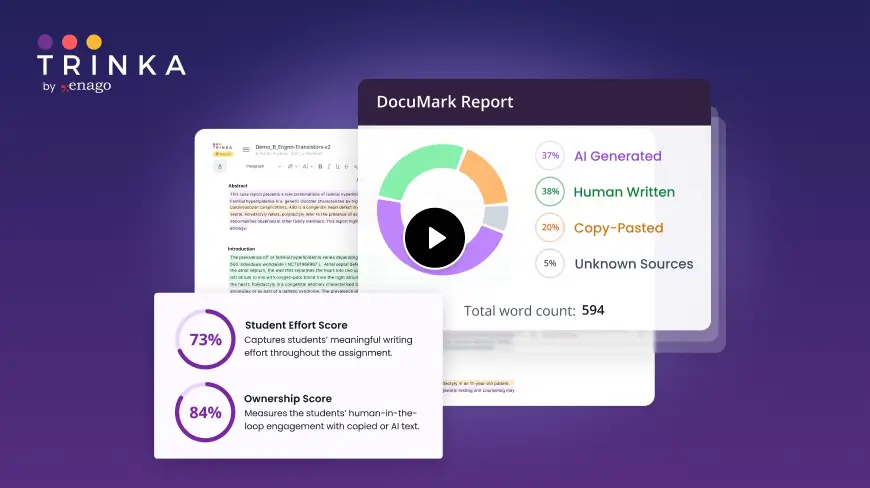
DocuMark: Responsible AI Use for Academic Integrity
Knowing your institution's AI policy is step one. DocuMark helps enforce it fairly by empowering universities to manage AI-generated content, prevent cheating, and support student writing through responsible AI use.
Common Questions About Albertson College of Idaho's AI Policies
Albertson College of Idaho has defined AI policies in 11 of 12 categories, with an overall coverage score of 92%.
The college requires transparency when AI materially contributes to research outputs, and student work using AI must not be presented as the student's own without acknowledgment. Faculty are also advised to tell students how AI may be used and cited in each course.
Undisclosed AI use can be enforced under the honor code as academic dishonesty when a student presents software-generated work as their own. The faculty guidance also notes that AI-detector software may be used, but warns instructors not to rely on it alone because it can be inaccurate.
The research integrity policy prohibits entering confidential, proprietary, or personally identifiable information into AI systems unless safeguards and permissions are in place. The provided sources do not identify any approved campus AI platform list.