Teaching & Learning
- ATCC prohibits students from using AI for coursework or assignments when that use is unauthorized
- The policy also states that AI-generated content in academic work requires disclosure or instructor approval, and course-level syllabus guidance governs use of AI or computational intelligence
Using unauthorized notes, Artificial Intelligence (AI), computational intelligence, or other aids during a test/exam or coursework.
Refer to the class syllabus regarding the use of AI or computational intelligence.
Using AI-generated content without disclosure or instructor approval.
- AI use in assessments is treated as cheating under the academic integrity policy
- ATCC prohibits students from using AI during tests or exams when that use is unauthorized
Using unauthorized materials or assistance on tests/exams or assignments.
Using unauthorized notes, Artificial Intelligence (AI), computational intelligence, or other aids during a test/exam or coursework.
Research
- ATCC states that presenting AI's words or ideas as one's own without proper attribution is plagiarism
- It also says using AI-generated content without disclosure or instructor approval is an academic integrity violation, but it does not provide a research-specific manuscript policy
Plagiarism is presenting work that is not one's own-words, ideas, images, statistics, or data-as one's own without proper citation. This includes:
Plagiarism of any kind (representing another person's, AI's, or computational intelligence's words or ideas as one's own without proper attribution or credit).
Using AI-generated content without disclosure or instructor approval.
- ATCC prohibits fabrication and falsification of data or research results
- However, the university does not define any AI-specific rules for using AI in research data collection, analysis, or interpretation
Fabrication: Inventing data, sources, or research results.
Falsification: Distorting, omitting, or misrepresenting data or sources.
- ATCC's academic integrity policy bars misrepresenting AI's words or ideas as one's own and prohibits undisclosed or unapproved AI-generated content
- It also prohibits fabrication and falsification of data or research results, but it does not set AI-specific rules for grant proposals, IRB applications, or research ethics declarations
Plagiarism of any kind (representing another person's, AI's, or computational intelligence's words or ideas as one's own without proper attribution or credit).
Using AI-generated content without disclosure or instructor approval.
Fabrication: Inventing data, sources, or research results.
Falsification: Distorting, omitting, or misrepresenting data or sources.
Academic Integrity
- The policy also ties AI use to instructor or syllabus-level direction
- ATCC requires proper attribution when AI's words or ideas are used and treats undisclosed AI-generated content as a violation unless there is instructor approval
Plagiarism is presenting work that is not one's own-words, ideas, images, statistics, or data-as one's own without proper citation.
Plagiarism of any kind (representing another person's, AI's, or computational intelligence's words or ideas as one's own without proper attribution or credit).
Using AI-generated content without disclosure or instructor approval.
Refer to the class syllabus regarding the use of AI or computational intelligence.
- ATCC states that academic integrity violations may lead to disciplinary action under its student conduct policy and procedure
- The acceptable use procedure also provides sanctions for IT-related violations, but the university does not define any stance on AI detection tools in the provided sources
Violations of academic integrity are taken seriously and may result in disciplinary actions as outlined in the ATCC Policy 3.6 Student Code of Conduct and ATCC Procedure 3.6.1 Student Conduct and Sanctions for Violation of Conduct.
Violations of this procedure may result in:
* Suspension or revocation of IT privileges.
* Disciplinary action under student or employee conduct codes.
* Legal action, including restitution for damages.
* Expulsion or termination of employment.
Institutional & Administrative
- The acceptable use procedure applies generally to users of institutional IT resources but does not address AI use by faculty or staff specifically
- The provided sources do not define any AI-specific rules for faculty or staff use in grading, feedback, teaching preparation, recommendation letters, or administrative communications
This procedure outlines the responsibilities and expectations for the acceptable use of Alexandria Technical and Community College’s information technology resources. It ensures compliance with Minnesota State Board Policy 5.22 and Procedure 5.22.1, and supports the security, privacy, and integrity of institutional data and systems.
Users must use IT resources in a manner that supports the College’s educational, research, and administrative missions.
- ATCC requires users to protect institutional data according to its classification and restricts access to private and confidential/secure data
- The acceptable use procedure requires use of authorized systems and data and allows monitoring of institutional IT resources, but it does not identify approved AI platforms or AI-specific data-entry rules
This procedure outlines the responsibilities and expectations for the acceptable use of Alexandria Technical and Community College’s information technology resources. It ensures compliance with Minnesota State Board Policy 5.22 and Procedure 5.22.1, and supports the security, privacy, and integrity of institutional data and systems.
While the College strives to provide reasonable privacy, users should have no expectation of privacy when using institutional IT resources. The College reserves the right to monitor and access data for:
* Routine system maintenance and troubledshooting.
* Security audits and investigations.
* Compliance with institutional, state, and federal policies.
* Protection of institutional assets and data integrity.
All users are responsible for:
* Complying with applicable laws, policies, and licensing agreements.
* Protecting their credentials and securing devices.
* Using authorized systems and data.
* Reporting suspected security incidents immediaty.
Users must protect institutional data according to it's classification:
* Public: Minimal protection required.
* Private: Restricted to authorized users (e.g., FERPA-protected data.)
* Confidential/Secure: Highly sensitive; requires encryption and limited access.
DocuMark: Responsible AI Use for Academic Integrity
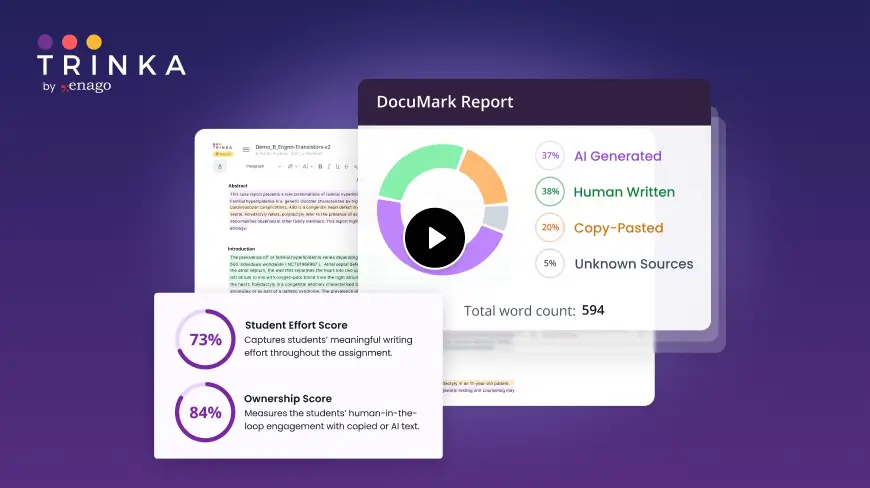
Knowing your institution's AI policy is step one. DocuMark helps enforce it fairly by empowering universities to manage AI-generated content, prevent cheating, and support student writing through responsible AI use.
Common Questions About Alexandria Technical & Community College's AI Policies
Alexandria Technical & Community College has defined AI policies in 9 of 12 categories, with an overall coverage score of 75%.
ATCC requires proper attribution when AI's words or ideas are used and treats undisclosed AI-generated content as a violation unless there is instructor approval. The policy also ties AI use to instructor or syllabus-level direction.
ATCC states that academic integrity violations may lead to disciplinary action under its student conduct policy and procedure. The acceptable use procedure also provides sanctions for IT-related violations, but the university does not define any stance on AI detection tools in the provided sources.
ATCC requires users to protect institutional data according to its classification and restricts access to private and confidential/secure data. The acceptable use procedure requires use of authorized systems and data and allows monitoring of institutional IT resources, but it does not identify approved AI platforms or AI-specific data-entry rules.