Teaching & Learning
- Students are permitted to use generative AI for coursework, but the university requires that assignments remain grounded in the student's own understanding and analysis
- Course-level rules may further limit or prohibit AI use, because faculty are expected to set explicit syllabus policies and unauthorized use in a course may be treated as academic dishonesty
In recognition of the evolving academic landscape and the growing presence of artificial intelligence in education, students are permitted to use generative AI tools—such as ChatGPT—alongside other online resources for their coursework.
Students must avoid copying and pasting entire passages generated by AI tools. Instead, they should paraphrase and incorporate the information into their own words. Direct quotations from AI-generated content must be clearly identified using quotation marks and properly cited. The use of AI-generated content should be limited and not excessive. The core of each assignment must reflect the student’s own understanding and analysis.
In general, all courses should have an AI policy, with each faculty member having the purview to decide whether it is appropriate or not appropriate for students to use selective generative AI in their course.
Before using a generative AI tool such as Chat GPT, please have a conversation with your instructor to determine whether AI use is permitted in the course. Unauthorized use may be considered academic dishonesty.
- The university does not set a standalone AI exam rule in the AI guidance, but exam use is governed by instructor authorization
- Unauthorized use of generative AI may be considered academic dishonesty, and the undergraduate code prohibits unauthorized materials, tools, and electronic communication during quizzes, tests, and examinations
Before using a generative AI tool such as Chat GPT, please have a conversation with your instructor to determine whether AI use is permitted in the course. Unauthorized use may be considered academic dishonesty.
In the context of tests, quizzes, examinations, or other in-class work, dishonest practices include but are not limited to:
* Possession of unauthorized material that could be used during a quiz, test, or examination for the purposes of cheating.
* The unauthorized use of books or notes during a quiz, test, or examination.
* The hiding or positioning of notes or other tools for the purposes of cheating on a quiz, test, or examination.
* Unauthorized possession or knowledge of any examination prior to its administration.
* Looking at someone else's quiz, test, or examination without the express permission of the instructor.
* Any form of unauthorized communication during a quiz, test, or examination. This includes use of any electronic communication devices without the consent of the instructor. Such devices include--but are not limited to-- cellular phones, Bluetooth, computer internet, recording devices, and PDA, CD and MP3 players.
- AI may be used as a supplementary learning aid to help students understand complex material, and the task force guidance frames it as a tool to support student learning rather than replace thinking
- Whether study-tool use is allowed in a given course is left to faculty policy, and the guidance specifically notes that some instructors may permit AI as a study tool even when it is banned for submitted work
Students may utilize generative AI tools as they would any other online resource. These tools can serve as valuable aids in understanding complex material, refining written content, and exploring new ideas.
Generative AI is to be used as a supplementary tool to enhance students’ own ideas and insights. It must not replace original thinking or be used to generate entire responses.
For example, in a class that does not permit AI use at any stage for submitted work, faculty may permit and provide guidance on the use of AI as a study tool.
Consider use of AI as a personal study tutor to support learning, separate from submitted assignments. Many students use AI technologies as a study resource and to provide feedback and simulations for other graded materials – if permitted, what guidelines and guidance should be provided?
- The university does not set a specific programming rule, but its AI task force explicitly raises code-writing as a context for faculty to evaluate
- Use of AI for coding is therefore not governed by a uniform university-wide permission or ban in the provided sources and is left to course-level policy decisions
o Is there a distinction between using AI as a tool (e.g., writing code for an engineering project) and using AI as a partner in thinking (as Ethan Mollick describes in Co-intelligence)?
o If there is such a distinction, what are the proper contexts for the different uses of AI?
In general, all courses should have an AI policy, with each faculty member having the purview to decide whether it is appropriate or not appropriate for students to use selective generative AI in their course.
Research
- The university acknowledges AI's possible benefits for research but emphasizes ethical risks, especially bias, hallucinations, and data privacy concerns
- This is framed as an ethics and awareness position for students' research development, not as a detailed compliance policy for grants, IRB, or formal research declarations
We uphold these values by recognizing that the use of artificial intelligence, while potentially beneficial to research, also carries the potential to introduce unwanted bias, non-factual hallucinations, and data privacy concerns.
By understanding, and promoting awareness of these concepts, Alfred University students are given the knowledge and accountability to grow their research potential, while upholding our community’s ethical and academic standards.
Academic Integrity
- Disclosure and citation of AI use are required when students use generative AI in assignments under open or moderate-use course policies
- Students must explicitly acknowledge AI use, follow faculty-provided citation styles or current APA/MLA guidance, and clearly mark direct quotations; faculty are also required to follow the same attribution rules and be transparent with students about their own AI use
Students must explicitly acknowledge the use of ChatGPT or any other generative AI tools in their assignments. Proper citation is required, and students should consult current APA or MLA guidelines on how to reference generative AI content.
Direct quotations from AI-generated content must be clearly identified using quotation marks and properly cited.
For open and moderate use statements, students must document all AI use using faculty provided citation styles.
Faculty must follow the same attribution rules that are expected of students and be transparent with their students regarding any AI use.
- The task force notes that very few syllabi mention AI detectors, which indicates no clear university-wide endorsement of AI detection tools in the provided sources
- Undisclosed or unauthorized AI use may be treated as academic dishonesty, and suspected cases follow the university's standard academic dishonesty process, including instructor-assessed penalties and appeal routes
Before using a generative AI tool such as Chat GPT, please have a conversation with your instructor to determine whether AI use is permitted in the course. Unauthorized use may be considered academic dishonesty.
This subcommittee will develop guidelines and processes for faculty to address instances where they suspect students have used AI in an academically dishonest manner.
Only 3 syllabi mentioned AI detectors.
A student charged with an unethical practice may accept the judgment and penalty assessed by the instructor.
A student charged with an unethical practice may appeal in writing directly to the instructor who assessed the penalty within fourteen (14) business days after the instructor sends email and written notification of the offense and penalty to the student.
Institutional & Administrative
- The sources also recommend training and resources for faculty, but they do not provide detailed rules for grading, recommendation letters, or administrative communications
- Faculty are expected to make AI use decisions for their courses, include explicit AI policies in syllabi, reinforce those policies in class, and model transparent and ethical AI use themselves
All faculty should ensure that all course syllabi include clear AI usage policies. Additionally, they should conduct classroom discussions on ethical AI use and learning.
In general, all courses should have an AI policy, with each faculty member having the purview to decide whether it is appropriate or not appropriate for students to use selective generative AI in their course.
Faculty must follow the same attribution rules that are expected of students and be transparent with their students regarding any AI use.
How will faculty engage with AI themselves, and how will they ensure that their use is transparent and a model of ethical academic behavior?
Include AI in New Faculty Orientation – Incorporate artificial intelligence into the New Faculty Week program, with a session dedicated to this. This should be required for new faculty and optional for returning faculty.
- However, the provided sources do not define approved AI platforms, institutional data classification tiers, or specific prohibited tools
- The university identifies data privacy as an ethical concern in AI use and warns that AI can create privacy risks, including misuse of personal information
Data Privacy: The ethical concern surrounding the collection, storage, and use of personal data by AI systems, focusing on individuals' rights to control their own information. (IBM)
There exists the possibility of the malicious use of AI’s capability of tapping into large datasets for the purpose of accessing protected private information about an individual or for stalking them.
We uphold these values by recognizing that the use of artificial intelligence, while potentially beneficial to research, also carries the potential to introduce unwanted bias, non-factual hallucinations, and data privacy concerns.
- Alfred University has an institutional AI Task Force created by Academic Affairs for 2024-2025, with multiple subcommittees focused on academic integrity, ethics, curriculum, and teaching
- The task force report outlines recommendations for syllabus policy requirements, faculty development, continued task force work, future operational and ethical guidelines, and expanded student training opportunities
During the 2024-2025 academic year, AU's Academic Affairs created an AI Task Force to examine the implications, challenges, and opportunities posed by AI technologies. Four subcommittees were developed to explore the following topics: Academic Integrity & AI, Ethics & Philosophy of AI, Learning Objectives & Curriculum Mapping, and Teaching with AI.
Alfred University convened an AI Task Force in Fall 2024 to explore the implications, challenges, and opportunities presented by AI technologies.
Recommendations:
• All faculty should ensure that all course syllabi include clear AI usage policies.
• Prepare a senate proposal to require syllabi to include clear AI usage policies.
• Incorporate AI education into both new faculty orientation and ongoing professional development.
• Provide faculty training resources via the Teaching and Learning Center, as well as using the TLC website to disseminate AI related teaching resources.
• Convene additional task forces to generate both operational and ethical guidelines.
• Establish training opportunities for students, such as an AI minor and/or certificate program.
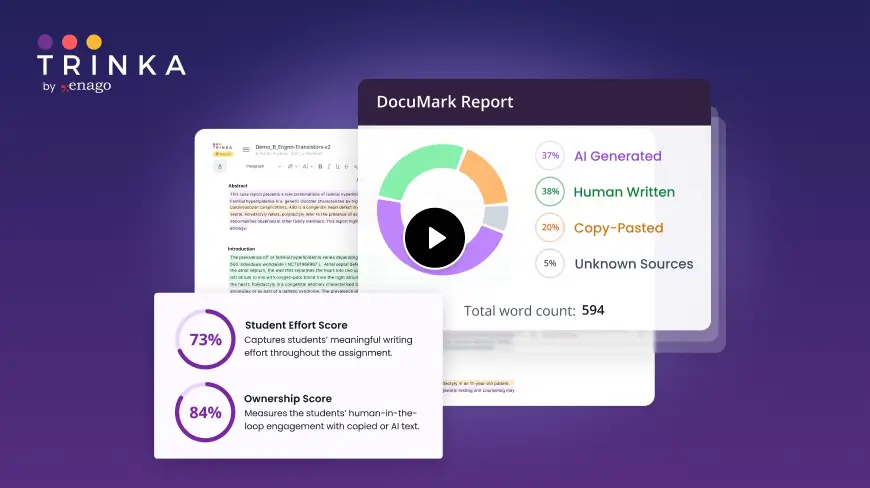
DocuMark: Responsible AI Use for Academic Integrity
Knowing your institution's AI policy is step one. DocuMark helps enforce it fairly by empowering universities to manage AI-generated content, prevent cheating, and support student writing through responsible AI use.
Common Questions About Alfred University's AI Policies
Alfred University has defined AI policies in 10 of 12 categories, with an overall coverage score of 83%.
Disclosure and citation of AI use are required when students use generative AI in assignments under open or moderate-use course policies. Students must explicitly acknowledge AI use, follow faculty-provided citation styles or current APA/MLA guidance, and clearly mark direct quotations; faculty are also required to follow the same attribution rules and be transparent with students about their own AI use.
Undisclosed or unauthorized AI use may be treated as academic dishonesty, and suspected cases follow the university's standard academic dishonesty process, including instructor-assessed penalties and appeal routes. The task force notes that very few syllabi mention AI detectors, which indicates no clear university-wide endorsement of AI detection tools in the provided sources.
The university identifies data privacy as an ethical concern in AI use and warns that AI can create privacy risks, including misuse of personal information. However, the provided sources do not define approved AI platforms, institutional data classification tiers, or specific prohibited tools.