Teaching & Learning
- Using unapproved technology to complete course activities without faculty permission is treated as an academic integrity violation
- Allen College requires student work in courses to be the student's own unless an assignment or professor explicitly authorizes otherwise
Student’s written or oral work of any kind, in-person or online, is expected to be the work of the student alone unless otherwise assigned or approved.
Unauthorized Collaboration: Unauthorized collaboration is working with others, or using unapproved technology, to complete course activities without the faculty’s explicit permission.
Unless the instructions explicitly state that collaboration is allowed, students should assume collaboration is not authorized.
Plagiarism includes submitting any assignment that is not the original work of the student.
- This applies to assessments generally rather than naming AI specifically
- Allen College prohibits use of unauthorized or unacknowledged materials, information, study aids, or resources during quizzes, tests, and other course activities unless prior authorization is given by the college representative
Cheating: Cheating is the use or attempted use of unauthorized or unacknowledged materials, information, or study aids that would provide an unfair advantage on a quiz/test or any other course activity.
Using unauthorized resources or conversing with others about the academic activity is forbidden.
The use of these materials, without prior authorization from the college representative, constitutes cheating.
Research
- Students' classroom research-methods projects are exempt from ACIRB approval only when the results or data are not later published, presented, or used for other research purposes
- For research involving human participants, Allen College requires ACIRB review and approval before beginning the study or project, including when the work involves existing data or previously collected human samples
A: All research and projects that will involve human participants must be submitted to the ACIRB for review and approval prior to beginning the study or project. This includes proposed research or projects involving existing data and previously collected human fluid and tissue samples, as well as any advertising or other recruitment procedures.
A: Yes. Projects conducted by Allen College undergraduate, graduate, and doctoral students need ACIRB approval, unless the project is done in the classroom setting for the purpose of teaching research methods. However, this means that at no point during or after the conclusion of the course can the results or the data be published, presented, or used for other research purposes. Therefore, students should discuss these criteria with their instructor or faculty advisor.
- The ACIRB also provides guidance on ethical issues, intellectual property, privacy, confidentiality, and risk minimization, and investigators cannot self-exempt human participant projects
- Allen College requires ACIRB oversight for research involving human participants and states that the board oversees protection of human subjects, responsible conduct, misconduct, and conflict of interest
The ACIRB is responsible for ensuring that ethical principles are applied in any proposal submitted for review. ACIRB members can provide guidance on protection of human subjects, intellectual property and other ethical issues that pertain to research or projects.
The ACIRB oversees protection of human subjects, responsible conduct of research/projects, misconduct and conflict of interest. The purpose of overseeing compliance is to ensure that all research and projects reviewed by the ACIRB are conducted with integrity and in compliance with Allen College, local, state, federal and funding agency regulations for research.
The primary role of an IRB is to ensure the privacy, safety, and ethical treatment of human participants in research and projects.
Allen College policy does not allow investigators to self-exempt their human participant projects.
Thus, depending on the circumstances, investigators conducting exempt studies may still need to make provisions to obtain informed consent, protect confidentiality, minimize risks, and address problems or complaints.
Academic Integrity
- Proper attribution is also required when using others' work or ideas in information technology contexts
- Allen College requires credit and clear citation when information is borrowed from a source, including course assignments such as discussion boards, worksheets, presentations, and papers
Plagiarism: Plagiarism is the use of information borrowed from a source, without giving credit to that source. If information is borrowed from a source, it must be paraphrased or quoted and clearly cited. This includes discussion board postings, worksheets, presentation slides, papers, and any other course assignments.
Plagiarizing the work or ideas of others without making proper attribution.
- Sanctions can range from resubmission for partial credit to a zero, course failure, suspension, dismissal, and other disciplinary consequences; the sources do not define any AI detection tools
- Allen College has a formal academic integrity enforcement process when a student is suspected of a violation, including review of evidence, a meeting with the student and a third-party observer, and submission of violation documentation
If a student is suspected of an academic integrity violation while enrolled at Allen College, the following PROCEDURE will be followed:
The purpose of this meeting is:
a. to explain the suspected academic integrity violation to the student, review the supportive evidence, and describe the proposed penalty if a violation has been determined.
b. to provide an opportunity for the student to explain their perspective of the suspected violation.
COLLEGE REPRESENTATIVE’S ACTION (check all that apply):
____Referral to student Success Coordinator
____Resubmission of assignment for partial credit
____Zero or failing grade for assignment
____Course failure
____Recommended dismissal from Allen College
____Recommended suspension
____Lowered score on assignment – Specify:_____________________________________________
Violations of this policy may result in the disciplinary action, which could include termination of all computer privileges and rights.
Institutional & Administrative
- Allen College applies its information technology resources policy to faculty and staff and expects ethical and responsible behavior when they use college technology
- The strategic plan also states that the college will provide faculty and staff opportunities and resources to support scholarly endeavors, but the sources do not define AI-specific rules for grading, feedback, recommendation letters, or teaching preparation
EFFECTIVE FOR: Faculty, Staff, Students, UnityPoint Health Employees, Alumni, Clients, and Guests on the Allen College campus.
Ethical Expectations: Allen College expects that students, faculty, staff, and UnityPoint Health employees will exhibit ethical and responsible behavior when utilizing the information technology resources available at Allen College.
Allen College will allocate institutional resources as well as pursue grant and donor support to provide faculty and staff the resources to support scholarly endeavors.
- Allen College's provided sources do not identify approved AI platforms, but they do impose general technology-use and privacy controls
- Email privacy does not apply on employer systems, personal software may not be installed or downloaded on library or computer lab machines, and unauthorized access to private files is prohibited
Email Usage: Electronic mail communications are the property of the employer and rights of privacy do not pertain in keeping secret the email messages received or sent by a user.
Absolutely NO personal software may be installed or downloaded by a user on any machine in the Barrett Library or the Allen College Computer Lab; please refer to UnityPoint Health – Allen Hospital SOP 1.IT.04, Use and Ownership of Software.
Browsing, accessing, copying, or changing private files of other users, and changing public files without authorization.
- Allen College's strategic plan states that the institution intends to embrace emerging technologies and leverage technological advances in education
- The plan frames innovation and technology as a core value and strategic goal, but it does not set out a specific AI governance framework, AI committee, or AI policy roadmap
Redefining Healthcare Education; Embracing Emerging Technologies
Innovation and Technology: Allen College advances curricular innovation by developing programs highly sought after by students and leveraging technological advances to ensure curricular success.
Embrace innovation, technology and lifelong learning. Allen College will work to expand its reach and impact on nursing and health sciences graduate education by embracing emerging technologies that disrupt traditional pedagogical models and student support services.
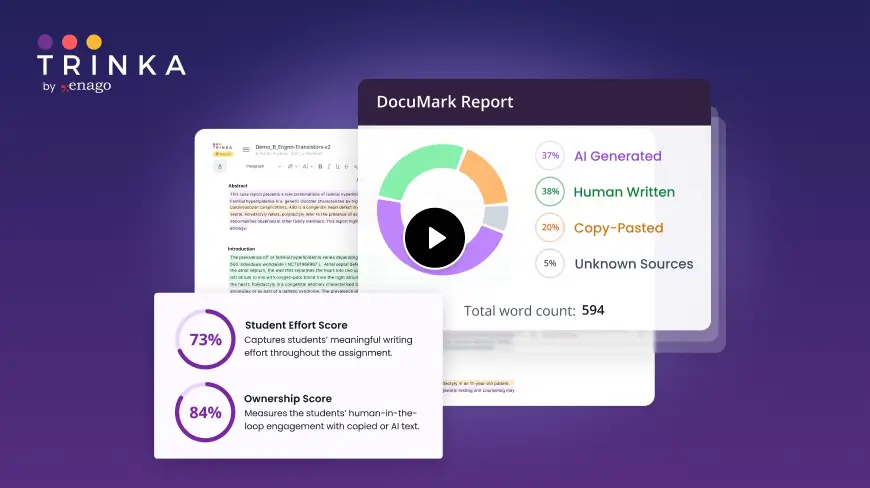
DocuMark: Responsible AI Use for Academic Integrity
Knowing your institution's AI policy is step one. DocuMark helps enforce it fairly by empowering universities to manage AI-generated content, prevent cheating, and support student writing through responsible AI use.
Common Questions About Allen College's AI Policies
Allen College has defined AI policies in 9 of 12 categories, with an overall coverage score of 75%.
Allen College requires credit and clear citation when information is borrowed from a source, including course assignments such as discussion boards, worksheets, presentations, and papers. Proper attribution is also required when using others' work or ideas in information technology contexts.
Allen College has a formal academic integrity enforcement process when a student is suspected of a violation, including review of evidence, a meeting with the student and a third-party observer, and submission of violation documentation. Sanctions can range from resubmission for partial credit to a zero, course failure, suspension, dismissal, and other disciplinary consequences; the sources do not define any AI detection tools.
Allen College's provided sources do not identify approved AI platforms, but they do impose general technology-use and privacy controls. Email privacy does not apply on employer systems, personal software may not be installed or downloaded on library or computer lab machines, and unauthorized access to private files is prohibited.