Teaching & Learning
- The policy applies to everything submitted for a grade, credit, or assessment
- Use of generative AI for graded coursework is prohibited unless the instructor explicitly permits it
- When an instructor allows AI, students must use it only as specified and must follow the professor’s rules for acknowledgment or referencing
• use of ChatGPT or other generative Artificial Intelligence (AI) without explicit permission from the instructor.
Unauthorized use of Artificial Intelligence (AI), or failure to disclose when or how AI has been used when authorization is given, is a violation of the Honor Code. Students may only use AI generative writing, artistic, or translating tools (such as but not limited to ChatGPT or Bard) when and as specified by the instructor. If and when such AI use is permitted, students must follow all guidelines established by the professor regarding acknowledging or referencing such use. Under the Honor Code, students must give proper credit whenever such AI is used.
Everything submitted to an instructor for a grade / credit / assessment is subject to the Honor Code Policy.
- AI use to answer exam questions is prohibited unless the exam question specifically authorizes it
- If unauthorized AI use is suspected, the professor may require supplemental or replacement measures to assess the student’s knowledge and may use those results to change the grade and support an Honor Code report
Use of AI to answer questions on exams is prohibited unless the question specifies that you are to use it. If unauthorized use of AI is suspected, the professor may implement reasonable supplemental or replacement measures to evaluate student knowledge or understanding of the topic, and the professor can use the results of such measures to re-evaluate the grade and to support reporting the student for an Honor Code violation.
• cheating on an examination,
- The university does not set a separate institution-wide rule for AI as personal study help
- This means permitted AI assistance depends on professor guidance in the course context covered by the Honor Code
- Instead, students are responsible for clarifying what help is allowed, and faculty are responsible for explaining in each assignment or syllabus what counts as a violation
Students may only use AI generative writing, artistic, or translating tools (such as but not limited to ChatGPT or Bard) when and as specified by the instructor.
It is the student’s responsibility to clarify whether (s)he can receive help / collaborate and the kind of help / collaboration allowed.
Faculty Members are responsible for:
1. Carefully clarifying on each assignment or in the syllabus what types of things would be considered to violate the Honor Code
Research
Academic Integrity
- They also must follow any professor instructions on how to acknowledge or reference that use
- Disclosure of AI use is required when authorization has been given, and students must give proper credit for permitted AI use
Unauthorized use of Artificial Intelligence (AI), or failure to disclose when or how AI has been used when authorization is given, is a violation of the Honor Code.
If and when such AI use is permitted, students must follow all guidelines established by the professor regarding acknowledging or referencing such use. Under the Honor Code, students must give proper credit whenever such AI is used.
- Undisclosed or unauthorized AI use is treated as an Honor Code violation
- Faculty also set course-specific sanctions, and repeated violations can escalate to university-level penalties through the Honor Code process
- Professors may use supplemental or replacement assessments when AI misuse is suspected, may re-evaluate grades based on those measures, and may report the student for an Honor Code violation
If unauthorized use of AI is suspected, the professor may implement reasonable supplemental or replacement measures to evaluate student knowledge or understanding of the topic, and the professor can use the results of such measures to re-evaluate the grade and to support reporting the student for an Honor Code violation.
Violations of the Honor Code will not be tolerated, and such breaches of academic trust will be met with appropriate sanctions. Professors have the ability to sanction students accused of breaching the Honor Code and have the responsibility of adding the names of such students to a university list of Honor Code violations. Sanctions for violators will be determined by the professor alone except in egregious cases, when the university may also take action.
• In the class policy or grading section, each faculty member will state course-specific sanctions for violations.
The ‘Three Strikes’ rule—once a student who is on the list for two violations violates the Code a third time, in addition to the course-specific sanctions deemed appropriate by the professor, the student’s case will be assigned to the Academic Standards Committee, which will review the alleged incidences and determine an appropriate university penalty beyond the course grade.
Institutional & Administrative
- For meeting notetaking, AI use by university participants is restricted by meeting type rather than broadly allowed
- When AI notetaking is used, hosts or senior Alvernia attendees have responsibilities for consent, privacy, review, and approval
- AI is prohibited in confidential meetings, left to participant discretion in meetings where AI dictation could hinder discussion or innovation, and permitted in public or external meetings if attendees allow it
1. Confidential Meetings, such as one-on-one meetings, personnel meetings, board, board committee, and administrative meetings identified as confidential, faculty council and faculty committee meetings including any confidential information or identified faculty or student information, etc... remain meetings where A.I. is prohibited
2. Meetings where the free flow of ideas, discussions and innovation may be negatively impacted by A.I. dictation, are meetings where A.I. is at the discretion of the members/participants of the meeting, and
3. Public meetings or meetings with external entities where the use of A.I. is allowed by attendees and don’t fall into category 1 or 2 above, are meetings where A.I. is permitted.
In the event a meeting falls in the second category of A.I. meetings (Meetings where the free flow of ideas, discussions and innovation may be negatively impacted by A.I. dictation) and an AI note-taker is available (in either a virtual meeting or an in-person meeting), the Alvernia meeting organizer or attendee is responsible for:
1. recommending whether an A.I. note-taker will be in use and obtaining verbal consent from the attendees/participants, and
2. understanding and adhering to legal requirements about use, consent, data retention, and disclosure when using AI notetaker/recording tools.
• When AI notetaking is used in a meeting, participants must be aware that AI notes may contain errors and should be reviewed for accuracy before widespread distribution.
o Notes must be reviewed by the Alvernia host or one of the most senior titled Alvernia attendees, verified by participants, and formally approved by the represented group.
- The university states that it cannot control what data third-party AI note-takers collect or how they use it, so it limits their use by meeting category
- Confidential meetings are off-limits for AI, sensitive information must be handled securely, and AI notetaking must be turned off during certain sensitive discussions
- The AI notetaking policy also says ITAC works with senior leadership to maintain a list of acceptable AI notetakers, and the IT policies page identifies broader data-protection policies that apply to end users and confidential data
ITAC Maintains and enforces this policy. Work with university senior leadership to establish and maintain a list of acceptable AI Notetakers.
Alvernia cannot control what data these tools collect and how that data is used, which include: i) all Alvernia-owned Zoom sessions, Microsoft Teams meetings, and other teleconferencing and meeting spaces and (ii) all Alvernia controlled in-person meetings. Alvernia cannot control what data these tools collect and how that data is used.
1. Confidential Meetings, such as one-on-one meetings, personnel meetings, board, board committee, and administrative meetings identified as confidential, faculty council and faculty committee meetings including any confidential information or identified faculty or student information, etc... remain meetings where A.I. is prohibited
• Sensitive data must be handled securely. Review university data protection policies regarding storage, access, and retention periods: Information Technology Policies | Alvernia University
• In the event an external provider uses AI notetaking, one of the most senior title Alvernia attendees must ensure AI notetaking is turned off for:
o sensitive meetings like performance evaluations, disciplinary matters, or discussions with students.
o breaks or when discussing confidential information. Ensure sensitive information is not recorded inadvertently.
This policy outlines the responsibility of end users of Alvernia University (“AU”) systems and network. It applies to all faculty, staff, student employees, trustees, contractors, business partners or volunteers who use AU networks, systems, and applications, or who access AU Internal or Confidential data.
- Alvernia has limited formal AI governance in the provided sources for AI notetaking
- No broader university-wide AI strategy or roadmap is defined in the provided sources
- ITAC is responsible for maintaining and enforcing the AI notetaking policy and works with senior leadership to maintain a list of acceptable AI notetakers, while the Senior Leadership Team gives final approval and reviews exceptions
ITAC Maintains and enforces this policy. Work with university senior leadership to establish and maintain a list of acceptable AI Notetakers. Receives exceptions to the policy.
Senior Leadership Team Serves as final approval for policy and assists with reviewing exceptions to the policy.
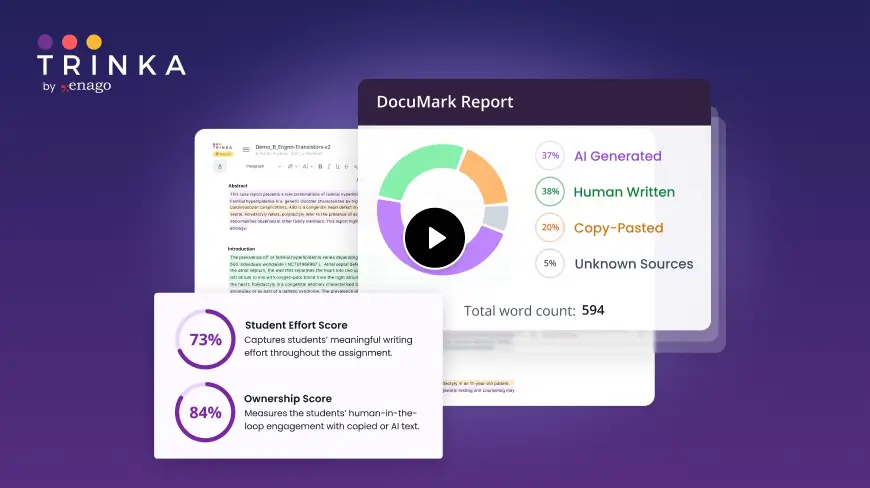
DocuMark: Responsible AI Use for Academic Integrity
Knowing your institution's AI policy is step one. DocuMark helps enforce it fairly by empowering universities to manage AI-generated content, prevent cheating, and support student writing through responsible AI use.
Common Questions About Alvernia College's AI Policies
Alvernia College has defined AI policies in 8 of 12 categories, with an overall coverage score of 67%.
Disclosure of AI use is required when authorization has been given, and students must give proper credit for permitted AI use. They also must follow any professor instructions on how to acknowledge or reference that use.
Undisclosed or unauthorized AI use is treated as an Honor Code violation. Professors may use supplemental or replacement assessments when AI misuse is suspected, may re-evaluate grades based on those measures, and may report the student for an Honor Code violation. Faculty also set course-specific sanctions, and repeated violations can escalate to university-level penalties through the Honor Code process.
The university states that it cannot control what data third-party AI note-takers collect or how they use it, so it limits their use by meeting category. Confidential meetings are off-limits for AI, sensitive information must be handled securely, and AI notetaking must be turned off during certain sensitive discussions. The AI notetaking policy also says ITAC works with senior leadership to maintain a list of acceptable AI notetakers, and the IT policies page identifies broader data-protection policies that apply to end users and confidential data.