Teaching & Learning
- For School Psychology students, AI is prohibited for papers, assignments, and other coursework unless the instructor explicitly permits it
- The policy also requires submitted work to reflect the student's own original thought and effort, and misuse for academic work is treated as academic dishonesty
Students must not use AI to generate, write, or complete papers, assignments, or any other work required for coursework unless the instructor explicitly permits it. All submissions must reflect the student’s own original thought and effort.
Using AI inappropriately, particularly for completing academic work, will be considered academic dishonesty and may result in disciplinary action, including potential dismissal from the program.
- The provided sources do not define a general policy on using AI for tutoring, studying, concept explanation, or revision
- The only relevant statement allows AI for approved purposes such as research assistance, but only with explicit instructor or advisor permission
AI tools may be used for data analysis, research assistance, or other approved purposes, but only with explicit permission from the instructor or advisor.
Research
- Any approved AI assistance must be disclosed and appropriately cited, and independent research must still be conducted in academically honest ways
- For School Psychology students, AI use in research-related writing is not allowed by default and requires explicit permission from the instructor or advisor
Each student is expected to conduct their work, both inside of the classroom and in their independent research in ways that are academically honest.
AI tools may be used for data analysis, research assistance, or other approved purposes, but only with explicit permission from the instructor or advisor. Students must disclose any AI assistance used and cite sources appropriately.
- For School Psychology students, AI may be used for data analysis only with explicit permission from the instructor or advisor
- The policy also requires disclosure of AI assistance, appropriate citation, and use that respects confidentiality, avoids harm, and maintains professional integrity
AI tools may be used for data analysis, research assistance, or other approved purposes, but only with explicit permission from the instructor or advisor. Students must disclose any AI assistance used and cite sources appropriately.
Students should understand the limitations and biases inherent in AI technologies and use them in ways that respect confidentiality, avoid harm, and maintain professional integrity.
- Alverno's School Psychology handbook requires students to use AI in ways that protect confidentiality, avoid harm, and uphold professional integrity
- It also prohibits AI from generating psychological reports, assessments, or client communications during practicum and internship, while allowing administrative uses only when confidentiality and service quality are not compromised
Students should understand the limitations and biases inherent in AI technologies and use them in ways that respect confidentiality, avoid harm, and maintain professional integrity.
During practicum and internship experiences, AI may not be used to generate psychological reports, assessments, or client communications. AI tools can be used for administrative tasks, but only if it does not compromise client confidentiality or the quality of services provided.
Academic Integrity
- For School Psychology students, disclosure and attribution are required whenever AI assistance is used with permission
- The handbook also ties acceptable AI use to professional ethics involving quotations, source recognition/citation, confidentiality, and privacy
Students must disclose any AI assistance used and cite sources appropriately.
Student honors professional ethics including appropriate use of quotations, recognition/citation of sources, acceptable use of AI, and respect for confidentiality and privacy.
- The sources do not define any AI detection tools or automated detection practices
- They do define enforcement: inappropriate AI use for academic work is treated as academic dishonesty, and the college academic misconduct process allows sanctions ranging from reprimand and assignment failure to course failure, program removal, or dismissal
Using AI inappropriately, particularly for completing academic work, will be considered academic dishonesty and may result in disciplinary action, including potential dismissal from the program.
These sanctions may include: a) verbal and/or written reprimand; b) failure of an assignment; and/or c) failure of a course. In extreme or repeated cases, sanctions may result in a student being removed from a program of study and/or dismissed from the College.
After the alleged misconduct has been discussed with the student, if the instructor concludes that misconduct occurred, the instructor may impose an appropriate sanction that might include: a letter of reprimand that will be copied to the student’s academic file; a repeat or replacement assignment; and/or an unsatisfactory designation for, and removal from, the course.
Institutional & Administrative
- The School Psychology handbook does not name approved AI platforms, but it does impose confidentiality limits on AI use
- Students are instructed to use AI in ways that respect confidentiality, and during practicum and internship AI may be used for administrative tasks only when client confidentiality and service quality are not compromised
Students should understand the limitations and biases inherent in AI technologies and use them in ways that respect confidentiality, avoid harm, and maintain professional integrity.
During practicum and internship experiences, AI may not be used to generate psychological reports, assessments, or client communications. AI tools can be used for administrative tasks, but only if it does not compromise client confidentiality or the quality of services provided.
- The explicit governance language in the sources is limited to program expectations for ethical practice
- The provided sources contain a School Psychology program-level ethical AI policy, but they do not define an institution-wide AI governance structure, strategy, committee, or roadmap
Ethical Use of Artificial Intelligence Policy for School Psychology Students
The program expects students to adhere to the highest standards of ethical practice in all aspects of their education and professional development.
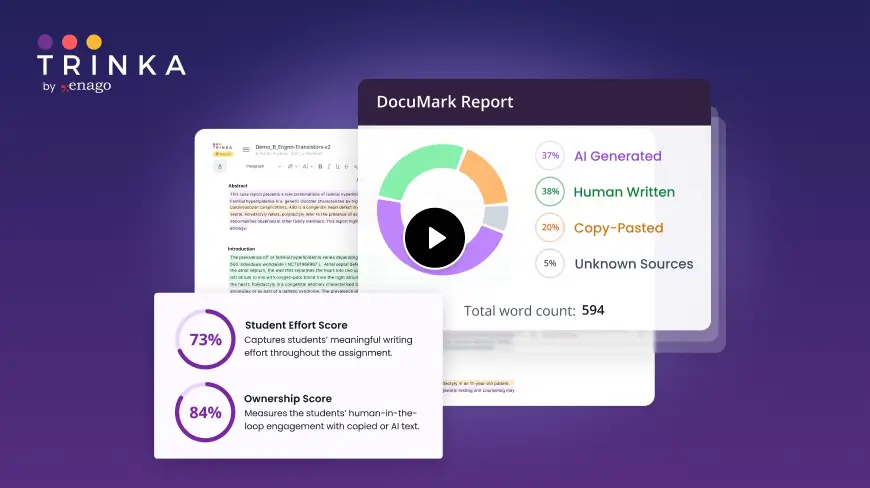
DocuMark: Responsible AI Use for Academic Integrity
Knowing your institution's AI policy is step one. DocuMark helps enforce it fairly by empowering universities to manage AI-generated content, prevent cheating, and support student writing through responsible AI use.
Common Questions About Alverno College's AI Policies
Alverno College has defined AI policies in 9 of 12 categories, with an overall coverage score of 75%.
For School Psychology students, disclosure and attribution are required whenever AI assistance is used with permission. The handbook also ties acceptable AI use to professional ethics involving quotations, source recognition/citation, confidentiality, and privacy.
The sources do not define any AI detection tools or automated detection practices. They do define enforcement: inappropriate AI use for academic work is treated as academic dishonesty, and the college academic misconduct process allows sanctions ranging from reprimand and assignment failure to course failure, program removal, or dismissal.
The School Psychology handbook does not name approved AI platforms, but it does impose confidentiality limits on AI use. Students are instructed to use AI in ways that respect confidentiality, and during practicum and internship AI may be used for administrative tasks only when client confidentiality and service quality are not compromised.