Teaching & Learning
- The use of AI-generated work in coursework without the specific permission and guidance of the instructor is considered plagiarism
- Instructors have the authority to set their own classroom policies, which may range from outright prohibition to allowing AI for specific tasks like brainstorming
The use of any unauthorized and uncredited material... and work generated by artificial intelligence (AI) without the specific permission and guidance of the instructor, constitutes plagiarism. Instructors reserve the right to establish guidelines for the use of AI in their courses.
- Individual instructors determine the specific rules for AI use in their course assessments
- Under the general Academic Honesty Policy, using unauthorized AI during assessments is considered plagiarism or cheating
Behavior that violates student academic integrity is considered academic dishonesty and constitutes sufficient cause for disciplinary action. Academic dishonesty includes (but is not limited to): Plagiarism... Cheating... The use of any unauthorized and uncredited material... and work generated by artificial intelligence (AI) without the specific permission and guidance of the instructor, constitutes plagiarism.
- Students may be permitted to use AI for learning assistance, such as for brainstorming or editing, but only if the instructor explicitly allows it and provides guidance
...an instructor may choose to prohibit the use of AI entirely, or they may choose to allow students to use AI for specific purposes, such as brainstorming or editing, while still requiring them to submit their own original work.
Research
Academic Integrity
- Failure to credit AI work constitutes plagiarism
- If AI use is permitted by an instructor, students are required to cite all generative AI content according to the instructor's specific guidelines
In all cases, students must cite sources, including generative AI content, per the instructor's guidelines. Failure to abide by an instructor’s AI use guidelines in a course is considered an act of academic dishonesty.
- Students accused of such a violation will be subject to the university's standard disciplinary procedures
- Failure to follow an instructor's guidelines regarding AI use is officially defined as an act of academic dishonesty
Failure to abide by an instructor’s AI use guidelines in a course is considered an act of academic dishonesty. Any student charged with academic dishonesty will face the disciplinary procedures outlined below.
Institutional & Administrative
- The university's governance strategy for AI in academics is to delegate authority to individual instructors, who reserve the right to establish specific AI guidelines for their own courses
Instructors reserve the right to establish guidelines for the use of AI in their courses. For example, an instructor may choose to prohibit the use of AI entirely, or they may choose to allow students to use AI for specific purposes... Failure to abide by an instructor’s AI use guidelines in a course is considered an act of academic dishonesty.
DocuMark: Responsible AI Use for Academic Integrity
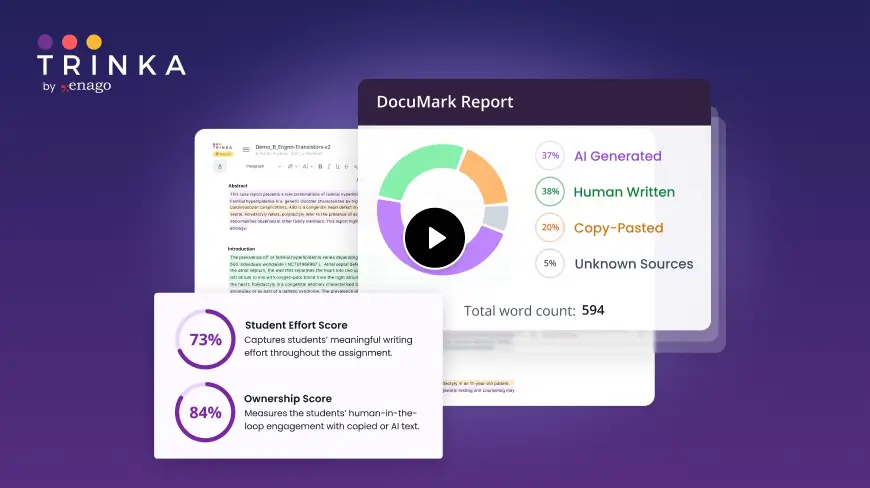
Knowing your institution's AI policy is step one. DocuMark helps enforce it fairly by empowering universities to manage AI-generated content, prevent cheating, and support student writing through responsible AI use.
Common Questions About American Academy of Art's AI Policies
American Academy of Art has defined AI policies in 6 of 12 categories, with an overall coverage score of 50%.
If AI use is permitted by an instructor, students are required to cite all generative AI content according to the instructor's specific guidelines. Failure to credit AI work constitutes plagiarism.
Failure to follow an instructor's guidelines regarding AI use is officially defined as an act of academic dishonesty. Students accused of such a violation will be subject to the university's standard disciplinary procedures.
No explicit data protection or approved AI platform policy is currently defined in the available policy sources.