Teaching & Learning
- Permitted use depends on course instructions and may differ by academic program or instructor
- Using AI to generate content contrary to course instructions or to complete assignments as one's own work is prohibited and can be treated as cheating or plagiarism
- Students may use generative AI for researching, brainstorming, outlining, and editing assistance, but AI-generated content is not original and any use in submitted work must be cited or attributed
The University supports the transparent and ethical use of generative artificial intelligence (Gen-AI), which refers to technologies that can create text, images, or multimedia. All use of Gen-AI programs must comply with all University policies, including without limitation, the University's academic integrity policy in the “Prohibited Student Conduct” section of the Student Handbook and any guidelines provided by individual departments.
While Gen-AI may be used to begin the process of researching and to provide editing assistance, Gen-AI-generated content is not considered original, so it must be cited as borrowed ideas, images, or wording. Any use of Gen-AI that appears in a submission must be attributed or cited appropriately, e.g., (OpenAI, 2024). Students are responsible for originality and accuracy of content developed from research or writing tools, including Gen-AI.
Gen-AI use standards may differ among academic programs. Students should consult the course syllabus or connect with their faculty member if they have any questions regarding how Gen-AI may be used in their course assignments.
Cheating is defined as fraud, deceit, or dishonesty in an academic assignment, or using or attempting to use materials, or assisting others in using materials that are prohibited or inappropriate in the context of the academic assignment in question. Examples include, but are not limited to, the following:
* allowing others to do an assignment or portion of an assignment for a student, including the use of a commercial term-paper service,
* inappropriate use of Artificial Intelligence (AI) to generate content as defined by course instructions,
Plagiarism is the adoption or incorporation of another's ideas without proper attribution of the source. It is more simply defined as taking the writings of another person or people or content generated by an Artificial Intelligence provider and representing them to be one's own.
- AI use in exams and assessments is controlled by instructor or course rules
- The assessment-scale materials show that some assessments may be AI-free while others may allow limited AI use with disclosure
- Collaborating with an AI provider on an exam or assignment without prior instructor approval is prohibited, and guidance for students also says not to use Copilot to generate answers for exams or quizzes
Cheating is defined as fraud, deceit, or dishonesty in an academic assignment, or using or attempting to use materials, or assisting others in using materials that are prohibited or inappropriate in the context of the academic assignment in question. Examples include, but are not limited to, the following:
* collaborating on an exam or assignment with any other person or AI provider without prior approval from the instructor,
For exams or quizzes, it is a test of your knowledge, so you should not use Copilot to generate answers.
AI Free
Work must be completed entirely without any AI assistance.
Students must rely entirely on their own knowledge, understanding, and skills.
Any AI use is a violation of student academic integrity.
An academic honesty pledge that AI was not used may be required.
AI Assisted
AI is used for tasks as specified such as brainstorming, planning, or feedback.
No AI content is allowed in the final submission.
Usage beyond speficied tasks is a violation of academic integrity.
Disclosure statement & links to AI Chats should be submitted with final product.
- Students are expected to use AI ethically, verify its accuracy, and follow course-specific rules
- The university encourages students to use generative AI as part of their academic experience for learning support
- Examples provided include research assistance, explanations of complex topics, study planning, concept review, flashcards, and practice questions
As part of American Public University System (APUS)’s culture of continuous improvement and innovation, generative artificial intelligence (Gen-AI) technologies are embraced as tools for learning in and out of the classroom. APUS aims to support students in understanding the potential benefits and risks of Gen-AI tools by exploring their ethical and appropriate uses in academic and professional contexts. The University encourages the use of Gen-AI tools as part of the students’ academic experiences. As an outcome of this, APUS students are expected to demonstrate ethical and appropriate use of Gen-AI in their courses.
Another use is study planning. Copilot can help organize your study schedule. If you need help with your busy week, you can provide your calendar, work hours, study time, and family time, and Copilot can help you find time for everything.
Understanding concepts is another use. If you're struggling with a particular concept, Copilot can provide explanations, examples, or even quiz you. Exam preparation is also a great use. Copilot can help you review key topics, create flashcards, and simulate exam questions to test your knowledge.
students should always verify the accuracy and relevance of Gen-AI content before using it in their academic work.
Research
- Students remain responsible for the originality and accuracy of the final content and must validate quotes, citations, and references that appear in AI-generated documents
- The university states that generative AI may be used to begin research and provide editing assistance, but AI-generated text is not original and must be cited or attributed in submitted work
While Gen-AI may be used to begin the process of researching and to provide editing assistance, Gen-AI-generated content is not considered original, so it must be cited as borrowed ideas, images, or wording. Any use of Gen-AI that appears in a submission must be attributed or cited appropriately, e.g., (OpenAI, 2024). Students are responsible for originality and accuracy of content developed from research or writing tools, including Gen-AI.
students must validate each direct quote, citation, and reference that appears in Gen-AI-generated documents to ensure that they are credible (see below).
- The AI materials also prohibit submitting personally identifiable information or other confidential information to generative AI tools
- The provided sources do not define a specific university-wide policy on using AI itself for data analysis or synthetic data generation
- For research involving human subjects, the university requires IRB review and approval before research begins, including secondary analysis of identifiable datasets
The APUS Institutional Review Board (IRB) reviews and approves all research involving human subjects to ensure that it is conducted in accordance with all federal, institutional, and ethical guidelines.
All human subject research under the aegis of APUS, regardless of funding source, must be reviewed and approved by the IRB before research can begin.
* Includes secondary analysis of existing datasets where participants are individually identifiable.
Do Not Submit Confidential Information to AI Tools: Do not submit personally identifiable information (e.g., name; physical or email address; health and medical records; or confidential or commercially sensitive information) to Gen-AI tools.
- Research involving human subjects must comply with IRB requirements and ethical guidelines, and student researchers must obtain professor approval before submitting for IRB review
- The provided sources do not set a specific AI rule for grant proposals or IRB applications, but they do require research to follow institutional and ethical rules and prohibit putting personally identifiable or confidential information into AI tools
The APUS Institutional Review Board (IRB) reviews and approves all research involving human subjects to ensure that it is conducted in accordance with all federal, institutional, and ethical guidelines.
Students seeking IRB approval for their research must first secure the approval of their professor prior to submitting their application.
Beginning January 1, 2011, ALL principal investigators (PIs) and co-PIs, must complete CITI training PRIOR to submitting the IRB application. (Log onto: https://www.citiprogram.org/ to complete the training. You will be able to create your own username and password). Failure to complete the training means the application will not be approved.
Do Not Submit Confidential Information to AI Tools: Do not submit personally identifiable information (e.g., name; physical or email address; health and medical records; or confidential or commercially sensitive information) to Gen-AI tools.
Academic Integrity
- Disclosure and attribution of AI use are required when AI appears in submitted work, and students must disclose the extent of their use when asked
- University guidance also instructs students to identify the AI tools they used, provide full citations and references, and, in some assessment settings, submit a disclosure statement and links to AI chats
Any use of Gen-AI that appears in a submission must be attributed or cited appropriately, e.g., (OpenAI, 2024).
When requested, students must reveal how and to what extent Gen-AI tools were used.
Indicate the AI tools that helped your work for research, editing, content creation, or other purposes.
Use a full citation and reference to attribute work to your AI tools.
Disclosure statement & links to AI Chats should be submitted with final product.
- Undisclosed or improper AI use is subject to academic misconduct enforcement
- The provided sources do not define a university stance on specific AI detection tools
- The policy states that violating the generative AI policy or related rules may lead to disciplinary action up to dismissal, and the cheating/plagiarism rules classify certain AI-assisted misconduct as violations
Failure to adhere to this Gen-AI Policy or any other policies and guidelines, may result in disciplinary action up to and including dismissal from the University.
Cheating is defined as fraud, deceit, or dishonesty in an academic assignment, or using or attempting to use materials, or assisting others in using materials that are prohibited or inappropriate in the context of the academic assignment in question.
Plagiarism is the adoption or incorporation of another's ideas without proper attribution of the source. It is more simply defined as taking the writings of another person or people or content generated by an Artificial Intelligence provider and representing them to be one's own.
Any AI use is a violation of student academic integrity.
Usage beyond speficied tasks is a violation of academic integrity.
Institutional & Administrative
- The provided sources do not define a university-wide policy governing faculty or staff use of AI for grading, feedback, lesson planning, recommendation letters, or administrative communications
- The only explicit faculty-related statement is that students should consult faculty members about how AI may be used in course assignments, and student IRB applications require instructor approval
Gen-AI use standards may differ among academic programs. Students should consult the course syllabus or connect with their faculty member if they have any questions regarding how Gen-AI may be used in their course assignments.
If you are a student applicant, your instructor will be prompted to approve your application once it is submitted in IRB Manager.
- It also warns specifically not to put PII into Copilot or any generative AI tool
- The provided sources do not identify a university-wide list of approved AI platforms
- The university prohibits students from entering personally identifiable information, health or medical records, and confidential or commercially sensitive information into generative AI tools
Do Not Submit Confidential Information to AI Tools: Do not submit personally identifiable information (e.g., name; physical or email address; health and medical records; or confidential or commercially sensitive information) to Gen-AI tools. They do not have the capacity to recognize personal information from public information. Thus, personal information may become publicly accessible information and may, therefore, appear in other people’s Gen-AI-generated work.
Do not put any personal identifiable information (PII) into Copilot or any generative AI tool, as it will remember it.
- The provided sources do not identify a specific AI governance committee or formal AI governance framework
- A 2023 press release also indicates an expansion of AI-related academic offerings, including a Bachelor of Science in Artificial Intelligence expected in summer 2024
- The university expresses an institutional strategy of embracing generative AI as part of continuous improvement, innovation, and student learning, while expecting ethical and appropriate use
As part of American Public University System (APUS)’s culture of continuous improvement and innovation, generative artificial intelligence (Gen-AI) technologies are embraced as tools for learning in and out of the classroom. APUS aims to support students in understanding the potential benefits and risks of Gen-AI tools by exploring their ethical and appropriate uses in academic and professional contexts. The University encourages the use of Gen-AI tools as part of the students’ academic experiences. As an outcome of this, APUS students are expected to demonstrate ethical and appropriate use of Gen-AI in their courses.
[From press release dated February 17, 2023] APUS is also expanding its portfolio of over 200 academic programs with several new offerings focused on digital marketing, data science, and artificial intelligence (AI). ... Another new program, the Bachelor of Science in Artificial Intelligence, is expected to be available for students in summer 2024, pending all necessary approvals.
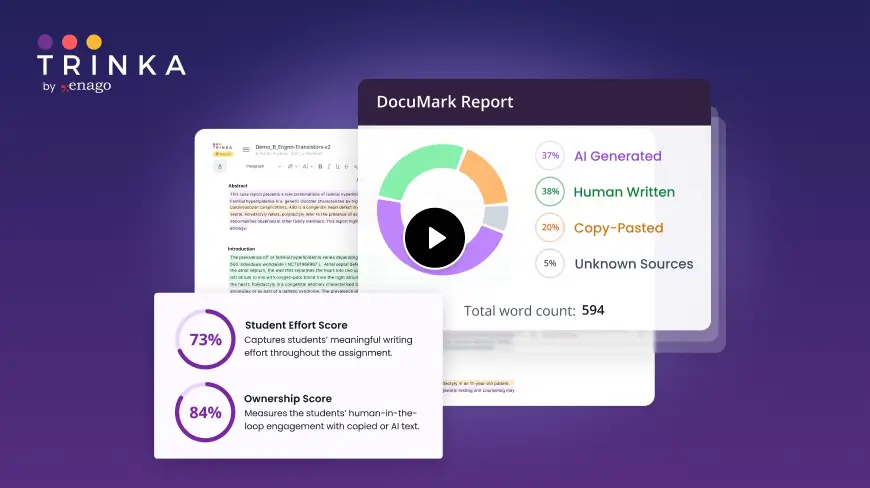
DocuMark: Responsible AI Use for Academic Integrity
Knowing your institution's AI policy is step one. DocuMark helps enforce it fairly by empowering universities to manage AI-generated content, prevent cheating, and support student writing through responsible AI use.
Common Questions About American Military University's AI Policies
American Military University has defined AI policies in 11 of 12 categories, with an overall coverage score of 92%.
Disclosure and attribution of AI use are required when AI appears in submitted work, and students must disclose the extent of their use when asked. University guidance also instructs students to identify the AI tools they used, provide full citations and references, and, in some assessment settings, submit a disclosure statement and links to AI chats.
Undisclosed or improper AI use is subject to academic misconduct enforcement. The policy states that violating the generative AI policy or related rules may lead to disciplinary action up to dismissal, and the cheating/plagiarism rules classify certain AI-assisted misconduct as violations. The provided sources do not define a university stance on specific AI detection tools.
The university prohibits students from entering personally identifiable information, health or medical records, and confidential or commercially sensitive information into generative AI tools. It also warns specifically not to put PII into Copilot or any generative AI tool. The provided sources do not identify a university-wide list of approved AI platforms.