Teaching & Learning
- American University does not impose a single university-wide rule for student AI use in coursework; use in classes is set at the instructor and course level
- Students must follow the AI policy stated in the syllabus, and using AI without permission or without disclosure may be treated as an Academic Integrity Code violation
We suggest all instructors include an Artificial Intelligence (AI) policy. There is no blanket AU policy regarding AI use in classes.
Students are responsible for reviewing, understanding and adhering to the AI policies listed in course syllabi as it relates to using AI in each course. Misuse of AI or use of AI without permission or disclosure may constitute a violation of the Academic Integrity Code.
Course syllabi should clearly state policies and expectations about the use of AI, whether prohibited or permitted.
- Course syllabi and exam instructions should state whether AI use is permitted
- The university does not set a blanket rule for AI use on exams; it is at the discretion of the individual instructor
Can students use AI on Take-Home Exams? This is up to the individual instructor and should be stated in the instructions for the exam. Instructors should address this in their syllabi and/or on an assignment-by-assignment basis.
- AI use for learning support is addressed at the course level rather than by a blanket student rule
- Faculty are encouraged to specify whether AI is allowed, discouraged, or expected for learning, and one sample policy explicitly says AI tools should be used critically to deepen subject matter understanding
The course syllabus should lay out an overall AI-use policy that applies to your course. Just as you may allow or disallow the use of devices in class, appraise your students of AU’s academic integrity code, or share your teaching philosophy and expectations, draft a statement that informs your students about allowable, encouraged, or expected AI-use.
AI is conditionally allowed: “In this course discourages but allows the use of AI. When using AI tools on assignments, add an appendix documenting (a) key passage of your AI exchange, (b) which AI tools were used, and (c) how AI tools were used (e.g. to generate ideas, turns of phrase, elements of text, etc.). AI tools should be used critically with an aim to deepen subject matter understanding. Use the ‘study mode’ setting whenever possible.”
AI is encouraged for learning: “In this course, you are expected to use AI (e.g., ChatGPT and image generation tools), and some assignments will require you to use AI tools. Learning to use AI is an emerging skill, the acquisition of which this course supports through examples and tutorials. Use the ‘study mode’ setting when relevant.”
Research
- American University permits AI in research writing assistance if researchers are transparent and follow disciplinary or publication standards
- Researchers must track and, where appropriate, disclose AI use, verify AI-generated content, and remain responsible for research integrity and reproducibility
Be transparent about the use of AI in your research. Clearly track and, where appropriate, disclose when, how, and which AI tools (including versions) are used, whether for data analysis, content generation, or writing assistance. Researchers are responsible for the reproducibility of their research outcomes. Remember that the standards around AI usage and disclosure are emergent and variable across disciplines.
Consult discipline and publication specific citation guidance to ensure transparency meets the prevailing standard for your discipline/publication.
Ensure the accuracy of AI-generated content. Always verify outputs against trusted sources, especially references and factual claims. Researchers bear full responsibility for the integrity of any material included in their research.
- The university allows AI use in research data analysis if researchers are transparent and protect data privacy
- Researchers must disclose qualifying AI use, verify outputs, avoid entering sensitive or proprietary information into publicly available tools, and consider bias and re-identification risks
Be transparent about the use of AI in your research. Clearly track and, where appropriate, disclose when, how, and which AI tools (including versions) are used, whether for data analysis, content generation, or writing assistance. Researchers are responsible for the reproducibility of their research outcomes. Remember that the standards around AI usage and disclosure are emergent and variable across disciplines.
Protect data privacy. Do not input sensitive or proprietary information into publicly available AI tools. Prioritize use of self-hosted AI systems or, if not available, AI systems that meet strict security standards (e.g., ISO 27001, SOC 2) and include opt-out options for data training or retention. If original data are shared for reproducibility purposes, every effort should be made to ensure that human subjects cannot be re-identified by a third-party using AI.
Evaluate potential bias. Critically assess ethical biases in AI-generated outputs, using automatic fairness checkers as supporting, rather than exclusive, tools. Consider how results might impact vulnerable populations or reinforce existing inequities.
- American University sets explicit limits on AI in research ethics and integrity contexts
- AI may not be used for tasks requiring human ethical judgment such as peer review or proposal evaluation, and if AI assists with grant writing or research compliance documentation such as IRB submissions, the principal investigator must verify and disclose that use
Do not use AI for academic tasks requiring human ethical judgment, such as peer reviews or proposal evaluations. If using AI to assist in grant writing or research compliance documentation (e.g., IRB submissions), the principal investigator must verify and disclose its involvement.
Respect intellectual property. Attribute AI-assisted contributions appropriately and do not list AI systems as a co-author, as they cannot be held accountable for research integrity. Follow publisher and tool-specific guidelines regarding attribution, licensing, and acceptable use.
Academic Integrity
- Disclosure is required or expected in multiple contexts
- The university says AI users should be transparent about whether work was wholly or partially created with AI, researchers must track and disclose relevant use, and faculty sample course policies include assignment-level documentation of AI exchanges, tools used, and how they were used
Be transparent about the use of AI. Disclose if a work product was wholly or partially created using an AI tool and, if appropriate, how AI was used to create the work product. Considering context is appropriate, transparency may not look the same in all situations; the key is honesty about use.
Be transparent about the use of AI in your research. Clearly track and, where appropriate, disclose when, how, and which AI tools (including versions) are used, whether for data analysis, content generation, or writing assistance.
AI is conditionally allowed: “In this course discourages but allows the use of AI. When using AI tools on assignments, add an appendix documenting (a) key passage of your AI exchange, (b) which AI tools were used, and (c) how AI tools were used (e.g. to generate ideas, turns of phrase, elements of text, etc.). AI tools should be used critically with an aim to deepen subject matter understanding. Use the ‘study mode’ setting whenever possible.”
For submitting written work, account for all the sources you use and research you do with appropriate citation, as directed in the course. Don‘t include sources you haven’t read or consulted! If you’re using any approved digital tools – including AI tools that might be permitted in the course, such as ChatGPT or tools that find or manage research – find and verify those sources, and read them, before including them in your submission.
- Suspected AI misuse is still enforceable through the Academic Integrity process, with allegations requiring other supporting evidence and sanctions governed by the Academic Integrity Code
- American University states that it does not subscribe to AI detection tools and that the Office of Academic Integrity will not accept those tool outputs as proof of a violation on their own
As of this date, the University does not subscribe to any AI detection tools. Additionally, the Office of Academic Integrity does not accept documentation from these tools as proof of a violation of the AIC on their own; allegations of such violations should be accompanied by other supporting evidence.
The difficulty of proving AI misuse without a reasonable doubt cannot be overstated. It is why AU’s agreement with Turnitin’s plagiarism software, which can be enabled in Canvas, does not include AI verification tools.
Institutional & Administrative
- Faculty and staff may use AI, but the university requires transparency, accountability, and human oversight
- Instructors are told not to rely solely on AI for grading or feedback and all final grade decisions must be made by humans; staff use must also remain under human oversight, and AI-generated content should not be represented as a person’s original work
Be transparent if AI is being used in the course, including, but not limited to, generation of course materials. Instructors are accountable for the work product, decisions, and impact of the output of AI tools.
It is not recommended that instructors solely rely on AI to grade, assess, or give feedback on student assignments. All final decisions about grades must be human.
AI-generated outcomes must always be subject to human oversight. Decisions impacting individuals at AU - including, but not limited to, those related to employment, admissions, student affairs, financial, editorial, fact-checking, validation, sourcing/crediting, or legal - require human accountability and cannot be made solely by AI systems.
AI generated content should never be represented as the original work of any person in any context.
Consistent with the general expectation of transparency, staff should disclose use based on how the work product is being used and/or could be interpreted.
- The university also requires use of OIT-approved tools for university data and prohibits using AI with AU-licensed online library resources that require AU sign-in
- American University prohibits entering sensitive, confidential, official use, or unapproved university data into AI tools unless there is approval, and it treats information given to open non-enterprise AI tools as public
Consider any information given to any open (non-enterprise) AI tool as if it were public.
Do not enter any sensitive data, or Confidential or Official Use data (as defined in the university Data Classification Policy) in an AI platform, unless approved by a university official.
Do not upload, input, or analyze university data in an AI tool that is not approved by Office of Information Technology (OIT). Contracts for approved tools should ensure that the data is not utilized for training models or is isolated in a separate instance inaccessible to external parties.
Using AI technologies with resources provided by online platforms licensed by American University is prohibited. If you are required to sign in using your AU ID to gain access to a library resource, this resource cannot be used with AI.
- American University has an institutional AI governance structure and principles-based approach
- Its interim guidance says a Responsible Use of AI Working Group was formed by the Chief Information Officer and Acting Provost to advise and make recommendations to the President’s Cabinet, and the university states that its AI approach is grounded in core values including human dignity, equity, integrity, and free inquiry
This guidance was developed with support of the Responsible Use of AI Working Group that has been formed by Chief Information Officer and Acting Provost to advise and make recommendations on responsible use of AI to the President’s Cabinet.
American University’s approach to Artificial Intelligence reflects our core values, including commitments to human dignity, equity, integrity, and free inquiry supporting truth-seeking, community, and positively impacting the world.
This guidance will be updated over time to reflect changes in the regulatory environment, industry standards, and technology.
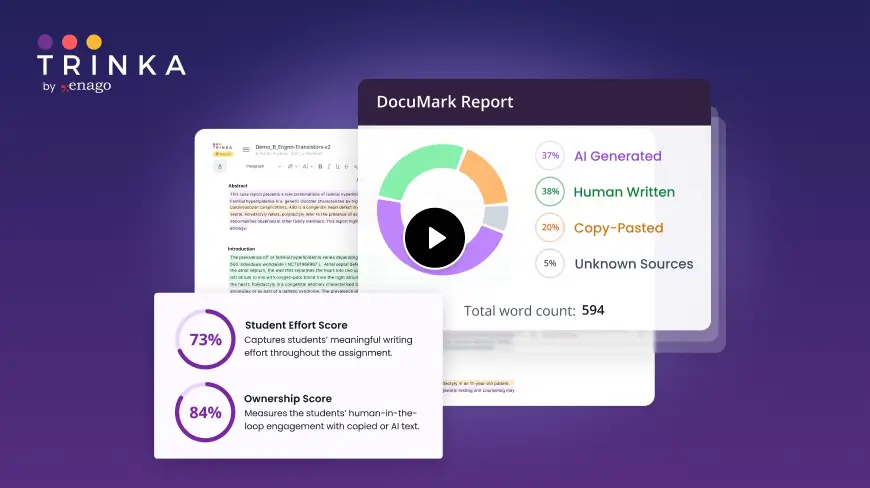
DocuMark: Responsible AI Use for Academic Integrity
Knowing your institution's AI policy is step one. DocuMark helps enforce it fairly by empowering universities to manage AI-generated content, prevent cheating, and support student writing through responsible AI use.
Common Questions About American University's AI Policies
American University has defined AI policies in 11 of 12 categories, with an overall coverage score of 92%.
Disclosure is required or expected in multiple contexts. The university says AI users should be transparent about whether work was wholly or partially created with AI, researchers must track and disclose relevant use, and faculty sample course policies include assignment-level documentation of AI exchanges, tools used, and how they were used.
American University states that it does not subscribe to AI detection tools and that the Office of Academic Integrity will not accept those tool outputs as proof of a violation on their own. Suspected AI misuse is still enforceable through the Academic Integrity process, with allegations requiring other supporting evidence and sanctions governed by the Academic Integrity Code.
American University prohibits entering sensitive, confidential, official use, or unapproved university data into AI tools unless there is approval, and it treats information given to open non-enterprise AI tools as public. The university also requires use of OIT-approved tools for university data and prohibits using AI with AU-licensed online library resources that require AU sign-in.