Teaching & Learning
- For graded work, Anderson University does not apply a single universal permission rule; use of generative AI depends on the assignment or instructor
- The graduate catalog treats unapproved AI-generated submission as academic dishonesty unless there is proper citation or explicit instructor permission, and the graduate nursing handbook is stricter by stating that students should expect AI use to be not permitted for graded coursework unless an instructor explicitly allows it
This scale of uses is generally meant to reference use of Gen AI in assignments that require something to be submitted for a grade.
Failure to acknowledge the use of Gen AI in a product submitted for a grade may violate Anderson University’s Academic Integrity policy.
● the unapproved use of generative AI (e.g., ChatGPT, image or code generators) to produce
content submitted as one’s own work, including essays, problem sets, programming code,
or artistic work, without proper citation or explicit instructor permission;
As a guiding principle, students should expect that using AI is not permitted to complete graded coursework.
The only time AI is acceptable is if the instructor explicitly allows it.
- AI is prohibited in at least some assessment contexts
- The Gen AI Use Scale states that quizzes, exams, and oral exams may be designated no-AI activities, and the graduate nursing handbook separately treats use of artificial intelligence programs to turn in assignments as fabrication while also listing improper handling of exams and quizzes as misconduct
Activities:
technology-free
discussions, reflective
writing, in-class work;
completing quizzes,
exams or oral exams.
You may not use
Generative AI for such
assignment or
activities.
• To turn in assignments that are the result of another’s work (fabrication) including artificial
intelligence programs
• Duplicating and disbursing in any format copyrighted national certification exam questions or
any exams, or quizzes utilized by the nursing program
- Anderson University explicitly recognizes AI for non-graded learning and study support
- The Gen AI Use Scale says it does not apply to tutoring, memorization, self-quizzing, testing knowledge, and translation-type uses, and university materials also describe AI study tutors and AI-supported learning experiences as part of the student experience
It is not applicable to other
academic activities for which AI could be useful, such as translations, memorization/tutoring, and self-quizzing or testing one’s knowledge of terms and concepts.
Introduced in AU 101 and reinforced across general education and upper-level courses, AI becomes a consistent part of the student experience—offering opportunity, flexibility, and choice throughout all four years.
* An adaptive AI study tutor that quizzes students, increases difficulty, and adjusts tone to enhance engagement
- The university explicitly includes programming code within its academic integrity rules on generative AI
- In the graduate catalog, AI-generated programming code submitted as a student's own work is unapproved unless there is proper citation or explicit instructor permission
● the unapproved use of generative AI (e.g., ChatGPT, image or code generators) to produce
content submitted as one’s own work, including essays, problem sets, programming code,
or artistic work, without proper citation or explicit instructor permission;
Research
- The university provides research-oriented AI support and expects transparent acknowledgment of AI use in research writing
- It also highlights AI-assisted dissertation and scholarly writing support, but the provided sources do not set a single mandatory university-wide permission rule for manuscript drafting beyond attribution and integrity expectations
Acknowledging the use of AI tools in research is crucial for transparency and integrity.
The use of artificial intelligence adds a new dimension to the research process, influencing how information is generated and interpreted.
Clearly stating the involvement of AI not only upholds academic honesty but also allows your peers and educators to understand the unique methodology, contributing to an open and collaborative academic culture.
* A dissertation-writing tutor bot supporting advanced research and scholarly writing
- Anderson University indicates that AI may be used in research-related information gathering and that factual outputs must be checked
- The university also describes preparing students to use AI in data analysis, but the provided materials do not define a specific policy for AI-based research data analysis procedures, synthetic data, or interpretation standards
AI can be useful for
researching info.,
definitions, and
concepts, or for
finding answers.
You must verify the
validity of any
seemingly factual info.
generated by AI.
Employers are already seeking graduates who are fluent in AI-assisted writing, content creation and data analysis.
- The materials ask users to consider whether AI use is properly attributed and consistent with the Honor Code, and they stress transparency and integrity in research
- For research use, the university emphasizes integrity, attribution, and ethical reflection rather than setting detailed rules for grant proposals or IRB submissions in the provided sources
Acknowledging the use of AI tools in research is crucial for transparency and integrity.
1. Academic Integrity
a. Have I properly attributed my use of Gen AI
tools in my work? Is the work I create with the
assistance of Gen AI, and how I present such
products, consistent with AU’s Honor Code
Academic Integrity
- Disclosure and attribution of AI use are required when AI is used in submitted work
- The Gen AI Use Scale warns that failure to acknowledge AI use in graded submissions may violate academic integrity policy, the graduate catalog requires proper citation or explicit instructor permission, and the graduate nursing handbook says students must cite AI technology used when AI is explicitly permitted
Failure to acknowledge the use of Gen AI in a product submitted for a grade may violate Anderson University’s Academic Integrity policy.
Acknowledging the use of AI tools in research is crucial for transparency and integrity.
The incorporation of AI into your assignments necessitates a clear acknowledgment of their use.
● the unapproved use of generative AI (e.g., ChatGPT, image or code generators) to produce
content submitted as one’s own work, including essays, problem sets, programming code,
or artistic work, without proper citation or explicit instructor permission;
When AI is explicitly permitted and used
as a tool in the completion of an assignment, students must cite the AI technology used.
- Enforcement language appears through existing academic dishonesty and fabrication provisions, including the graduate catalog and graduate nursing handbook
- The provided sources define undisclosed or unapproved AI use as an academic integrity issue, but they do not provide a specific university policy on AI-detection tools
Anderson University supports and promotes academic honesty and personal integrity and regards cheating,
plagiarism, and all other forms of academic dishonesty as serious offenses against the university community.
● the unapproved use of generative AI (e.g., ChatGPT, image or code generators) to produce
content submitted as one’s own work, including essays, problem sets, programming code,
or artistic work, without proper citation or explicit instructor permission;
Submitting an assignment that has been created by one or more AI tools and presenting yourself as the author
or creator is unethical and deceptive, and clearly violates AU’s Academic Integrity Policy under item 5, II.B.:
Fabrication.
Institutional & Administrative
- The university explicitly supports faculty and staff use of AI and provides resources for instructional integration
- It states that faculty will be equipped to integrate AI into coursework and that BoodleBox will be available for faculty, staff, and students, but the provided sources do not define detailed rules on grading, recommendation letters, or administrative communications
At Anderson University, we will:
• Equip faculty with opportunities to integrate meaningful AI conversations, tools, activities, or assignments into our
students’ coursework and academic programs.
BoodleBox to be Available Free for Faculty, Staff and Student Use
Anderson University, as part of its strategic focus on the ethical implementation of Artificial Intelligence, has deployed BoodleBox, a campus-wide suite of free-to-use AI tools, soon to be available to all faculty, staff and students.
Visit the Artificial Intelligence Resource Hub in Canvas: Instructor of Record Responsibilities course
- Anderson University has an approved institutional AI platform and frames its use in terms of privacy and security
- The university says it provides campus-wide access to BoodleBox as a secure platform, notes that prompts and data are protected in a closed environment, and its ethical guidance asks users to evaluate how submitted information is used and who can access personal data
To ensure fairness, privacy, and academic integrity, AU provides campus-wide access to BoodleBox, a secure AI platform.
Security: Prompts and data entered by AU members are protected in a closed, walled-garden environment
2. Data Privacy and Confidentiality - assessment of specific tools
a. What happens to the information I submit to a
resource that utilized Gen AI? How is the
information I input used after it generates the
results of my work with Gen AI?
b. Who has access to my personal information?
c. Is my data only contained within the model I
use, or is it transferred or sold to other models
or entities?
- The sources describe a vision statement, a unified campus approach, faculty training, and committee-led work on AI in teaching and learning
- Anderson University has an explicit institutional AI strategy centered on ethical implementation, academic integrity, and campus-wide adoption
As an internationally recognized* higher education leader in innovative educational technology, Anderson University
acknowledges its responsibility to equip students to successfully engage in a world context increasingly shaped by
Artificial Intelligence (AI) technologies.
Anderson University embraces the opportunities Artificial Intelligence presents,
modeling responsible use while upholding standards of premier academic integrity in keeping with the University’s core
Christian values and exceptional academic rigor.
“In keeping with our culture of innovation, Anderson University determined that our entire campus (all faculty, staff, and students) is best served with a unified approach to using AI tools,” said Anderson University Provost Dr. Ryan Neal.
Last year, Professor Nathan Cox, AU Associate Provost and Director of AU’s Center for Learning and Teaching Excellence, was tasked with leading a committee on the evolving ethical use of AI in teaching and learning at Anderson University as they participated in a year-long institute on AI, Pedagogy and the Curriculum.
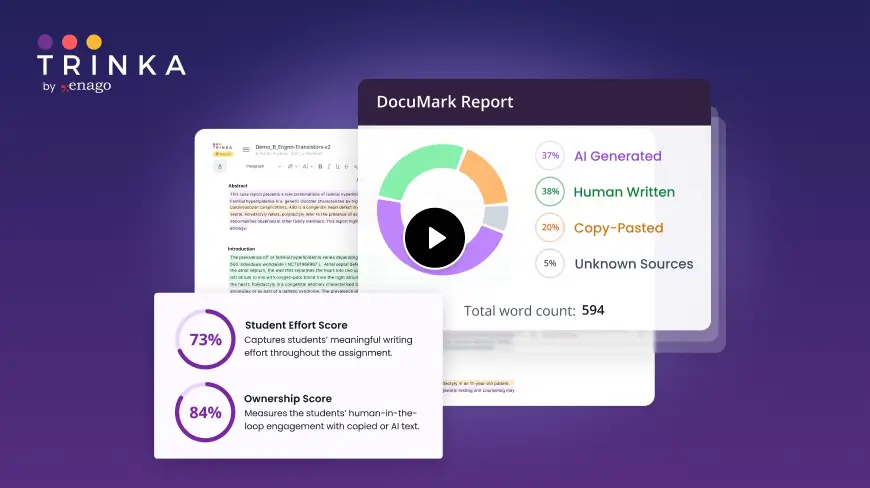
DocuMark: Responsible AI Use for Academic Integrity
Knowing your institution's AI policy is step one. DocuMark helps enforce it fairly by empowering universities to manage AI-generated content, prevent cheating, and support student writing through responsible AI use.
Common Questions About Anderson University's AI Policies
Anderson University has defined AI policies in 12 of 12 categories, with an overall coverage score of 100%.
Disclosure and attribution of AI use are required when AI is used in submitted work. The Gen AI Use Scale warns that failure to acknowledge AI use in graded submissions may violate academic integrity policy, the graduate catalog requires proper citation or explicit instructor permission, and the graduate nursing handbook says students must cite AI technology used when AI is explicitly permitted.
The provided sources define undisclosed or unapproved AI use as an academic integrity issue, but they do not provide a specific university policy on AI-detection tools. Enforcement language appears through existing academic dishonesty and fabrication provisions, including the graduate catalog and graduate nursing handbook.
Anderson University has an approved institutional AI platform and frames its use in terms of privacy and security. The university says it provides campus-wide access to BoodleBox as a secure platform, notes that prompts and data are protected in a closed environment, and its ethical guidance asks users to evaluate how submitted information is used and who can access personal data.