Teaching & Learning
- For student coursework, AI use is governed by faculty discretion at the course level
- Students may use AI for ideation, research assistance, translation, or tutoring only when permitted and properly acknowledged and cited, and presenting AI-generated or modified work as their own is treated as academic dishonesty
Presenting AI-generated or modified work as your own constitutes academic dishonesty.
Using AI in ways that violate instructor policies or without explicit permission violates the University's Academic Integrity Policy.
Using AI as a reference tool for ideation, research assistance, translation, or tutoring is permitted with faculty discretion if properly acknowledged and cited. Always check your syllabus and consult instructors about AI use in specific courses.
Faculty determine how, if, and when generative AI may be used in their courses based on learning outcomes.
Faculty incorporating AI must clearly state usage parameters in syllabi, announcements, and assignment instructions.
- Use of AI in assessments is not set by a single blanket student rule; it is determined by faculty based on course learning outcomes
- Instructors must communicate permitted or prohibited AI use in course documents and assignment instructions, so exam and assessment use depends on those course-level policies
AI in Teaching & Learning: Faculty and staff should refer to institutional guidelines on AI integration in coursework, assessments, and student support tools.
Faculty determine how, if, and when generative AI may be used in their courses based on learning outcomes.
Faculty incorporating AI must clearly state usage parameters in syllabi, announcements, and assignment instructions.
Presenting content created by generative AI as your own constitutes academic dishonesty. Faculty determine appropriate use in their courses and must clearly communicate expectations in syllabi.
- The university permits AI for non-graded learning support such as brainstorming, study materials, tutoring, concept explanation, self-quizzing, and pre-reading assistance
- This use is framed as supportive rather than substitutive, and in course contexts it remains subject to faculty discretion and any acknowledgment or citation requirements
Generative AI can support your education through brainstorming, creating study materials, and explaining difficult concepts.
Using AI as a reference tool for ideation, research assistance, translation, or tutoring is permitted with faculty discretion if properly acknowledged and cited.
For instance, AI can support self-quizzing, assist in the pre-reading of materials, and aid in the development of structured thesis statements.
However, the benefits of AI must be balanced with awareness of its limitations and risks, as well as a commitment to ethical use.
Research
- For research outputs, AI may be used to support brainstorming, refining ideas, editing, and presentation, but it must not replace the researcher as the primary writing agent
- Researchers and authors must disclose AI use, verify the accuracy of AI-generated content, and, for Andrews University Press submissions, authors must write the manuscript themselves and disclose any AI-generated text, outlines, images, graphs, tables, or similar material
Researchers using Generative AI must transparently disclose its use in methods, acknowledgements, or other appropriate sections.
Researchers are responsible for verifying accuracy of AI-generated content in research outputs.
Andrews University Press will not knowingly publish any manuscripts in which authors used generative AI in violation of the following best-practice guidelines:
AI should only be used to support rather than replace research and is appropriate for brainstorming, refining an author’s ideas, and editing but must not serve as the primary source for data or the primary writing agent.
AI cannot legally serve as a co-author (since AI is not a moral agent and cannot be held liable for the content of what it generates); therefore, authors must write the entire manuscript themselves, maintaining a unified voice.
Any AI-generated text (even if rewritten), any AI-generated outline followed by the author, or any image, graph, table, or the like generated by AI must be disclosed to the publisher and the reader.
- The university restricts use of AI with research data by prohibiting uploads of unpublished research data or confidential information into generative AI tools
- Any AI-generated data must be thoroughly reviewed, fact-checked, and sourced by the author, and AI systems used for data analysis or decision support that process university data require approval and output review for accuracy and bias
Never upload unpublished research data or confidential information into Generative AI tools.
Inputting unpublished work into AI tools makes it available to the model's dataset, potentially exposing it to other researchers' queries, jeopardizing intellectual property protection, and risking privacy violations.
Any AI-generated data must be thoroughly reviewed, fact-checked, and sourced by the author.
AI for Data Analysis & Decision Support: Requires approval before implementation if it processes university data. Outputs must be reviewed for accuracy and bias.
- The university requires transparent disclosure of AI use in research and holds researchers responsible for verifying AI-generated content
- Researchers must also follow journal, funder, professional society, and IRB rules, and the policy specifically warns against uploading confidential materials such as unpublished manuscripts or funding proposals under peer review
Researchers using Generative AI must transparently disclose its use in methods, acknowledgements, or other appropriate sections.
Researchers are responsible for verifying accuracy of AI-generated content in research outputs.
Follow all policies set by journals, funding agencies, and professional societies regarding AI use in research.
Those conducting human subjects research involving AI must follow Institutional Review Board policies.
Avoid uploading third parties' confidential information, as AI tools may not protect such data and could breach contractual commitments. This includes unpublished manuscripts or funding proposals under peer review. NIH, NSF, and other organizations prohibit using AI
Academic Integrity
- Disclosure requirements vary by role
- Employees must disclose substantial AI-created content, students must follow course policies, student academic use that is permitted must be properly acknowledged and cited, researchers must disclose AI use in research sections, and Andrews University Press requires disclosure of AI-generated text, outlines, images, graphs, tables, and similar content to both the publisher and reader
When AI tools are used to generate substantial content in final work products, disclosure to a supervisor is required. However, minor assistance - such as grammar checking, editing suggestions, brainstorming, or using AI as a thought partner - does not need disclosure.
Using AI as a reference tool for ideation, research assistance, translation, or tutoring is permitted with faculty discretion if properly acknowledged and cited.
Researchers using Generative AI must transparently disclose its use in methods, acknowledgements, or other appropriate sections.
Disclosure:
Employees, disclose substantial content created using generative AI. Minor assistance (grammar checking, editing, brainstorming) doesn't require disclosure. Students, follow course policies.
Any AI-generated text (even if rewritten), any AI-generated outline followed by the author, or any image, graph, table, or the like generated by AI must be disclosed to the publisher and the reader.
- Violations are handled through existing academic integrity procedures, and undisclosed AI influence in press submissions may lead to manuscript rejection and void contractual obligations
- The university cautions faculty against relying on AI detectors alone because of false positives and bias, and it expects additional evidence and conversation with the student before proceeding
Exercise caution with AI detection tools, which risk misidentification, false positives, bias
A conversation with the student should take place when additional evidence is presented.
Follow university academic integrity procedures for policy violations.
Reporting Violations:
Report faculty misuse to the Chief Academic Officer, research misuse to the Dean of Research, student misuse through the Academic Integrity policy, and staff misuse to supervisors or HR.
Failure to disclose AI influence may result in the rejection of the manuscript and will void any contractual obligations Andrews University Press may have with the author.
Institutional & Administrative
- Faculty and staff may use AI, but it must supplement rather than replace human judgment
- Faculty set course AI rules and must clearly communicate them, while staff and administrators may use AI to improve efficiency only with transparency, ethical oversight, adherence to privacy standards, and human review of AI-generated recommendations before implementation
No university decision may be made by AI alone. Users must critically assess AI-generated content for accuracy, bias, and appropriateness before applying it in any official capacity.
Faculty determine how, if, and when generative AI may be used in their courses based on learning outcomes.
Faculty incorporating AI must clearly state usage parameters in syllabi, announcements, and assignment instructions.
Staff and administrators play a vital role in integrating AI to enhance efficiency, streamline operations, and support data-driven decision-making. AI should be used responsibly, with transparency and ethical oversight, ensuring it aligns with Andrews University’s core values. While AI can improve workflow automation and provide valuable insights, it should always complement human judgment rather than replace it.
Administrative Use:
Staff must adhere to data privacy standards when using generative AI. All generated recommendations require human review before implementation.
- The university prohibits entering confidential, sensitive, personally identifiable, or otherwise restricted data into generative AI tools unless authorized and approved
- AI systems that process protected university data must be evaluated and approved by Institutional Operations Council and IT Services, and the university maintains a list of approved AI tools and permitted use cases
Data security is paramount. Never input confidential, sensitive, or personally identifiable information into AI tools unless explicitly authorized under validated contracts and security controls.
AI tools using public or non-sensitive information require no special permission. However, any AI system that interacts with, generates, or makes decisions based on protected university data must be evaluated and approved by the Institutional Operations Council and Information Technology Services before deployment.
A list of approved AI tools and their permitted use cases will be maintained and updated regularly to guide staff and administrators in selecting AI solutions that align with university policies and security protocols.
Treat information given to an AI tool as if it were public.
Entering any restricted data into any generative AI tool or service is prohibited unless given proper administrative approval. This includes data protected by FERPA, HIPAA, other private client data, private information related to employees, material under confidential review and not written by the AI user (such as funding proposals, manuscripts, etc.), and intellectual property not publicly available.
Tool Approval:
Generative AI systems processing protected university data must be evaluated and approved by Institutional Operations Council and IT Services.
- Andrews has an institution-wide AI governance framework that emphasizes ethical guidelines, compliance, human oversight, and approval workflows for protected-data systems
- The policy also states that approved tools and permitted uses will be maintained and updated, and it identifies Institutional Operations Council and IT Services as approval bodies for certain AI deployments
General Assumptions
• AI will advance unpredictably, transforming many aspects of Andrews University.
• Access to generative AI tools is essential for innovation.
• Ethical guidelines for responsible use will uphold our mission and values.
• AI's interdisciplinary nature will enhance cross-departmental collaboration.
• Compliance with regulations and best practices will minimize risks.
Human oversight is essential - no university decision may be made by AI alone.
A list of approved AI tools and their permitted use cases will be maintained and updated regularly to guide staff and administrators in selecting AI solutions that align with university policies and security protocols.
any AI system that interacts with, generates, or makes decisions based on protected university data must be evaluated and approved by the Institutional Operations Council and Information Technology Services before deployment.
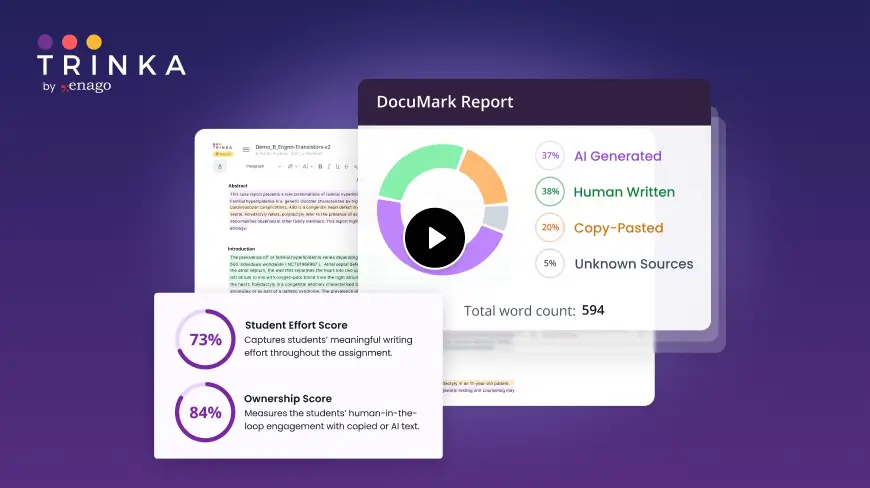
DocuMark: Responsible AI Use for Academic Integrity
Knowing your institution's AI policy is step one. DocuMark helps enforce it fairly by empowering universities to manage AI-generated content, prevent cheating, and support student writing through responsible AI use.
Common Questions About Andrews University's AI Policies
Andrews University has defined AI policies in 11 of 12 categories, with an overall coverage score of 92%.
Disclosure requirements vary by role. Employees must disclose substantial AI-created content, students must follow course policies, student academic use that is permitted must be properly acknowledged and cited, researchers must disclose AI use in research sections, and Andrews University Press requires disclosure of AI-generated text, outlines, images, graphs, tables, and similar content to both the publisher and reader.
The university cautions faculty against relying on AI detectors alone because of false positives and bias, and it expects additional evidence and conversation with the student before proceeding. Violations are handled through existing academic integrity procedures, and undisclosed AI influence in press submissions may lead to manuscript rejection and void contractual obligations.
The university prohibits entering confidential, sensitive, personally identifiable, or otherwise restricted data into generative AI tools unless authorized and approved. AI systems that process protected university data must be evaluated and approved by Institutional Operations Council and IT Services, and the university maintains a list of approved AI tools and permitted use cases.