Teaching & Learning
- For student coursework and assignments, AI use is prohibited by default unless the instructor explicitly authorizes it in the course syllabus
- The university also provides optional syllabus language showing that faculty may allow AI broadly, allow it only for limited tasks, or prohibit it entirely at the course level
However, unless the instructor explicitly states in the course syllabus that students may use generative AI tools to develop content that is submitted as part of an assignment for a course, their use in that course is prohibited. For more information, please see OP 10.26 Use of Generative AI Tools by Students.
Generally speaking, you are not allowed to use artificial intelligence (AI) engines, software, or artwork generating programs to produce work for this class EXCEPT on X (consider specifying the particular assignment in which AI is allowed). I will provide more information about this specific assignment when the time is appropriate in the course. You may not, however, construe this limited use as permission to use these technologies in any other facet of this course.
The use of generative AI tools (add examples of tools that students might use based on the context of your course) are not permitted in this course; therefore, any use of AI tools for work in this class may be considered a violation of ASU’s Academic Integrity policy and the Student Code of Conduct since the work is not your own.
- The university does not set a separate institution-wide AI rule specifically for exams or quizzes in the provided materials
- Instead, faculty are directed to decide what AI use they will allow or disallow for each activity or assessment and to state those expectations in the syllabus and assignments
The use of GenAI technologies in the classroom and related policies are at the faculty’s discretion. Faculty should clearly communicate your expectations for AI use in their syllabus.
Test AI Tools: Submit exam questions, essay prompts, or learning activities to generative AI systems like ChatGPT, Gemini, Claude, Perplexity, and Scribe. Analyze the responses to understand how students might use AI to plan, develop, or complete their work.
Review and Adapt Your Syllabus: Identify which activities or assessments could incorporate AI. Decide what AI usage you will allow or disallow for each activity or assignment.
Research
- This is framed as a data-handling restriction tied to privacy rather than a broader research-analysis policy
- The university states that confidential data, including non-public research data, should not be entered into publicly available generative AI tools
You should not enter data classified as confidential (including non-public research data, finance, HR, student records, medical information, etc.) into publicly available Generative AI tools, in accordance with the ASU’s Privacy Policy. Information shared with Generative AI tools using default settings is not private and could expose proprietary or sensitive information to unauthorized parties.
Academic Integrity
- When an instructor allows AI use in a course, the sample syllabus language requires disclosure and citation
- Students may be required to include a statement explaining which AI tool they used and how they used it, and AI use must be documented and cited according to the discipline’s citation style
Your use of AI tools must be properly documented and cited for academic integrity. For this course, we will use [Insert citation style for your discipline and perhaps an example of an AI citation according to this style.]
You are expected to include a disclosure statement at the end of your assignment describing which AI tool you used and how you used it. For example, “ChatGPT was used to draft about 50 percent of this paper and to provide revision assistance. AI-produced content was edited for accuracy and style. Your use of AI tools must be properly documented and cited for academic integrity.
For this course, we will use [Insert citation style for your discipline and perhaps an example of an AI citation according to this style.]
- Unauthorized AI use may be treated as a violation of academic integrity and the student code of conduct, with referral to the Office of Student Conduct
- ASU provides faculty with qualitative detection guidance, such as comparing suspected AI-written work to a student’s prior work and checking citations for fabricated sources
Compare a student’s prior work to a student product with suspected AI use to determine if their level of vocabulary, structure style, and expertise is consistent.
Check references/citations to verify works cited are legitimate, since generative AI can manufacture non-existent sources.
The use of generative AI tools (add examples of tools that students might use based on the context of your course) are not permitted in this course; therefore, any use of AI tools for work in this class may be considered a violation of ASU’s Academic Integrity policy and the Student Code of Conduct since the work is not your own. The use of unauthorized AI tools will result in referral to the Office of Student Conduct.
Institutional & Administrative
- Faculty use of AI in teaching is governed primarily through instructor discretion in the provided materials
- Faculty are encouraged to set clear syllabus policies, determine which activities or assignments may incorporate AI, and communicate permitted and prohibited uses to students
The use of GenAI technologies in the classroom and related policies are at the faculty’s discretion. Faculty should clearly communicate your expectations for AI use in their syllabus.
Faculty members are encouraged to include clear guidelines in their syllabi regarding the acceptable use of AI tools in their courses. This helps ensure students understand the expectations and boundaries for using AI in their academic work.
Review and Adapt Your Syllabus: Identify which activities or assessments could incorporate AI. Decide what AI usage you will allow or disallow for each activity or assignment.
Set Clear Policies: Clearly outline your expectations for AI use in your syllabus and assignments. Specify which AI practices you encourage or prohibit.
- The provided sources do not identify a university-approved AI platform list
- The university instructs users not to enter confidential information into publicly available generative AI tools
- The examples given include non-public research data, finance, HR, student records, and medical information, and the guidance warns that default settings are not private
You should not enter data classified as confidential (including non-public research data, finance, HR, student records, medical information, etc.) into publicly available Generative AI tools, in accordance with the ASU’s Privacy Policy. Information shared with Generative AI tools using default settings is not private and could expose proprietary or sensitive information to unauthorized parties.
Angelo State University is firmly committed to privacy, in both the collection and use of individual information and monitoring of the use of university information resources.
- Angelo State has established an AI Center of Excellence as part of its institutional AI strategy
- The center is intended to integrate AI across academic disciplines and operational units, support students, faculty, staff, industry, and outside researchers, and is explicitly grounded in ethics, transparency, community engagement, and responsible innovation
Angelo State University has launched a new Artificial Intelligence Center of Excellence (AI-COE) with the goal to integrate and infuse artificial intelligence (AI) across every academic discipline and operational unit on campus, as well as into the greater West Texas community.
Coupled with ASU’s existing AI academic programs and infrastructure, the funding will allow the AI-COE to expand its auspices well beyond just the Computer Science Department to initially also include Information Technology, the Innovation and Research Hub, and the College of Graduate Studies and Research. Eventually, it will involve faculty and staff from across campus, as well as local business owners and outside researchers, who are looking at potential uses of AI in many different areas.
The AI-COE will also serve as a collaborative hub for ASU students, faculty and staff across all academic disciplines – from computer science and business to agriculture, education, health sciences and the arts – where they will explore how AI can enhance learning, solve real-world problems and drive regional economic development.
Our vision is to provide world-class instruction and equipment to lead West Texas in AI education and industry collaboration. But as we embrace the promise of AI, we must also proceed with caution and care. Ethics, transparency and community engagement will be the cornerstones of our approach.
The Angelo State AI Center of Excellence empowers innovation across disciplines, industries and communities. This groundbreaking initiative is transforming how we learn, teach and lead in the age of AI, and is committed to bridging the AI divide by making artificial intelligence accessible, ethical and impactful for all.
We’re building it responsibly. The center is guided by four core pillars that reflect ASU’s commitment to responsible innovation and long-term impact:
1. Ethics and Policy
2. AI Development Labs
3. Education and Envisioning
4. Co-Working
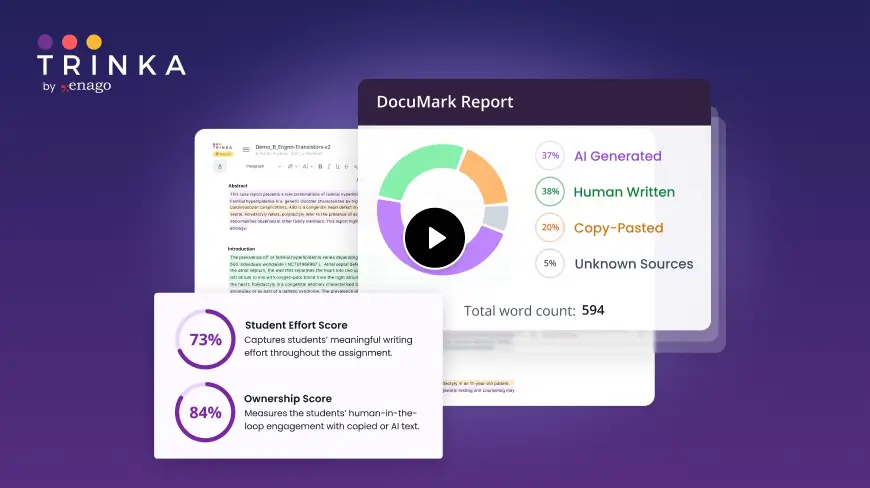
DocuMark: Responsible AI Use for Academic Integrity
Knowing your institution's AI policy is step one. DocuMark helps enforce it fairly by empowering universities to manage AI-generated content, prevent cheating, and support student writing through responsible AI use.
Common Questions About Angelo State University's AI Policies
Angelo State University has defined AI policies in 8 of 12 categories, with an overall coverage score of 67%.
When an instructor allows AI use in a course, the sample syllabus language requires disclosure and citation. Students may be required to include a statement explaining which AI tool they used and how they used it, and AI use must be documented and cited according to the discipline’s citation style.
ASU provides faculty with qualitative detection guidance, such as comparing suspected AI-written work to a student’s prior work and checking citations for fabricated sources. Unauthorized AI use may be treated as a violation of academic integrity and the student code of conduct, with referral to the Office of Student Conduct.
The university instructs users not to enter confidential information into publicly available generative AI tools. The examples given include non-public research data, finance, HR, student records, and medical information, and the guidance warns that default settings are not private. The provided sources do not identify a university-approved AI platform list.