Teaching & Learning
- Students are not permitted to submit AI-generated work as their own in coursework or other assessed submissions
- The guidance also states that unauthorised use of AI in assessments is considered collusion and may be treated under academic offence procedures
- The university states that work produced by generative AI does not demonstrate a student's own knowledge and, if submitted as their own work, may amount to academic misconduct
A student who submits work created by generative AI as if it were their own work for assessment is not demonstrating their own skills, knowledge and understanding and may therefore be liable to an academic misconduct finding.
You must not submit any work generated by artificial intelligence (AI) as your own.
Use of artificial intelligence (AI) in this context includes using tools such as ChatGPT, DALL-E, Midjourney, Bard and other online text or image generators. Work generated by AI tools cannot be assured to be accurate and must not be submitted as your own work.
Collusion can also include unauthorised use of artificial intelligence (AI), where a student knowingly prompts an AI tool to generate the content (text or images or both) to be submitted as all or part of an assessment submission, and where there is no clear expectation or permission for this from the Module Leader. The student is liable for an academic offence in these circumstances.
- Use of AI in assessments is not allowed unless there is clear permission or expectation from the module leader
- The university also indicates that students should ask the module leader if they are unsure whether AI use is permitted
- The policy specifically treats unauthorised AI-generated content submitted for assessment as collusion and an academic offence
Collusion can also include unauthorised use of artificial intelligence (AI), where a student knowingly prompts an AI tool to generate the content (text or images or both) to be submitted as all or part of an assessment submission, and where there is no clear expectation or permission for this from the Module Leader. The student is liable for an academic offence in these circumstances.
If you are in any doubt as to whether you can use generative AI in your work, ask your Module Leader.
- However, this encouragement is paired with a requirement not to submit AI-generated output as their own work and to understand boundaries around acceptable use
- Students are encouraged to engage with AI and the university presents AI as a tool to support learning, employability, and understanding of its strengths and weaknesses
AI is an important tool that will shape all of our futures, and it is crucial that our students understand it and know how to use it effectively and ethically.
At ARU, we're helping our students to use AI to improve their skills and employability, while also making sure they understand its strengths and limitations.
As a student it is important that you take every opportunity to learn about AI, whilst recognising that any work generated by generative AI should not be submitted as your own work. Your tutors and support staff are keen to help ensure you can use AI ethically and effectively to develop your own ideas.
Research
Academic Integrity
- The university requires students to acknowledge any permitted use of generative AI in their work
- It directs students to cite and reference AI outputs using ARU's guidance and states that acknowledgement should be included whenever AI has been used to support learning or generate ideas
If you use generative AI as part of your study process, to support your learning, or to generate ideas, then you should acknowledge your use in your work and ensure that all relevant text and images are appropriately cited and referenced in accordance with the guidance provided by ARU.
Please check the University Library's referencing pages for guidance on how to reference outputs from AI tools in your work.
- Undisclosed or unauthorised AI use in assessed work may be handled as academic misconduct
- The academic regulations classify such conduct under collusion and assign penalties through the university's academic offence procedures
- The policy says students are liable to an academic misconduct finding or academic offence where AI-generated content is submitted as their own or used without permission in assessment
A student who submits work created by generative AI as if it were their own work for assessment is not demonstrating their own skills, knowledge and understanding and may therefore be liable to an academic misconduct finding.
Collusion can also include unauthorised use of artificial intelligence (AI), where a student knowingly prompts an AI tool to generate the content (text or images or both) to be submitted as all or part of an assessment submission, and where there is no clear expectation or permission for this from the Module Leader. The student is liable for an academic offence in these circumstances.
The outcome of an investigation by the Module Leader may include one or more of the following:
• no case to answer;
• issue of oral guidance;
• issue of written guidance;
• a resubmission opportunity if this is the first attempt at the component. The module mark and grade shall be capped at the minimum pass mark and corresponding minimum grade if the resubmitted work is of a pass standard;
• issue of a formal warning, with no further penalty;
• replacement mark of zero for the component;
• replacement mark of zero for the module.
Institutional & Administrative
- The university states that staff are using AI to support teaching and student services, including lesson planning, assessment support, student assistance, and employability resources
- The sources describe active use and institutional support for staff development, but they do not set a detailed university-wide rule framework for staff use in grading, feedback, or communications
At ARU, staff are using AI in a number of innovative and creative ways to support teaching, learning and assessment and improve the student experience.
Examples include:
planning lesson activities
producing teaching resources
supporting students with revision
creating examples of how AI can assist with employability
creating guidance for students on AI use
using AI to create quiz questions based on the syllabus content, helping both students and staff with assessment preparation.
Staff are using AI in a variety of different ways, for example to create lesson activities and supporting resources, to save time, and to support students to improve their AI literacy, while also helping students to appreciate the limitations and risks of AI use.
- The provided sources do not identify specific approved platforms or a formal data-classification scheme
- It also states that human oversight remains essential and that AI should augment rather than replace human judgment
- The university requires that AI be adopted in a secure, ethical, and legally compliant way and says users must protect privacy, data, and intellectual property
We will proactively embrace the opportunities AI offers while ensuring its adoption is responsible, ethical, and inclusive.
We are committed to using AI in a secure, ethical and legal way, ensuring that human oversight, privacy, data and intellectual property are protected.
We will continue to use AI to augment, not replace, human expertise, and create conditions where our staff and students can co-create knowledge, solve problems, and make a positive impact in society.
- It also frames AI as part of ARU's long-term transformation and social-impact agenda
- The university has an institution-wide AI vision that commits it to responsible, ethical, inclusive adoption of AI across teaching, research, and operations
- Its strategy emphasizes human oversight, protection of privacy and intellectual property, investment in AI capability, and preparing students and staff to use AI effectively
Our ambition is to become an AI-enabled University where all our students and staff can thrive by being capable, critical and creative users of AI, and where AI is embedded in all our teaching, research and operations.
We will proactively embrace the opportunities AI offers while ensuring its adoption is responsible, ethical, and inclusive.
We are committed to using AI in a secure, ethical and legal way, ensuring that human oversight, privacy, data and intellectual property are protected.
By investing in our people, partnerships, and digital infrastructure, ARU will lead in AI-enhanced learning, discovery, and public value creation.
As AI reshapes industries and professions, ARU is preparing students and staff to use it confidently, critically and responsibly. We are not simply adapting to change — we are helping shape it.
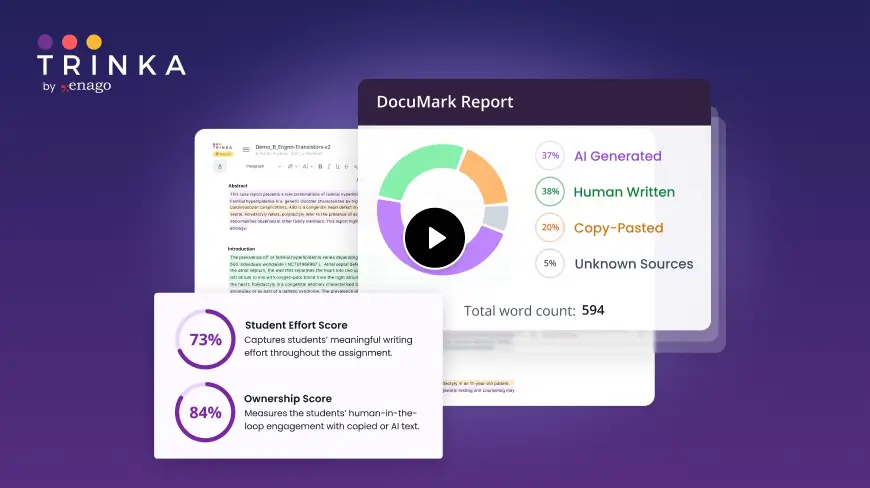
DocuMark: Responsible AI Use for Academic Integrity
Knowing your institution's AI policy is step one. DocuMark helps enforce it fairly by empowering universities to manage AI-generated content, prevent cheating, and support student writing through responsible AI use.
Common Questions About Anglia Ruskin University's AI Policies
Anglia Ruskin University has defined AI policies in 8 of 12 categories, with an overall coverage score of 67%.
The university requires students to acknowledge any permitted use of generative AI in their work. It directs students to cite and reference AI outputs using ARU's guidance and states that acknowledgement should be included whenever AI has been used to support learning or generate ideas.
Undisclosed or unauthorised AI use in assessed work may be handled as academic misconduct. The policy says students are liable to an academic misconduct finding or academic offence where AI-generated content is submitted as their own or used without permission in assessment. The academic regulations classify such conduct under collusion and assign penalties through the university's academic offence procedures.
The university requires that AI be adopted in a secure, ethical, and legally compliant way and says users must protect privacy, data, and intellectual property. It also states that human oversight remains essential and that AI should augment rather than replace human judgment. The provided sources do not identify specific approved platforms or a formal data-classification scheme.