Teaching & Learning
- Use of unauthorized material, information, electronic devices, or study aids in assessments is prohibited unless the instructor gives permission
- The college also states that it provided online exam proctoring through Honorlock, which includes artificial intelligence and academic integrity support
B. Cheating is using or attempting to use unauthorized material, information, electronic devices or study aids in an academic exercise, assignment or assessment without the instructor’s permission.
• Provided online exam proctoring through Honorlock®, which incorporates artificial intelligence and academic integrity
support
- It also requires regular and substantive interaction by faculty and instructional staff in distance education courses
- The college does not define a student AI study-assistance policy, but its online instruction guidance states that faculty are experimenting with artificial intelligence to help students learn
As we experiment with the wonderful possibilities of artificial intelligence to help our students learn, this is a reminder to keep the USDE’s guidance around regular and substantive interaction in mind. As you will see below, it is required, for student success as well as federal financial aid eligibility that faculty and instructional staff members regularly and substantially interact with students in their distance education courses.
The U.S. Department of Education emphasizes the importance of regular and substantive interaction in distance education courses. This interaction ensures that students receive meaningful engagement and support in online learning environments. Compliance with these requirements is essential for federal financial aid eligibility.
Research
Academic Integrity
- Students found responsible may face discipline up to dismissal or revocation of a credential
- Separately, the college states that it has provided Honorlock for online exam proctoring, which incorporates artificial intelligence and academic integrity support
- Suspected academic misconduct may be reported by faculty, staff, students, or third parties, and the college investigates and determines responsibility under its procedures
A. Any faculty, staff, student or third party who suspects a student or former student has committed academic misconduct may submit a report to the college in accordance with the procedures.
B. A student or former student who is found responsible for academic misconduct may be disciplined, up to and including dismissal from the college or revocation of a credential in accordance with the procedures.
C. Upon receipt of a report, the college will conduct an investigation and make a determination as to whether the student or former student is responsible for academic misconduct in accordance with the procedures.
The board of trustees hereby authorizes the president (or designee) to develop, maintain and keep current appropriate procedures to implement and enforce this policy.
• Provided online exam proctoring through Honorlock®, which incorporates artificial intelligence and academic integrity
support
Institutional & Administrative
- Faculty and instructional staff may experiment with artificial intelligence to help students learn, but distance education courses still require regular and substantive human interaction
- The guidance specifically requires faculty and instructional staff to interact regularly and substantially with students, and substantive interaction includes direct instruction, feedback on coursework, responding to content questions, facilitating discussions, or other accreditor-approved activities
As we experiment with the wonderful possibilities of artificial intelligence to help our students learn, this is a reminder to keep the USDE’s guidance around regular and substantive interaction in mind. As you will see below, it is required, for student success as well as federal financial aid eligibility that faculty and instructional staff members regularly and substantially interact with students in their distance education courses.
Substantive interaction is engaging students in teaching, learning, and assessment, consistent with the content under discussion. It must include at least two of five components:
* Providing direct instruction = “live synchronous instruction where both the instructor and the student are online and in communication at the same time.”
* Assessing or providing feedback on a student’s coursework
* Providing information or responding to questions about the content of a course or competency
* Facilitating a group discussion regarding the content of a course or competency
* Other instructional activities are approved by the institution’s or program’s accrediting agency
- AACC has an institutional strategy for the innovative and responsible adoption of artificial intelligence
- The board minutes also describe a phased process of discovery and analysis, research and development, recommendations, and long-term implementation
- The strategy is described as collaborative, values-based, ethical, and mission-aligned, with broad campus participation and focus areas that include pedagogy, digital literacy, academic integrity, AI infrastructure, information security, analytics, and governance
Dr. Millner and Dr. Kralevich presented AI at AACC, the College’s institutional strategy for the innovative and responsible adoption of artificial intelligence. They explained that the initiative reflected a collaborative, values-based approach to positioning AACC as a leader in leveraging AI to better serve its students and community, emphasizing the urgency for community colleges to prioritize AI given the needs of working adults, first-generation students, and career changers.
They noted that AI presents both opportunities and risks and reaffirmed AACC’s commitment to a thoughtful, ethical, and mission-aligned approach.
They outlined a comprehensive strategy that builds on existing AI-related work across the College, organized into two tracks, Academic Innovation and Technology Transformation, with broad campus participation. Key focus areas include pedagogy, digital literacy, academic integrity, AI infrastructure, information security, analytics, and governance. They described a phased approach beginning with discovery and analysis, followed by research and development, recommendations, and long-term implementation.
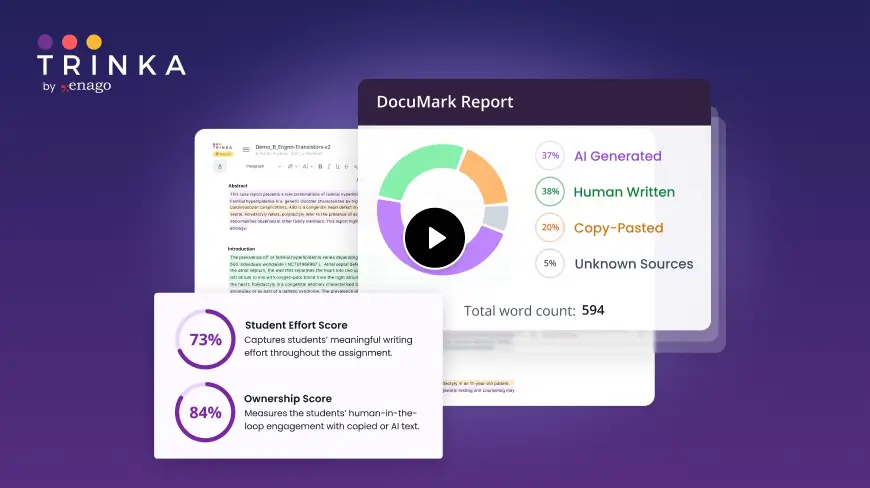
DocuMark: Responsible AI Use for Academic Integrity
Knowing your institution's AI policy is step one. DocuMark helps enforce it fairly by empowering universities to manage AI-generated content, prevent cheating, and support student writing through responsible AI use.
Common Questions About Anne Arundel Community College's AI Policies
Anne Arundel Community College has defined AI policies in 5 of 12 categories, with an overall coverage score of 42%.
No explicit disclosure requirement is currently defined in the available policy sources.
Suspected academic misconduct may be reported by faculty, staff, students, or third parties, and the college investigates and determines responsibility under its procedures. Students found responsible may face discipline up to dismissal or revocation of a credential. Separately, the college states that it has provided Honorlock for online exam proctoring, which incorporates artificial intelligence and academic integrity support.
No explicit data protection or approved AI platform policy is currently defined in the available policy sources.