Teaching & Learning
- Antioch’s Couple and Family Therapy program permits students to use AI in academic work if they follow program guidelines
- In the PsyD program, AI use in graduate coursework requires full transparency and advance agreement or approval from faculty
- The work submitted must remain the student’s own, AI-generated content cannot be copied directly or used without attribution, and misuse can trigger academic sanctions
Students are permitted to use AI technologies to assist with their academic work, provided that they abide by the following guidelines:
○ Responsible Use of AI: AI can be a powerful tool for generating ideas, streamlining workflows, and facilitating research. However, any content generated by AI should be used as a guide or reference rather than a source for direct quotations or unattributed ideas. Essentially, AI can provide the starting point for your work, but the final product should be your own.
○ Maintain Academic Integrity: While AI can assist in generating content, students must still do their own work. This means synthesizing information, developing their own arguments, and writing their own prose. Directly copying and pasting content generated by AI into academic work without attribution is considered plagiarism.
Non-compliance with these guidelines could result in consequences as outlined in the program's academic integrity policy, which may include academic sanctions, up to and including dismissal from the program.
generate course work, and dissertation research and writing must always take place with full transparency. This includes transparency between students and their dissertation supervisors who must agree, in advance, how any generative AI tools will be used;
Unauthorized use of generative AI tools for scholarly work in the AUS PsyD program may be considered an offense under Antioch University’s 6.105 Student Academic Integrity Policy on Violations of Academic Integrity; specifically, 2. Falsification and 3. Cheating/Unauthorized Use of Resources.
- This is presented as permitted support for student learning, alongside guidance that students should understand AI’s limits and critically evaluate its outputs
- Antioch’s Couple and Family Therapy program explicitly recognizes AI as a learning aid that can support personalized learning and help students understand complex concepts
AI tools such as ChatGPT can support this mission in various ways:
● Empowering Students with Knowledge: AI can serve as a powerful learning aid, supplementing traditional teaching methods and providing personalized learning experiences. It can help students assimilate complex concepts more effectively and allow them to explore areas of interest in greater depth.
○ Awareness and Understanding: Before utilizing any AI tool, students should understand the capabilities and limitations of the technology, how it works, and the source of its information.
This includes understanding that AI technology, at its current state, may generate false or misleading information.
Research
- AI use in drafting must be disclosed and cited, AI cannot be listed as an author, and readers must be told which tools were used and how
- The CFT program also allows AI to support research-related work if it is acknowledged and the final written product remains the student’s own
- In the AUS PsyD program, generative AI may be used in research and dissertation writing only with advance agreement or approval from supervisors, instructors, and/or the dissertation committee, and with full transparency
This guidance will be updated as higher education learns more about the impact of generative AI on academic work. The guidance below outlines important considerations for PsyD students, professors, supervisors, and dissertation committee members on the use of generative AI tools (such as ChatGPT) in graduate student research and dissertation writing. The guidance covers requirements both for approval and for documentation of the use of generative AI tools in course projects and dissertation research and writing.
generate course work, and dissertation research and writing must always take place with full transparency. This includes transparency between students and their dissertation supervisors who must agree, in advance, how any generative AI tools will be used; as well as transparency between PsyD students and the audiences of their work, who must be provided a clear and complete description and citation of any use of generative AI tools in creating the scholarly work
“When a generative artificial intelligence (AI) model is used in the drafting of a manuscript for an APA publication, the use of AI must be disclosed in the methods section and cited.
• AI cannot be named as an author on an APA scholarly publication.
If students wish to use generative AI tools in a written course project or dissertation, this must be done with the prior approval of the course instructor and/or dissertation committee. Careful attention must be paid to appropriately cite and describe any use of generative AI tools in the research or writing process. It must be clear to the reader which generative AI tools were used, as well as how and why they were used.
○ Citation of AI: While the AI itself is not an author, it is a tool that can assist in the process of knowledge creation. If a student uses AI to assist with their work, it should be acknowledged.
- Antioch’s CFT program states that AI can be used to facilitate research and analyze social, economic, and environmental data, but students must independently verify facts, data, and references and should not rely on AI instead of traditional research methods
- In the AUS PsyD program, using third-party generative AI tools with research data raises privacy and security risks; students must not input identifiable participant data or confidential information, and sensitive-data processing requires documented permission such as IRB approval
● Advancing Social Justice: AI can assist in identifying and analyzing patterns in social data, which can provide critical insights into areas of social inequality and injustice. This knowledge can be used to inform and drive research aimed at social justice.
● Promoting Economic and Environmental Justice: AI can help students understand and address complex economic and environmental issues. It can be used to analyze economic trends and understand the impact of human activities on the environment
○ Verify AI-Generated Content: Always cross-check any facts, data, or references generated by AI tools. Remember that AI systems are not infallible and their suggestions should not be accepted without critical evaluation.
■ Independent Research: AI tools should not replace traditional methods of research. Students are encouraged to use library resources, academic databases, and other reputable sources for research.
If students are working with research participant data, using third-party generative AI tools to process the data may come with additional privacy and security risks. For example, students working with data from human research participants must not submit any personal or identifying participant information, nor any information that could be used to re identify an individual or group of participants to third-party generative AI tools, as these data may then become available to others, constituting a major breach of research participant privacy. Similarly, students working with other types of confidential information, such as information disclosed as part of an industry partnership, must not submit these data to third- party generative AI tools, as this could breach non-disclosure terms in an agreement.
Students wishing to use generative AI tools for processing such data must have documented appropriate permissions to do so, for example, explicit approval from the Institutional Review Board.
- Antioch ties AI use in research to academic and research integrity requirements
- The PsyD handbook also requires protection of participant privacy and documented permission for sensitive data processing with AI tools
- In the AUS PsyD program, unauthorized AI use in scholarly work may be treated as an academic integrity violation, and AI use must be transparent, approved in advance, and aligned with APA guidance
PsyD graduate students and faculty supervisors are expected to strive for the highest standards of academic quality and research integrity in all scholarly activities, and therefore the use of generative AI tools in the process of graduate course work, and dissertation research and writing must always take place with full transparency.
Unauthorized use of generative AI tools for scholarly work in the AUS PsyD program may be considered an offense under Antioch University’s 6.105 Student Academic Integrity Policy on Violations of Academic Integrity; specifically, 2. Falsification and 3. Cheating/Unauthorized Use of Resources.
“When a generative artificial intelligence (AI) model is used in the drafting of a manuscript for an APA publication, the use of AI must be disclosed in the methods section and cited.
• AI cannot be named as an author on an APA scholarly publication.
Students wishing to use generative AI tools for processing such data must have documented appropriate permissions to do so, for example, explicit approval from the Institutional Review Board.
Academic Integrity
- Antioch also states AI cannot be named as an author in APA scholarly publication
- Antioch requires disclosure and acknowledgment of AI use in the programs that address it
- The AUS PsyD program requires a clear and complete description and citation of generative AI use, including disclosure in the methods section for APA publications, while the CFT program says AI assistance should be acknowledged and provides a sample citation approach
who must be provided a clear and complete description and citation of any use of generative AI tools in creating the scholarly work
“When a generative artificial intelligence (AI) model is used in the drafting of a manuscript for an APA publication, the use of AI must be disclosed in the methods section and cited.
• AI cannot be named as an author on an APA scholarly publication.
Careful attention must be paid to appropriately cite and describe any use of generative AI tools in the research or writing process. It must be clear to the reader which generative AI tools were used, as well as how and why they were used.
○ Citation of AI: While the AI itself is not an author, it is a tool that can assist in the process of knowledge creation. If a student uses AI to assist with their work, it should be acknowledged.
Here is an example of how a student might appropriately cite the use of an AI tool like ChatGPT:
In the formulation of my research hypothesis, I utilized OpenAI's language model, ChatGPT, as a brainstorming tool to generate ideas. The final research hypothesis was developed independently, based on my critical evaluation and synthesis of the AI-generated ideas and my own research.
- Directly copying AI output without attribution is identified as plagiarism in the CFT program
- Antioch’s materials do not define a stance on AI detection tools, but they do define enforcement consequences for misuse
- The AUS PsyD program says unauthorized AI use may be treated as a violation under the Student Academic Integrity Policy, and the CFT program says non-compliance may lead to academic sanctions up to dismissal
Unauthorized use of generative AI tools for scholarly work in the AUS PsyD program may be considered an offense under Antioch University’s 6.105 Student Academic Integrity Policy on Violations of Academic Integrity; specifically, 2. Falsification and 3. Cheating/Unauthorized Use of Resources.
Directly copying and pasting content generated by AI into academic work without attribution is considered plagiarism.
Non-compliance with these guidelines could result in consequences as outlined in the program's academic integrity policy, which may include academic sanctions, up to and including dismissal from the program.
Institutional & Administrative
- Antioch states that faculty will determine acceptable AI use for assignments in their specific courses
- The AUS PsyD dissertation guidance also applies to professors, supervisors, and dissertation committee members, and requires advance agreement with students about how generative AI will be used in scholarly work
Faculty will advise the acceptable use of AI for their assignments in their specific courses, taking into consideration ethical and academic standards and program requirements.
The guidance below outlines important considerations for PsyD students, professors, supervisors, and dissertation committee members on the use of generative AI tools (such as ChatGPT) in graduate student research and dissertation writing.
This includes transparency between students and their dissertation supervisors who must agree, in advance, how any generative AI tools will be used;
- Antioch restricts the use of AI tools with sensitive data
- No approved platform list is stated in the provided sources
- The AUS PsyD program prohibits submitting identifying participant data or other confidential information to third-party generative AI tools unless there is documented permission such as IRB approval, and the CFT program expressly prohibits entering PHI into any AI tool, with possible severe disciplinary action for violations
students working with data from human research participants must not submit any personal or identifying participant information, nor any information that could be used to re identify an individual or group of participants to third-party generative AI tools, as these data may then become available to others, constituting a major breach of research participant privacy. Similarly, students working with other types of confidential information, such as information disclosed as part of an industry partnership, must not submit these data to third- party generative AI tools, as this could breach non-disclosure terms in an agreement.
Students wishing to use generative AI tools for processing such data must have documented appropriate permissions to do so, for example, explicit approval from the Institutional Review Board.
○ Protection of Personal Health Information: The safeguarding of personal health information (PHI) is of paramount importance in clinical practice. Students are expressly prohibited from entering any PHI, including client-related information, into any AI tool. This is a critical mandate in maintaining compliance with Health Insurance Portability and Accountability Act (HIPAA) regulations. Violation of this directive may result in severe disciplinary action.
- Antioch states that an Artificial Intelligence Taskforce drafted an institutional AI policy
- The policy is described as establishing the university’s commitment to ethical, responsible, and non-discriminatory AI use across governance, operations, pedagogy, and academic integrity, grounded in values of equity, transparency, and academic excellence
Antioch University Artificial Intelligence (AI) Taskforce has drafted the AU Institutional AI Policy that establishes Antioch University’s commitment to the ethical, responsible, and non-discriminatory use of Artificial Intelligence (AI) across governance, operations, pedagogy, and academic integrity. It aims to harness AI’s potential while upholding Antiohc’s values of equity, transparency, and academic excellence.
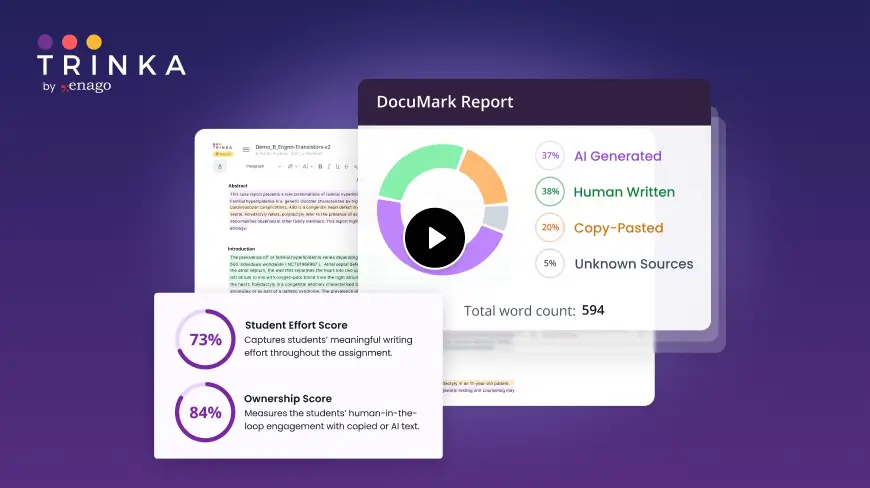
DocuMark: Responsible AI Use for Academic Integrity
Knowing your institution's AI policy is step one. DocuMark helps enforce it fairly by empowering universities to manage AI-generated content, prevent cheating, and support student writing through responsible AI use.
Common Questions About Antioch University - Seattle's AI Policies
Antioch University - Seattle has defined AI policies in 10 of 12 categories, with an overall coverage score of 83%.
Antioch requires disclosure and acknowledgment of AI use in the programs that address it. The AUS PsyD program requires a clear and complete description and citation of generative AI use, including disclosure in the methods section for APA publications, while the CFT program says AI assistance should be acknowledged and provides a sample citation approach. Antioch also states AI cannot be named as an author in APA scholarly publication.
Antioch’s materials do not define a stance on AI detection tools, but they do define enforcement consequences for misuse. The AUS PsyD program says unauthorized AI use may be treated as a violation under the Student Academic Integrity Policy, and the CFT program says non-compliance may lead to academic sanctions up to dismissal. Directly copying AI output without attribution is identified as plagiarism in the CFT program.
Antioch restricts the use of AI tools with sensitive data. The AUS PsyD program prohibits submitting identifying participant data or other confidential information to third-party generative AI tools unless there is documented permission such as IRB approval, and the CFT program expressly prohibits entering PHI into any AI tool, with possible severe disciplinary action for violations. No approved platform list is stated in the provided sources.