Teaching & Learning
- Course-level policy is set by instructors rather than by a single university-wide rule
- The syllabus guidance also recommends that instructors may prohibit AI when writing itself is central to learning
- Students are told to check the syllabus before using AI in assignments, and faculty are expected to define how and when AI may be used in their classes
Students are expected to abide by the Academic Integrity Code.
Faculty are asked to communicate clear expectations to students on generative AI use in their courses.
* Check course policies – Instructors may have specific rules on AI use, always review the course syllabus before incorporating AI into assignments.
● Guideline 1: Be proactive in clearly defining how and when students can use AI in your class, including why it may be appropriate in some instances and why it is not appropriate in others. Include this guidance in your syllabus and discuss it with your class at the start of the semester.
● Guideline 1: Writing to learn is an intellectual activity that is crucial to the cognitive and social development of learners and writers. You should consider not permitting the use of AI for those in-class and homework activities in which the act of writing is central to student learning.
- The university does not set a single blanket rule for AI use in exams and assessments
- Faculty are also advised to disclose any intended use of AI in assessing student work
- Instead, faculty are asked to state course expectations, and the syllabus guidance includes sample policies ranging from permissive to restrictive, including examples that allow AI for assessments and examples where use is disallowed unless otherwise stated
Faculty are asked to communicate clear expectations to students on generative AI use in their courses.
● Guideline 3: Disclose any intended use of AI in the assessment of student work and ask students to opt in or out to having their work added to a public database in this way.
● “This course encourages students to explore the use of generative artificial intelligence (GAI) tools such as ChatGPT for all assignments and assessments. Any such use must be appropriately acknowledged and cited.
● “Certain assignments in this course will permit or even encourage the use of generative artificial intelligence (GAI) tools such as ChatGPT. The default is that such use is disallowed unless otherwise stated.
- The student guidance frames these uses as study support, while still requiring responsible use, source verification, and adherence to course policies and academic standards
- AI is permitted and actively recommended for non-graded learning support such as study guides, tutoring-style review, practice questions, flashcards, mnemonics, and study planning
Using AI responsibly in research, writing and other academic areas requires a commitment to transparency, accuracy and adherence to academic standards and policies.
* Check course policies – Instructors may have specific rules on AI use, always review the course syllabus before incorporating AI into assignments.
### AI as a Study Partner
* Generate practice questions: Use your sources to organize notes, generate flashcards and create detailed study guides.
* Create interactive study sessions: Have AI quiz you conversationally, like a tutor, by asking follow-up questions and encouraging you to explain concepts in your own words.
* Generate mnemonics and memory aids: Create acronyms, rhymes or memory techniques to help you retain information.
* Time management and study plans: Organize your study schedule, break down topics into manageable chunks and suggest efficient study techniques based on your learning style.
Research
- Student guidance also states that AI-generated content used in writing must be cited properly
- The university allows AI use in university-related research and scholarship if its use is clearly documented and disclosed, and if the output is thoroughly reviewed by a human before use
The use of generative AI for any university-related research, scholarship or work, should be clearly documented and disclosed.
Generative AI-produced content may be biased, inaccurate, completely fabricated or contain copyright-protected or proprietary information, therefore requiring thorough human review prior to use.
Using AI responsibly in research, writing and other academic areas requires a commitment to transparency, accuracy and adherence to academic standards and policies.
* Verify and Cite Sources – AI can help locate sources, but always verify them for accuracy and credibility. If AI-generated content is used, it must be cited properly.
- The university also warns that third-party AI systems collect, analyze, and store entered data
- AI may be used with university information only when the tool has completed internal review and contract protections are in place
- Public or published university information may be used with AI tools, but sensitive or confidential information, including student records, health information, and proprietary information, must not be used with any AI tools
Faculty, students and staff may use university information with generative AI tools or services only when:
* The AI tool or service being used has undergone appropriate internal reviews and contract terms are in place to protect data assets.
Any data entered into third-party AI systems is collected, analyzed and stored in that system which raises concerns about surveillance, data privacy and security risks.
* Public or published data: Data that is publicly available or published university information, as defined by the App State Data Classification standards, can be used with AI tools.
* Sensitive information: Student records subject to FERPA, health information, proprietary information and any other data classified as confidential must not be used with any AI tools.
- The research guidelines page also points researchers to external agency policies, including NIH and NSF guidance for review processes
- For university-related research and scholarship, AI use should be clearly documented and disclosed, and outputs require human review before use
- The university directs researchers to follow ethical and legal standards, especially regarding privacy, consent, ownership, and academic integrity, and refers them to Office of Research and Innovation guidance
Adhere to ethical and legal standards and norms of the disciplines and the university, with regard to data privacy, consent, ownership and academic integrity. The Office of Research and Innovation has published guidelines to help researchers navigate the laws, rules and policies governing research.
The use of generative AI for any university-related research, scholarship or work, should be clearly documented and disclosed.
Generative AI-produced content may be biased, inaccurate, completely fabricated or contain copyright-protected or proprietary information, therefore requiring thorough human review prior to use.
The following resources may be helpful to Appalachian State researchers seeking guidance on the use of generative artificial intelligence (AI) in research and grants.
* The Use of Generative Artificial Intelligence Technologies is Prohibited for the NIH Peer Review Process (released June 23, 2023)
* Use of Generative AI in the NSF Merit Review Process (released Dec. 14, 2023)
Academic Integrity
- The university also links researchers to major style guides for citing generative AI
- Disclosure and citation are expected when AI is used in university-related research, scholarship, or work
- Student guidance says AI-generated content must be cited properly, and the syllabus guidance recommends acknowledgment and citation in courses that permit AI use
The use of generative AI for any university-related research, scholarship or work, should be clearly documented and disclosed.
* Verify and Cite Sources – AI can help locate sources, but always verify them for accuracy and credibility. If AI-generated content is used, it must be cited properly.
● “This course encourages students to explore the use of generative artificial intelligence (GAI) tools such as ChatGPT for all assignments and assessments. Any such use must be appropriately acknowledged and cited.
● “Certain assignments in this course will permit or even encourage the use of generative artificial intelligence (GAI) tools such as ChatGPT. The default is that such use is disallowed unless otherwise stated. Any such use must be appropriately acknowledged and cited.
## How to Cite Generative AI
#### American Psychological Association (APA)
#### Chicago Manual of Style
#### MLA Style
- Undisclosed or unauthorized AI use is enforced through existing academic integrity rules rather than a standalone AI misconduct code
- The research resources page links out to AI detection and plagiarism resources but does not establish a university AI detection rule
- The syllabus guidance advises faculty to address suspected inappropriate AI use collaboratively rather than punitively in tone, but violations can still be treated as academic misconduct
Students are expected to abide by the Academic Integrity Code.
Cheating. Using, attempting to use, or giving unauthorized assistance or materials in an effort to gain academic advantage.
Plagiarism. Presenting the words or ideas of another as one’s own words or ideas.
● Guideline 1: If you suspect a student may have used AI inappropriately, address these issues/questions from a collegial and collaborative perspective instead of an adversarial or combative perspective. Do not use an accusatory/punitive tone in these conversations, but rather focus on how, when, and why students should use AI
Violations of this policy will be considered academic misconduct.
In addition to citation guidance, Scribbr also offers plagiarism and AI detection
Institutional & Administrative
- Faculty are also advised to disclose any intended AI use in assessing student work
- Faculty and staff are permitted to use AI for teaching preparation, student support, communications, and administrative efficiency
- Faculty examples include creating tailored feedback, brainstorming quizzes and assignments, and drafting communications; staff examples include drafting and summarizing emails, transcribing meeting notes, automating data entry, drafting policy documents, and summarizing reports
Teaching and Learning
* Personalized learning: Create tailored content, feedback and guidance for students based on their individual needs and learning styles.
* Content creation: Brainstorm materials such as quizzes, rubrics and assignments.
* Communication: Draft emails, announcements, event promotion and other communications.
● Guideline 3: Disclose any intended use of AI in the assessment of student work and ask students to opt in or out to having their work added to a public database in this way.
AI is transforming how we manage workflows, communicate and make decisions. Whether streamlining administrative processes, enhancing collaboration or supporting professional growth, AI can help staff work more efficiently while improving services and operations across the university.
AI can be used to draft and summarize emails, transcribe meeting notes and automate data entry. Creating reports, drafting policy documents and organizing information more efficiently, allowing staff to focus on high-priority tasks.
- Free or non-App State-managed versions of tools such as ChatGPT are explicitly identified as unauthorized when they lack a university contract or data-sharing controls
- Public or published university information may be used with AI tools, but sensitive or confidential information must not be entered into unapproved systems and, in some cases, must not be used with any AI tools
- The university requires use of reviewed and contracted AI tools for university information and maintains approved tool lists with categories such as university-provided, available upon request, and approved but not supported
Faculty, students and staff may use university information with generative AI tools or services only when:
* The AI tool or service being used has undergone appropriate internal reviews and contract terms are in place to protect data assets.
ITS strives to thoroughly vet and approve AI tools for university use based on data privacy and protection measures, including:
* Secure handling and storage: When using AI tools, personal and institutional data should be securely managed and not shared with third parties.
* Data retention: When prompts, responses or uploaded files are submitted to an AI tool, they may be copied or retained by the LLM provider. ITS encourages the use of tools that do not use university data to train public models.
Reminder: Even with these precautions, data privacy and security remain paramount. Do not enter sensitive or confidential information into any AI chat interface that has not been approved for use with sensitive or confidential data.
* Unauthorized AI tools: Tools that lack a university contract, lack appropriate data-sharing controls. This includes free or non-App State-managed versions of AI tools like ChatGPT.
* Sensitive information: Student records subject to FERPA, health information, proprietary information and any other data classified as confidential must not be used with any AI tools.
These lists include AI tools that have been reviewed and are currently available for use in one of the following ways:
* As a university-provided and supported tool
* As a university-provided tool available upon request
* Other university-approved, but not supported tools
- The AI Hub is also described as a living site that will continue to evolve as university work on AI progresses
- Appalachian State has a formal AI governance structure centered on the Chancellor’s Artificial Intelligence Task Force and other AI advisory groups
- The task force is cross-divisional and is charged with assessing AI’s role across teaching, research, service, and administrative operations, while developing strategic guidance and recommendations for responsible use and stronger safeguards for security and privacy
Welcome to the AI Hub for App State, a centralized location for AI tools, training and resources to support teaching and learning, research and administrative work for students, faculty and staff. This is a living site, which means we will be continuously updating and evolving to respond to user needs and changing information.
The Chancellor’s Artificial Intelligence Task Force (AITF) is a cross-divisional team committed to assessing the evolving role of AI in teaching, research, service and administrative operations at Appalachian State University.
Chaired by Chief Information Officer Keith Werner, the AITF will develop strategic guidance and recommendations for the responsible use of AI across campus while enhancing safeguards for institutional security and individual privacy.
The Chief Information Officer serves as the Chair of the AITF. Existing AI advisory groups, notably the Provost's AI Task Force, are actively engaged in investigating the responsible use of AI. Academic Affairs also currently has AI advisory groups for respective divisions. These, and other advisory groups as they are developed, will inform the AITF.
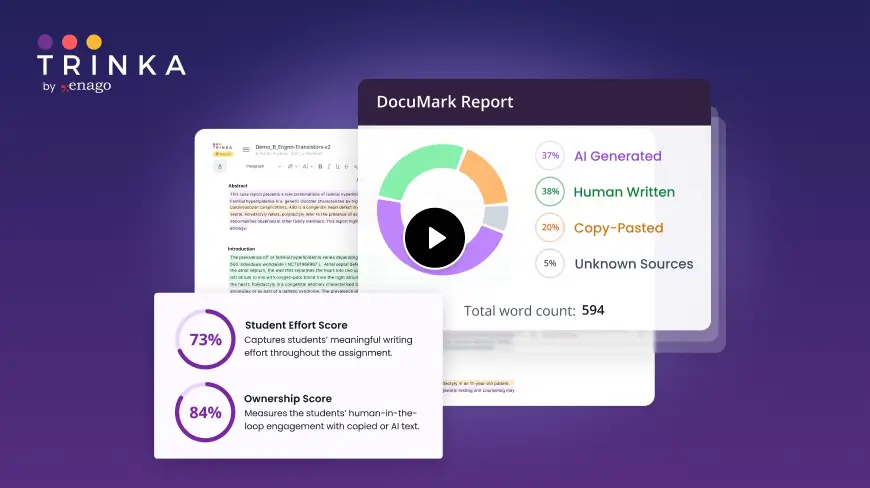
DocuMark: Responsible AI Use for Academic Integrity
Knowing your institution's AI policy is step one. DocuMark helps enforce it fairly by empowering universities to manage AI-generated content, prevent cheating, and support student writing through responsible AI use.
Common Questions About Appalachian State University's AI Policies
Appalachian State University has defined AI policies in 11 of 12 categories, with an overall coverage score of 92%.
Disclosure and citation are expected when AI is used in university-related research, scholarship, or work. Student guidance says AI-generated content must be cited properly, and the syllabus guidance recommends acknowledgment and citation in courses that permit AI use. The university also links researchers to major style guides for citing generative AI.
Undisclosed or unauthorized AI use is enforced through existing academic integrity rules rather than a standalone AI misconduct code. The syllabus guidance advises faculty to address suspected inappropriate AI use collaboratively rather than punitively in tone, but violations can still be treated as academic misconduct. The research resources page links out to AI detection and plagiarism resources but does not establish a university AI detection rule.
The university requires use of reviewed and contracted AI tools for university information and maintains approved tool lists with categories such as university-provided, available upon request, and approved but not supported. Public or published university information may be used with AI tools, but sensitive or confidential information must not be entered into unapproved systems and, in some cases, must not be used with any AI tools. Free or non-App State-managed versions of tools such as ChatGPT are explicitly identified as unauthorized when they lack a university contract or data-sharing controls.