Teaching & Learning
- University-wide student conduct policy treats unauthorized, undisclosed, or uncredited use of artificial intelligence on academic work as academic misconduct
- At the faculty guidance level, AI use on assignments is not governed by one uniform rule; faculty are encouraged to set course- and assignment-specific syllabus policies, and a program-level handbook for the PA program states that instructors may allow or disallow some or all uses
This includes the purchase or acquisition of papers from any source, as well as unauthorized, undisclosed use of artificial intelligence. For specific questions consult with the faculty member, but the following rules must be observed:
Collect observations, including numerical data, independently. Acknowledge a source if borrowing various words, ideas, phrases, or data from original sources and blending them with one's own. If instructors permit seeking assistance of other students or tools such as artificial intelligence on academic work, acknowledge the exact nature of the assistance in detail. This includes papers, laboratory work, and computer programs. It is forbidden to use a commercial writing service.
B. Attempting to give or to receive unauthorized assistance on academic work, and attempting to hinder others in their academic work. This includes unauthorized, uncredited use of artificial intelligence to create work claimed as your own.
Because generative AI has a range of uses and limitations which vary across disciplines, classroom environments, learning opportunities, and tasks, we recommend each faculty member consider AI uses and limitations in the context of each course. You might use AI liberally in one course, selectively in another, or not at all.
We encourage faculty to include a statement in each course syllabus explaining what AI uses are and are not permitted, as this could be different for each class. This may even vary among assignments; the syllabus is a way to communicate that to students.
Absent a clear statement from a course instructor, use of or consultation with generative AI shall be treated analogously to assistance from another person. In particular, using generative AI tools to substantially complete an assignment or exam (e.g. by entering exam or assignment questions) is not permitted.
Individual course instructors are free to set their own policies regulating the use of generative AI tools in their courses, including allowing or disallowing some or all uses of such tools. Course instructors should set such policies in their course syllabi and clearly communicate such policies to students.
- For examinations, assistance that is not approved by the instructor is prohibited under the general exam procedures
- In the PA program handbook, using generative AI tools to substantially complete an exam is expressly not permitted unless an instructor states otherwise
To eliminate suspicious behavior during any type of examination all sources of assistance not approved by the instructor are to be left in a designated location away from the testing area, except for those materials previously specified by the faculty member.
Absent a clear statement from a course instructor, use of or consultation with generative AI shall be treated analogously to assistance from another person. In particular, using generative AI tools to substantially complete an assignment or exam (e.g. by entering exam or assignment questions) is not permitted.
- The university does not set a single institution-wide rule for student study assistance with generative AI
- Faculty guidance says AI uses vary by course and instructors should specify permitted and prohibited uses in syllabi; the PA program handbook says, absent instructor guidance, consultation with generative AI is treated like assistance from another person and students should disclose non-incidental use
Because generative AI has a range of uses and limitations which vary across disciplines, classroom environments, learning opportunities, and tasks, we recommend each faculty member consider AI uses and limitations in the context of each course. You might use AI liberally in one course, selectively in another, or not at all.
We encourage faculty to include a statement in each course syllabus explaining what AI uses are and are not permitted, as this could be different for each class. This may even vary among assignments; the syllabus is a way to communicate that to students.
Absent a clear statement from a course instructor, use of or consultation with generative AI shall be treated analogously to assistance from another person.
Students should acknowledge the use of generative AI (other than incidental use) and default to disclosing such assistance when in doubt.
- AI use in programming work is addressed through the general academic integrity rules rather than a separate coding-specific AI policy
- If instructors permit AI assistance on computer programs, students must acknowledge the exact nature of that assistance in detail; unauthorized or uncredited AI use on work claimed as one's own is misconduct
Collect observations, including numerical data, independently. Acknowledge a source if borrowing various words, ideas, phrases, or data from original sources and blending them with one's own. If instructors permit seeking assistance of other students or tools such as artificial intelligence on academic work, acknowledge the exact nature of the assistance in detail. This includes papers, laboratory work, and computer programs. It is forbidden to use a commercial writing service.
B. Attempting to give or to receive unauthorized assistance on academic work, and attempting to hinder others in their academic work. This includes unauthorized, uncredited use of artificial intelligence to create work claimed as your own.
Research
Academic Integrity
- Arcadia requires acknowledgment when AI assistance is permitted on academic work
- The student handbook requires detailed acknowledgment of the exact nature of assistance, and the PA program handbook says students should acknowledge non-incidental generative AI use and default to disclosure when in doubt; faculty guidance also provides a sample citation format for courses that allow AI use with acknowledgment
The most general rule is that any use of words or ideas that are not your own, whether the source is published or not, should be acknowledged fully and in detail. Since disciplines show some differences on how this should be done, instructors should be consulted as to the form and nature of the acknowledgments required by each field.
Collect observations, including numerical data, independently. Acknowledge a source if borrowing various words, ideas, phrases, or data from original sources and blending them with one's own. If instructors permit seeking assistance of other students or tools such as artificial intelligence on academic work, acknowledge the exact nature of the assistance in detail. This includes papers, laboratory work, and computer programs. It is forbidden to use a commercial writing service.
Students should acknowledge the use of generative AI (other than incidental use) and default to disclosing such assistance when in doubt.
Students are allowed to use advanced automated tools (artificial intelligence or machine learning tools such as ChatGPT or Dall-E 2) on assignments in this course if that use is properly documented and credited. For example, text generated using ChatGPT-3 should include a citation such as: “Chat-GPT-3. (YYYY, Month DD of query). “Text of your query.” Generated using OpenAI. https://chat.openai.com/” Material generated using other tools should follow a similar citation convention.
- The provided sources do not mention AI detection tools
- Enforcement is handled through the university's academic integrity process: unauthorized, undisclosed, or uncredited AI use is treated as academic misconduct, faculty have final authority over course penalties in academic integrity cases, and additional sanctions may also apply
This includes the purchase or acquisition of papers from any source, as well as unauthorized, undisclosed use of artificial intelligence. For specific questions consult with the faculty member, but the following rules must be observed:
B. Attempting to give or to receive unauthorized assistance on academic work, and attempting to hinder others in their academic work. This includes unauthorized, uncredited use of artificial intelligence to create work claimed as your own.
If a student is found responsible for a violation of a University regulation, the Judicial Board shall impose one or a combination of the following sanctions or alternative sanctions when they seem appropriate. In every case concerning academic integrity, the faculty member has the final authority for determining penalties to be applied within the course. Sanctions applied by the Judicial Board that involve grades are advisory to the faculty member concerned.
In every case concerning academic integrity, the faculty member has the final authority for determining penalties to be applied within the course. Sanctions as called for in the procedures of the Judicial Board involving course grades are only advisory to the faculty member involved. The Judicial Board has authority to determine administrative sanctions.
Institutional & Administrative
- Faculty and staff are given guidance rather than a single mandatory institutional rule
- Arcadia recommends that faculty evaluate AI use in the context of each course and include syllabus statements explaining what uses are and are not permitted; no explicit policy in the provided sources addresses grading, recommendation letters, or administrative communications
Because generative AI has a range of uses and limitations which vary across disciplines, classroom environments, learning opportunities, and tasks, we recommend each faculty member consider AI uses and limitations in the context of each course. You might use AI liberally in one course, selectively in another, or not at all.
We encourage faculty to include a statement in each course syllabus explaining what AI uses are and are not permitted, as this could be different for each class. This may even vary among assignments; the syllabus is a way to communicate that to students.
Best practice would also communicate the reason for any use that you do or do not allow.
- The institutional position in the provided materials is primarily decentralized, with course-level decisions left to instructors
- Arcadia has published faculty/staff guidance and a library research guide on generative AI, but the provided sources do not state a formal university-wide AI governance framework, committee structure, or strategic roadmap
Because generative AI has a range of uses and limitations which vary across disciplines, classroom environments, learning opportunities, and tasks, we recommend each faculty member consider AI uses and limitations in the context of each course. You might use AI liberally in one course, selectively in another, or not at all.
We encourage faculty to include a statement in each course syllabus explaining what AI uses are and are not permitted, as this could be different for each class. This may even vary among assignments; the syllabus is a way to communicate that to students.
Generative AI in higher education is a new and evolving topic. New information, strategies, and concepts are emerging all the time. To learn more, you can read through UCLA’s comprehensive guide exploring many topics and facets of the discussion. Keep up with changes by attending webinars and other professional development opportunities, reading higher education publications such as The Chronicle, and talking with colleagues (and students!)
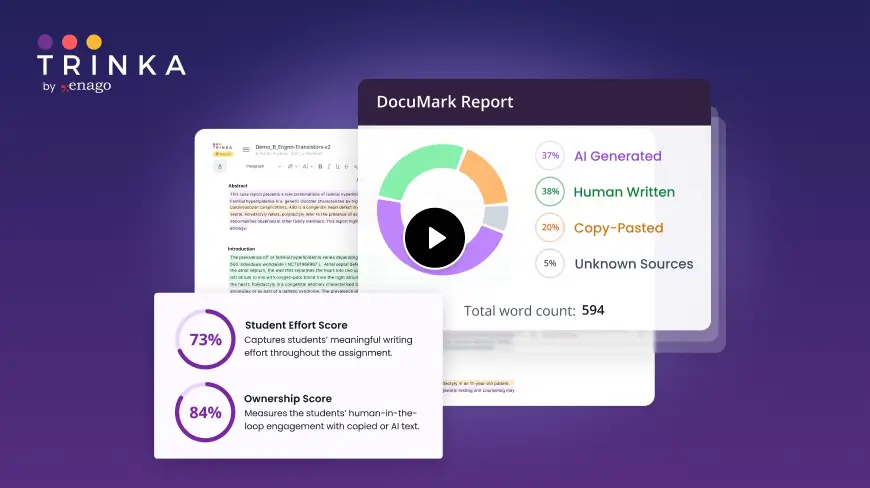
DocuMark: Responsible AI Use for Academic Integrity
Knowing your institution's AI policy is step one. DocuMark helps enforce it fairly by empowering universities to manage AI-generated content, prevent cheating, and support student writing through responsible AI use.
Common Questions About Arcadia College's AI Policies
Arcadia College has defined AI policies in 8 of 12 categories, with an overall coverage score of 67%.
Arcadia requires acknowledgment when AI assistance is permitted on academic work. The student handbook requires detailed acknowledgment of the exact nature of assistance, and the PA program handbook says students should acknowledge non-incidental generative AI use and default to disclosure when in doubt; faculty guidance also provides a sample citation format for courses that allow AI use with acknowledgment.
The provided sources do not mention AI detection tools. Enforcement is handled through the university's academic integrity process: unauthorized, undisclosed, or uncredited AI use is treated as academic misconduct, faculty have final authority over course penalties in academic integrity cases, and additional sanctions may also apply.
No explicit data protection or approved AI platform policy is currently defined in the available policy sources.