Teaching & Learning
- Arcadia does not set one university-wide rule for all coursework
- In the PA Program, absent instructor guidance, using generative AI to substantially complete an assignment is not permitted
- Faculty are encouraged to set course- and assignment-specific AI rules in the syllabus, and unauthorized or undisclosed AI use on written work is treated as plagiarism or academic misconduct
Because generative AI has a range of uses and limitations which vary across disciplines, classroom environments, learning opportunities, and tasks, we recommend each faculty member consider AI uses and limitations in the context of each course. You might use AI liberally in one course, selectively in another, or not at all.
We encourage faculty to include a statement in each course syllabus explaining what AI uses are and are not permitted, as this could be different for each class. This may even vary among assignments; the syllabus is a way to communicate that to students.
It is important to communicate to students that you will hold them accountable for unauthorized uses of AI on class assignments. You might consider adding guidance to your syllabus, such as:
“Use of artificial intelligence or machine learning tools to produce or assist with content production without proper authorization and attribution is plagiarism and will be treated as a violation of Arcadia University’s Code of Academic Responsibility.”
This includes the purchase or acquisition of papers from any source, as well as unauthorized, undisclosed use of artificial intelligence. For specific questions consult with the faculty member, but the following rules must be observed:
Absent a clear statement from a course instructor, use of or consultation with generative AI shall be treated analogously to assistance from another person. In particular, using generative AI tools to substantially complete an assignment or exam (e.g. by entering exam or assignment questions) is not permitted.
Individual course instructors are free to set their own policies regulating the use of generative AI tools in their courses, including allowing or disallowing some or all uses of such tools. Course instructors should set such policies in their course syllabi and clearly communicate such policies to students.
- Use of AI in exams is prohibited unless the instructor has clearly authorized it
- The student handbook bars unapproved assistance during examinations, and the PA Program specifically says using generative AI to substantially complete an exam is not permitted unless an instructor states otherwise
To eliminate suspicious behavior during any type of examination all sources of assistance not approved by the instructor are to be left in a designated location away from the testing area, except for those materials previously specified by the faculty member.
Absent a clear statement from a course instructor, use of or consultation with generative AI shall be treated analogously to assistance from another person. In particular, using generative AI tools to substantially complete an assignment or exam (e.g. by entering exam or assignment questions) is not permitted.
Individual course instructors are free to set their own policies regulating the use of generative AI tools in their courses, including allowing or disallowing some or all uses of such tools.
- Arcadia's faculty guidance says AI use for learning support may be allowed, but this is left to each instructor and course context
- The guidance also states students remain responsible for guiding, verifying, and crafting their own work rather than copying AI output without understanding
Because generative AI has a range of uses and limitations which vary across disciplines, classroom environments, learning opportunities, and tasks, we recommend each faculty member consider AI uses and limitations in the context of each course. You might use AI liberally in one course, selectively in another, or not at all.
We encourage faculty to include a statement in each course syllabus explaining what AI uses are and are not permitted, as this could be different for each class. This may even vary among assignments; the syllabus is a way to communicate that to students.
Howard University School of Law professor Matthew Bruckner explains to students what tasks are acceptable and underscores the students’ responsibilities for ethical use: “Generative AI tools can be invaluable for generating ideas, identifying sources, synthesizing text, and starting to understand what is essential about a topic.
But YOU must guide, verify and craft your work product; do not just cut and paste without understanding.”
- Arcadia does not provide a separate university-wide coding-specific AI rule
- However, the student handbook requires acknowledgment when instructors permit AI assistance on academic work, and this requirement explicitly includes computer programs
If instructors permit seeking assistance of other students or tools such as artificial intelligence on academic work, acknowledge the exact nature of the assistance in detail. This includes papers, laboratory work, and computer programs.
Research
Academic Integrity
- The faculty guidance also provides a citation example for documented AI use, while the PA Program directs students to acknowledge non-incidental use and disclose it when in doubt
- Arcadia requires disclosure and attribution when AI assistance is used if the instructor permits it, and students should consult instructors about the form of acknowledgment required in a discipline
The most general rule is that any use of words or ideas that are not your own, whether the source is published or not, should be acknowledged fully and in detail. Since disciplines show some differences on how this should be done, instructors should be consulted as to the form and nature of the acknowledgments required by each field.
If instructors permit seeking assistance of other students or tools such as artificial intelligence on academic work, acknowledge the exact nature of the assistance in detail. This includes papers, laboratory work, and computer programs.
Students are allowed to use advanced automated tools (artificial intelligence or machine learning tools such as ChatGPT or Dall-E 2) on assignments in this course if that use is properly documented and credited. For example, text generated using ChatGPT-3 should include a citation such as: “Chat-GPT-3. (YYYY, Month DD of query). “Text of your query.” Generated using OpenAI. https://chat.openai.com/” Material generated using other tools should follow a similar citation convention.
Students should acknowledge the use of generative AI (other than incidental use) and default to disclosing such assistance when in doubt.
- The sources provided do not define a university policy on AI detection software
- Arcadia states that unauthorized, undisclosed, or uncredited AI use can constitute plagiarism or other academic misconduct and will be handled under the Code of Academic Responsibility
It is important to communicate to students that you will hold them accountable for unauthorized uses of AI on class assignments. You might consider adding guidance to your syllabus, such as:
“Use of artificial intelligence or machine learning tools to produce or assist with content production without proper authorization and attribution is plagiarism and will be treated as a violation of Arcadia University’s Code of Academic Responsibility.”
This includes the purchase or acquisition of papers from any source, as well as unauthorized, undisclosed use of artificial intelligence. For specific questions consult with the faculty member, but the following rules must be observed:
Attempting to give or to receive unauthorized assistance on academic work, and attempting to hinder others in their academic work. This includes unauthorized, uncredited use of artificial intelligence to create work claimed as your own.
Institutional & Administrative
- Arcadia provides guidance to faculty and staff rather than mandatory uniform operational rules
- Faculty are recommended to decide AI use by course context and to communicate permitted and prohibited uses in syllabi; the library guide also points faculty to sample policies and further learning resources
Because generative AI has a range of uses and limitations which vary across disciplines, classroom environments, learning opportunities, and tasks, we recommend each faculty member consider AI uses and limitations in the context of each course. You might use AI liberally in one course, selectively in another, or not at all.
We encourage faculty to include a statement in each course syllabus explaining what AI uses are and are not permitted, as this could be different for each class. This may even vary among assignments; the syllabus is a way to communicate that to students.
Temple University and Colorado State University both have brief guides that present a variety of sample syllabus language that could be useful in various classroom contexts. Lance Eaton has compiled what appears to be the most comprehensive collection of sample policies and syllabus language to date.
- The stated institutional approach in these sources is to support faculty judgment and ongoing learning as AI develops
- Arcadia frames generative AI as an evolving area and offers informational guidance and resource pages, but the provided sources do not establish a formal university-wide AI governance structure, committee, or strategic roadmap
The field is constantly developing, and new products and capabilities continue to emerge.
Because generative AI has a range of uses and limitations which vary across disciplines, classroom environments, learning opportunities, and tasks, we recommend each faculty member consider AI uses and limitations in the context of each course.
While constantly evolving, this guide can help you to get a sense of the opportunities, limitations, and risks generative AI brings with it in the context of higher education.
Generative AI in higher education is a new and evolving topic. New information, strategies, and concepts are emerging all the time.
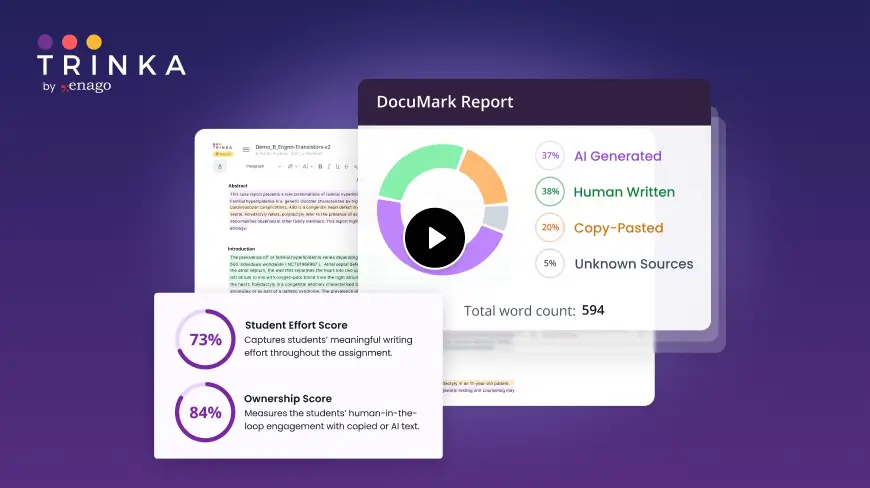
DocuMark: Responsible AI Use for Academic Integrity
Knowing your institution's AI policy is step one. DocuMark helps enforce it fairly by empowering universities to manage AI-generated content, prevent cheating, and support student writing through responsible AI use.
Common Questions About Arcadia University's AI Policies
Arcadia University has defined AI policies in 8 of 12 categories, with an overall coverage score of 67%.
Arcadia requires disclosure and attribution when AI assistance is used if the instructor permits it, and students should consult instructors about the form of acknowledgment required in a discipline. The faculty guidance also provides a citation example for documented AI use, while the PA Program directs students to acknowledge non-incidental use and disclose it when in doubt.
Arcadia states that unauthorized, undisclosed, or uncredited AI use can constitute plagiarism or other academic misconduct and will be handled under the Code of Academic Responsibility. The sources provided do not define a university policy on AI detection software.
No explicit data protection or approved AI platform policy is currently defined in the available policy sources.