Teaching & Learning
- Student use of generative AI in coursework and assignments is determined by the instructor
- Students must follow syllabus/assignment directions on whether AI is permitted and, if permitted, how it may be used and cited; using AI outside those permissions may be treated as an academic integrity violation
“Students should only use generative AI in their coursework as permitted by their instructor. Be sure to check your syllabus and assignment instructions to determine whether the use of generative AI is permitted and, if so, how it should be used and cited.”
- Using generative AI (or any other aid) on an examination or academic exercise when such aid has been restricted by the instructor is considered cheating under ASU’s academic integrity policy
“Examples of academic dishonesty include, but are not limited to... Cheating: Using or possessing unauthorized materials, information, or study aids in any academic exercise. This includes... obtaining aid on an examination or academic exercise that has been restricted by the instructor...”
- ASU encourages students to use generative AI to support learning and professional growth (e.g., creating study guides, practice quizzes, summarizing complex topics, refining writing), while being mindful of limitations and following course/instructor rules for graded work
“Students can use generative AI in many ways to support their learning and professional growth, from generating study guides and practice quizzes to summarizing complex topics and refining their writing.”
- Use of generative AI for code generation and programming assignments is at the instructor’s discretion; students must follow the syllabus/assignment rules on whether AI is permitted and, if permitted, how it must be used and cited
“Students should only use generative AI in their coursework as permitted by their instructor. Be sure to check your syllabus and assignment instructions to determine whether the use of generative AI is permitted and, if so, how it should be used and cited.”
Research
- ASU researchers must be transparent about the use of generative AI in research and disclose its use in publications, presentations, and other research outputs (consistent with applicable publisher/conference requirements)
“Researchers must be transparent about the use of generative AI in their research. This includes disclosing the use of generative AI in any publications, presentations, or other research outputs.”
- AI use involving research data must comply with the ASU Data Handling Standard
- Users may not enter sensitive or restricted institutional data into publicly available generative AI tools (i.e., tools from entities not contractually bound to ASU)
“Users may not enter any sensitive or restricted institutional data (as defined in the ASU Data Handling Standard) in any publicly available GenAI tool (i.e., GenAI tools that are provided by entities not contractually bound to ASU).”
- They must ensure responsible use consistent with transparency and confidentiality expectations for research work
- Researchers remain responsible for the accuracy and integrity of their research outputs even when generative AI is used to assist
“Researchers are responsible for the accuracy and integrity of their research, even if they have used generative AI to assist them.”
Academic Integrity
- When generative AI use is permitted, students must acknowledge its use appropriately and follow the instructor’s directions for how to cite/acknowledge AI assistance
“If you have been given permission to use a generative AI tool, you also need to make sure that you are acknowledging its use appropriately and in line with your instructor’s directions.”
- Unauthorized use of generative AI is handled under ASU’s academic integrity framework as a form of academic dishonesty/cheating, using the university’s established processes for addressing violations
“Academic dishonesty is not limited to conventional acts of cheating, but includes...any form of dishonest conduct. The ASU Student Academic Integrity Policy lists prohibitions that apply to all academic exercises.”
Institutional & Administrative
- ASU encourages faculty and staff to experiment with generative AI tools for teaching, research, and administrative tasks, with care and an understanding of risks and opportunities, consistent with university guidance (including digital trust/data protection expectations)
“We encourage you to experiment with these tools in your work, whether for teaching, research or other administrative tasks. We also urge you to do so with care and with a clear understanding of the opportunities and risks associated with these tools.”
- ASU IT provides access to AI applications and a platform for custom solutions that are compliant with university data handling policies
- ASU prohibits entering sensitive or restricted institutional data into any publicly available generative AI tool (from entities not contractually bound to ASU)
“Users may not enter any sensitive or restricted institutional data (as defined in the ASU Data Handling Standard) in any publicly available GenAI tool... ASU IT provides access to a growing number of AI applications and a platform for creating custom solutions that are compliant with university data handling policies.”
- ASU’s institution-wide initiative “AI at ASU” describes the university’s strategy to harness AI to support its education and research mission, supported by university guidance such as Digital Trust Guidelines to promote responsible use
“AI at ASU represents our comprehensive initiative to harness the power of artificial intelligence for the betterment of our university community and society at large. We are building a future where AI is a powerful ally in our mission to provide accessible, high-quality education and drive groundbreaking research.”
DocuMark: Responsible AI Use for Academic Integrity
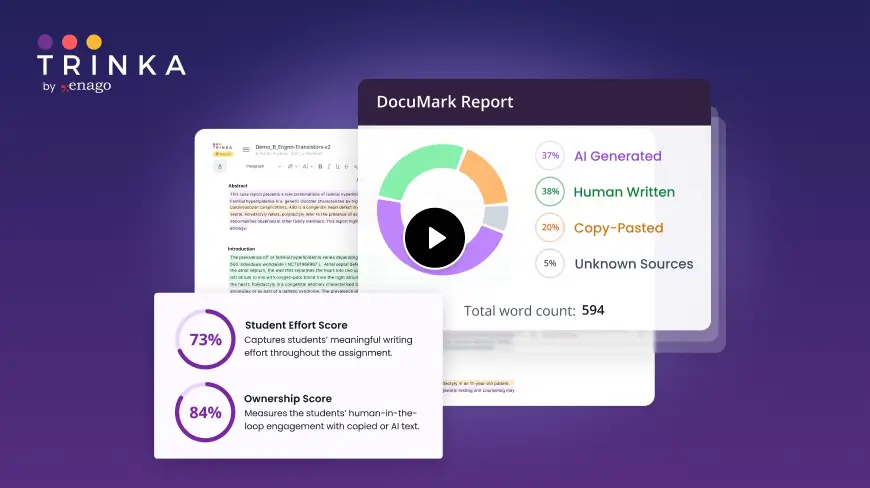
Knowing your institution's AI policy is step one. DocuMark helps enforce it fairly by empowering universities to manage AI-generated content, prevent cheating, and support student writing through responsible AI use.
Common Questions About Arizona State University's AI Policies
Arizona State University has defined AI policies in 12 of 12 categories, with an overall coverage score of 100%.
When generative AI use is permitted, students must acknowledge its use appropriately and follow the instructor’s directions for how to cite/acknowledge AI assistance.
Unauthorized use of generative AI is handled under ASU’s academic integrity framework as a form of academic dishonesty/cheating, using the university’s established processes for addressing violations.
ASU prohibits entering sensitive or restricted institutional data into any publicly available generative AI tool (from entities not contractually bound to ASU). ASU IT provides access to AI applications and a platform for custom solutions that are compliant with university data handling policies.