Teaching & Learning
- When instructors allow AI, students are expected to verify outputs and disclose and cite their use
- Student use of generative AI in coursework is generally left to faculty or committee discretion rather than governed by a single blanket rule
- New College guidance tells faculty to state in syllabi and assignment instructions whether AI use is permitted or prohibited, and The College states that generative AI use falls under ASU academic integrity policies and processes
The New College Dean's Office encourages schools and faculty to determine whether student use of generative AI/ChatGPT in their courses is permitted or prohibited and to state this and any parameters in your syllabi, announcements, and assignment instructions.
The use of Generative AI/ChatGPT falls within ASU's Academic Integrity policies and processes.
If instructors allow, Generative AI may be used as a tool by students for creating their work.
Students are responsible for properly citing and acknowledging any use of generative AI. Include a brief disclosure describing how AI was used and what prompts were used. Failure to do so may violate academic integrity policies.
Generative AI tools (e.g., ChatGPT, Copilot, Gemini) have limitations and can produce inaccurate or misleading information. Do not assume outputs are correct. Students are responsible for verifying facts, data, and sources using reliable references.
- For graduate culminating assessments, including written and oral examinations, portfolios, capstones, theses, and dissertations, AI use is determined by the student’s committee
- Students must consult the committee about allowable uses, and unallowed use or using AI for a significant portion of the work should be reported under the Student Academic Integrity Policy
This document provides guidance on the use of generative AI within the context of the graduate culminating experience, including written and oral examinations, portfolios, applied projects, capstone courses, master’s theses, and doctoral dissertations.
The graduate student’s committee is responsible for determining permissible amounts and types of generative AI–if any–to use as a support tool for the student’s culminating experience. It is the student’s responsibility to consult with their committee to understand appropriate and allowable uses of generative AI for their culminating experience.
If a committee finds that a student utilized an unallowed generative AI tool or produced a significant portion of their culminating work using generative AI, they should report the violation according to the ASU Student Academic Integrity Policy.
- ASU explicitly presents AI as a tool that can support learning and teaching
- Students remain responsible for checking accuracy and using AI thoughtfully
- The university also provides an example of a student using ChatGPT Edu to get feedback on an essay draft to improve writing skills, indicating permitted study-support use in that tool context
Arizona State University seeks to balance the potential of generative Artificial Intelligence (AI) tools to support learning with the need for academic integrity, rigor, and transparency.
A student wants feedback on an essay draft to improve writing skills.
Steps
1. Upload your essay file or paste your essay text into the chat.
2. Ask for feedback or suggestions for improvement.
3. Review and apply the feedback to your work.
Generative AI tools (e.g., ChatGPT, Copilot, Gemini) have limitations and can produce inaccurate or misleading information. Do not assume outputs are correct. Students are responsible for verifying facts, data, and sources using reliable references.
Research
- The policy also directs students to ASU Library guidance for citing AI models and uses of AI in research
- For graduate theses, dissertations, and other culminating documents, AI use in writing is governed by the student’s committee
- If the committee permits AI as a support tool, the student must be transparent and correctly attribute all uses in the document
This document provides guidance on the use of generative AI within the context of the graduate culminating experience, including written and oral examinations, portfolios, applied projects, capstone courses, master’s theses, and doctoral dissertations.
The graduate student’s committee is responsible for determining permissible amounts and types of generative AI–if any–to use as a support tool for the student’s culminating experience.
If the committee permits the use of generative AI, the student must be transparent about their use of generative AI and correctly attribute all uses in their document(s).
Refer to the ASU Artificial Intelligence site, Office of the University Provost site and ASU Library Guide on generative AI for frequently asked questions (FAQs) and more information about citing AI models, permanent links to AI results, and uses of AI in research.
- ASU also states that non-approved AI tools need review for ASU acceptability and may require a security assessment before use
- In addition, the IRB exempt wizard excludes studies that involve development of an AI tool or use of an AI tool for data analysis
- AI use in human-subjects research that collects data, analyzes identifiable data, interacts with participants, or impacts participants must be disclosed and approved in the IRB application
Any use of AI for research that interacts with human subjects, collects data, analyzes identifiable data, or impacts participants must be disclosed and approved in your IRB application.
All AI tools not included on ASU’s AI Tools for the ASU Community, needs to be reviewed for ASU acceptability and may require a security assessment by ASU Enterprise Technology before use.
Study does not involve development of an Artificial Intelligence (AI) tool or use of AI tool for data analysis
- ASU requires disclosure and IRB approval when AI is used in human-subjects research that interacts with participants or affects data collection or analysis
- The university also frames research conduct broadly in terms of ethical and responsible conduct, and says non-approved AI tools may need ASU acceptability review and a security assessment before use
Any use of AI for research that interacts with human subjects, collects data, analyzes identifiable data, or impacts participants must be disclosed and approved in your IRB application.
All AI tools not included on ASU’s AI Tools for the ASU Community, needs to be reviewed for ASU acceptability and may require a security assessment by ASU Enterprise Technology before use.
To communicate ASU’s position regarding the ethical, responsible conduct and reporting of research and scholarly activity
Academic Integrity
- ASU requires disclosure and attribution when AI use is permitted
- Departmental guidance also emphasizes that students must cite borrowed content sources and verify AI-generated citations
- Students are told to cite and acknowledge generative AI use, include a brief disclosure of how AI and prompts were used, and graduate students using permitted AI in culminating documents must be transparent and correctly attribute all uses
Students are responsible for properly citing and acknowledging any use of generative AI. Include a brief disclosure describing how AI was used and what prompts were used. Failure to do so may violate academic integrity policies.
If instructors allow some use of AI it is important that students cite their use of AI.
If the committee permits the use of generative AI, the student must be transparent about their use of generative AI and correctly attribute all uses in their document(s).
Within their courses and assignments, faculty should emphasize that students must cite any borrowed content sources to comply with all applicable citation guidelines and copyright law and avoid plagiarism. Simply put, if students use generative AI, they should cite it:
Students and faculty should also ensure any AI-generated citations are correct, as generative AI tools are notorious for listing nonsensical citations.
- ASU administration does not recommend any specific AI detection tools for coursework and says their results are unreliable
- For graduate culminating work, unallowed AI use or AI-generated significant portions of work should be reported under the Student Academic Integrity Policy
- Detection-tool results should be used only as a starting point for a conversation, and suspected AI use alone is not enough to begin a formal academic integrity investigation
ASU administration has not recommended any specific tools or apps to detect the use of AI in coursework. The accuracy of AI detection tools is not reliable; any results from these tools should be used for nothing more than a starting point for a conversation between faculty and the student whose work is in question. Suspected use of Generative AI in coursework is not sufficient evidence to begin a formal Academic Integrity investigation.
If a committee finds that a student utilized an unallowed generative AI tool or produced a significant portion of their culminating work using generative AI, they should report the violation according to the ASU Student Academic Integrity Policy. When in doubt refer to the ASU Student Academic Integrity Policy.
Institutional & Administrative
- Faculty are also advised to define course AI policies clearly in the syllabus
- ASU encourages faculty and staff to use institutionally supported AI tools for teaching, course design, and research
- The provost site says faculty and staff can build FERPA-compliant AI projects in CreateAI Builder and use ChatGPT Edu in a FERPA-compliant environment, and engineering guidance gives an example of an instructor using ChatGPT Edu for course preparation while retaining human review and selection
The platform enables faculty and staff to develop FERPA-compliant AI-powered projects that leverage extensive knowledge bases, assess bias using the Ethical AI Engine, and access robust data for evaluation and efficacy research.
As we further develop CreateAI Builder’s capabilities, ChatGPT EDU provides faculty and staff with access to a leading AI provider with robust capabilities in data analysis and research, all within a FERPA-compliant environment.
We recommend that faculty and staff develop teaching and learning experiences in CreateAI Builder to maximize access to data on usage and engagement.
An instructor uses ChatGPT EDU to generate sample quiz questions for an upcoming lecture. The instructor reviews, edits, and selects the best ones, making class prep faster without outsourcing judgment.
Define your policy: in the course syllabus, provide a clear policy of each academic violation, examples of the violation, and possible consequences.
- ASU has approved AI tools and sets data-use boundaries for them
- Non-listed AI tools used in research must be reviewed for ASU acceptability and may require a security assessment
- The digital trust guidance says ASU offers approved tools for FERPA-protected and non-regulated PII, ChatGPT Edu is approved for ASU non-regulated and internal data and FERPA-protected/public data only, and it is not approved for HIPAA or other regulated data
ASU has agreements with several vendors and now offers tools that have been approved for use with FERPA-protected and non-regulated PII.
CreateAI Builder is ASU’s institutional platform for building secure, FERPA-compliant, and scalable AI experiences.
ChatGPT Edu interactions comply with strict privacy standards. The ChatGPT Edu application is approved for ASU non-regulated and internal data and is FERPA compliant. ChatGPT Edu will not use any data, prompts, or responses for any AI training. The retention period configured on ASU’s ChatGPT Edu workspace is 180 days.
When using ChatGPT Edu, remember that this tool is approved for FERPA-protected and public data only. It is not approved for HIPAA or other regulated data.
All AI tools not included on ASU’s AI Tools for the ASU Community, needs to be reviewed for ASU acceptability and may require a security assessment by ASU Enterprise Technology before use.
- ASU describes a university-wide AI strategy centered on Principled Innovation, secure enterprise infrastructure, and evolving ethics guidance
- Digital trust guidance and pre-release evaluation materials also show governance processes for approved tools, privacy, safety, and escalation paths
- The institution says its approach is rooted in Principled Innovation, is building the technical foundation for enterprise AI in education, and maintains faculty ethics guidance as living principles for decisions about students, research, and operations
ASU's approach to artificial intelligence is rooted in Principled Innovation, empowering you to use AI thoughtfully and responsibly.
ASU is building the foundation for a new era of AI innovation that is accessible, secure, and purpose-driven. By investing in advanced machine learning, data science capabilities, and enterprise-scale infrastructure, ASU is creating the conditions for students, faculty, and staff to confidently explore and build AI-powered experiences.
These principles provide a compass for daily decision-making, whether you’re building AI tools, integrating them into curricula, or evaluating their impact on students, research, and operations.
They aren’t static rules, they’re living guidelines meant to evolve alongside the technology and our collective understanding of it.
Arizona State University is committed to the practice of Principled Innovation, embracing innovation with curiosity and wisdom.
Student-facing chatbots serve a diverse range of student needs, from answering factual questions to assisting with creative projects and academic advising. Given their broad impact, it is critical to develop escalation paths for cases where chatbot interactions require human intervention.
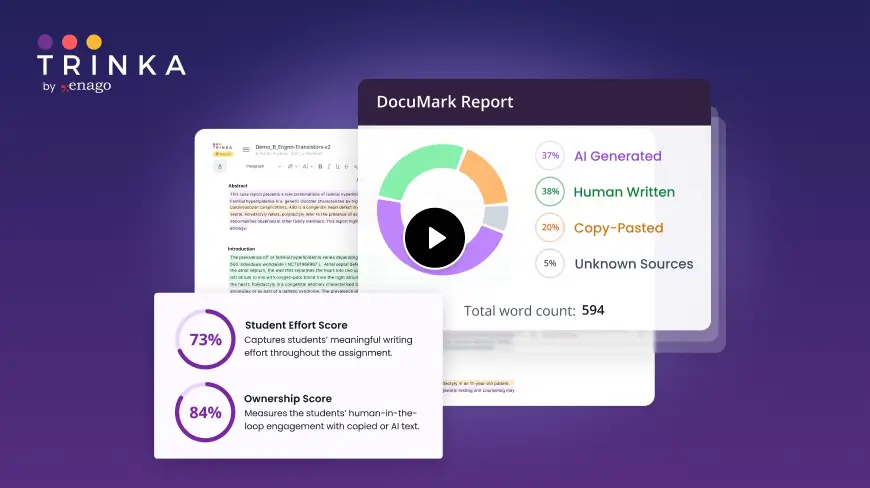
DocuMark: Responsible AI Use for Academic Integrity
Knowing your institution's AI policy is step one. DocuMark helps enforce it fairly by empowering universities to manage AI-generated content, prevent cheating, and support student writing through responsible AI use.
Common Questions About Arizona State University--West's AI Policies
Arizona State University--West has defined AI policies in 11 of 12 categories, with an overall coverage score of 92%.
ASU requires disclosure and attribution when AI use is permitted. Students are told to cite and acknowledge generative AI use, include a brief disclosure of how AI and prompts were used, and graduate students using permitted AI in culminating documents must be transparent and correctly attribute all uses. Departmental guidance also emphasizes that students must cite borrowed content sources and verify AI-generated citations.
ASU administration does not recommend any specific AI detection tools for coursework and says their results are unreliable. Detection-tool results should be used only as a starting point for a conversation, and suspected AI use alone is not enough to begin a formal academic integrity investigation. For graduate culminating work, unallowed AI use or AI-generated significant portions of work should be reported under the Student Academic Integrity Policy.
ASU has approved AI tools and sets data-use boundaries for them. The digital trust guidance says ASU offers approved tools for FERPA-protected and non-regulated PII, ChatGPT Edu is approved for ASU non-regulated and internal data and FERPA-protected/public data only, and it is not approved for HIPAA or other regulated data. Non-listed AI tools used in research must be reviewed for ASU acceptability and may require a security assessment.