Teaching & Learning
- The handbook also treats receiving unauthorized assistance on coursework and having another person do coursework as academic dishonesty
- Use of artificial-intelligence programs for coursework is prohibited when it is inconsistent with university policy, a course syllabus, or an instructor’s directives
1. “Academic Dishonesty” means an action that violates a rule regarding academic work required to obtain an academic degree or certificate.1 Examples include, but are not limited to, using unauthorized materials, information, or study aids using artificial-intelligence programs in a manner that is inconsistent with University policy, a course syllabus, or an instructor’s directives; cheating; plagiarism; forgery; falsification of information; receiving unauthorized assistance on coursework; providing false information to receive an extension to complete work; any violation of a campus, departmental, program, or faculty rules relating to an academic matter that may lead to an unfair academic advantage; or complicity with another individual who has engaged in an act of academic dishonesty.
Doing course work for another student or getting another person to do course work for you. This includes all forms of unauthorized assistance, including assistance from tutors or commercial services.
- The handbook separately prohibits unauthorized materials or collaboration during examinations
- AI use during exams or other assessments is not allowed when it is unauthorized or conflicts with university, syllabus, or instructor rules
1. “Academic Dishonesty” means an action that violates a rule regarding academic work required to obtain an academic degree or certificate.1 Examples include, but are not limited to, using unauthorized materials, information, or study aids using artificial-intelligence programs in a manner that is inconsistent with University policy, a course syllabus, or an instructor’s directives; cheating; plagiarism; forgery; falsification of information; receiving unauthorized assistance on coursework; providing false information to receive an extension to complete work; any violation of a campus, departmental, program, or faculty rules relating to an academic matter that may lead to an unfair academic advantage; or complicity with another individual who has engaged in an act of academic dishonesty.
Using any materials, devices, or sources of information not authorized by the instructor during an examination, project, or assignment.
Collaborating during an examination with any person by giving or receiving information without specific permission from the instructor.
- However, the verified sources do not define a formal policy on students using AI as personal study help for non-graded learning
- The university provides AI training and development through its Center for AI and Data Analytics, including undergraduate programming on AI, prompting, and ethics
The mission of the Center for Artificial Intelligence and Data Analytics (CAIDA) is to advance data analytics, AI, innovation, and research in support of recruitment and retention efforts, institutional effectiveness, academic enhancement and excellence, and workforce development at UAPB. As a central source of expertise and support, CAIDA serves as the university’s hub for data-informed decision-making, AI training and development, and interdisciplinary research.
The event was held Wednesday March 11th at the L.A. Davis, Sr. Student Union and had a amazing turnout. This beginner friendly introduction to AI, covered topics such as:
* What is AI?
* How can use AI?
* Creating Prompts for AI
* AI Ethics & Safety
* And hand-on exercises on AI prompting!
Research
- The university has an institutional initiative promoting AI and data analytics to strengthen research capacity and research productivity
- CAIDA is described as a university hub for data-informed decision-making, AI training and development, interdisciplinary research, and applied research, but the sources do not set specific compliance rules for research data or analysis use
Achieving this goal requires not only growth in research activity and external funding, but also the strategic use of emerging technologies, particularly artificial intelligence (AI) and data analytics, to modernize research infrastructure, enhance decision-making, and improve outcomes across the institution.
By leveraging AI-enabled tools and data-driven approaches, UAPB can accelerate research productivity while simultaneously advancing student success, operational effectiveness, workforce development, and institutional sustainability.
The mission of the Center for Artificial Intelligence and Data Analytics (CAIDA) is to advance data analytics, AI, innovation, and research in support of recruitment and retention efforts, institutional effectiveness, academic enhancement and excellence, and workforce development at UAPB. As a central source of expertise and support, CAIDA serves as the university’s hub for data-informed decision-making, AI training and development, and interdisciplinary research.
CAIDA fulfills a dual institutional and research-facing role, including:
* Institutional Data & Analytics Hub
* AI Training & Workforce Development
* Innovation & Applied Research
* Research Infrastructure & Capacity Building
- The verified sources do not define AI-specific rules for grant proposals, IRB applications, or research ethics declarations
- The student handbook prohibits falsifying or fabricating data and sources in research papers, laboratory projects, survey research, and field research
Submitting altered, fabricated, or falsified data as experimental data from laboratory projects, survey research, or other field research.
Falsifying or inventing the sources or facts in a research paper or other assignment.
Academic Integrity
- Students must follow attribution and documentation requirements when using others’ words, ideas, or arguments
- For AI use, the university does not set a standalone citation format in the verified sources, but it requires compliance with university policy, the course syllabus, and instructor directives
This concept demands that any student work presented truly represents the student’s own honest effort and is the product of his/her own intellect and abilities.
Submitting as one’s own work the words, ideas, or arguments of another person without appropriate attribution and documentation according to the style sheet used in the discipline.
1. “Academic Dishonesty” means an action that violates a rule regarding academic work required to obtain an academic degree or certificate.1 Examples include, but are not limited to, using unauthorized materials, information, or study aids using artificial-intelligence programs in a manner that is inconsistent with University policy, a course syllabus, or an instructor’s directives; cheating; plagiarism; forgery; falsification of information; receiving unauthorized assistance on coursework; providing false information to receive an extension to complete work; any violation of a campus, departmental, program, or faculty rules relating to an academic matter that may lead to an unfair academic advantage; or complicity with another individual who has engaged in an act of academic dishonesty.
- The verified sources do not state a policy on AI detection tools specifically
- The university prohibits academic dishonesty in any form and routes allegations through academic integrity and student conduct procedures
- Instructors document and report violations and may impose sanctions, while students have appeal rights; sanctions escalate from an F on the assignment to course failure, suspension, and expulsion
Any instructor that alleges a student has committed a violation of academic integrity has the responsibility of documenting, reporting and proposing sanctions.
When a violation of academic integrity is suspected:
1. The instructor has the responsibility of informing the student of the charge or allegation of violating academic integrity standards and of proposed sanctions as appropriate for the alleged violation. The instructor will inform the student of his/her right to appeal all decisions.
For the first violation, the student will be given an “F” for the assignment and given a written warning that is placed in the student’s file but will not be indicated on his/her record. The student will be required to complete training related to academic integrity.
For the second violation, the student will receive an “F” for the course and a letter will be placed in the student’s academic file.
For a third violation or first critical violation, the student will be suspended from the University for one academic year, given an “XF” on his/her transcript, and a letter will be placed in the student’s academic file.
For a fourth violation or second critical violation, the student will be expelled from the University for repeated violations of academic integrity. The student will be given an “XF” on his/her transcript, and a letter will be placed in the student’s academic file noting the offenses.
3. Academic Dishonesty in any form is prohibited. Subject to more specific rules, the following procedures shall be utilized in connection with allegations of academic dishonesty:
a. An instructor may take appropriate action, such as assigning a Student a grade of “F” for the course and suspending the Student from the class. The “F” will be the final grade and the Student may not withdraw from the course with another notation. A description of the incident and the action taken will be reported to the appropriate dean and will be placed in the Student’s file in the Registrar’s office.
b. Within 3 business days of notification, the Student may appeal either the finding of academic dishonesty or the penalty (or both) to the Vice Chancellor for Academic Affairs or a person or panel designated to hear such appeals. The Student will be allowed to continue in class until the appeal is adjudicated.
Institutional & Administrative
- They do state that faculty are responsible for classroom management and that CAIDA supports faculty, staff, and administrators with AI training and development
- The verified sources do not define rules for faculty or staff using AI for grading, feedback, lesson planning, recommendation letters, or administrative communications
1. Classroom management and behaviors not otherwise in violation of published behavioral rules are under the jurisdiction and responsibility of the faculty member.
Through strategic guidance, technical assistance, and collaborative initiatives, the Center enables faculty, students, staff, and administrators to leverage data and intelligent systems to enhance student success, strengthen operational performance, and increase research competitiveness.
- The university has an institutional AI strategy centered on CAIDA
- UAPB describes AI and data analytics as part of its broader strategy to strengthen research capacity and institutional impact, and it identifies CAIDA as the university hub for AI training, data-informed decision-making, and interdisciplinary research
As a Carnegie-designated Research College and University, the University of Arkansas at Pine Bluff (UAPB) is intentionally advancing toward Research 2 (R2) status as part of its broader strategy to strengthen research capacity, competitiveness, and institutional impact.
Achieving this goal requires not only growth in research activity and external funding, but also the strategic use of emerging technologies, particularly artificial intelligence (AI) and data analytics, to modernize research infrastructure, enhance decision-making, and improve outcomes across the institution.
The mission of the Center for Artificial Intelligence and Data Analytics (CAIDA) is to advance data analytics, AI, innovation, and research in support of recruitment and retention efforts, institutional effectiveness, academic enhancement and excellence, and workforce development at UAPB. As a central source of expertise and support, CAIDA serves as the university’s hub for data-informed decision-making, AI training and development, and interdisciplinary research.
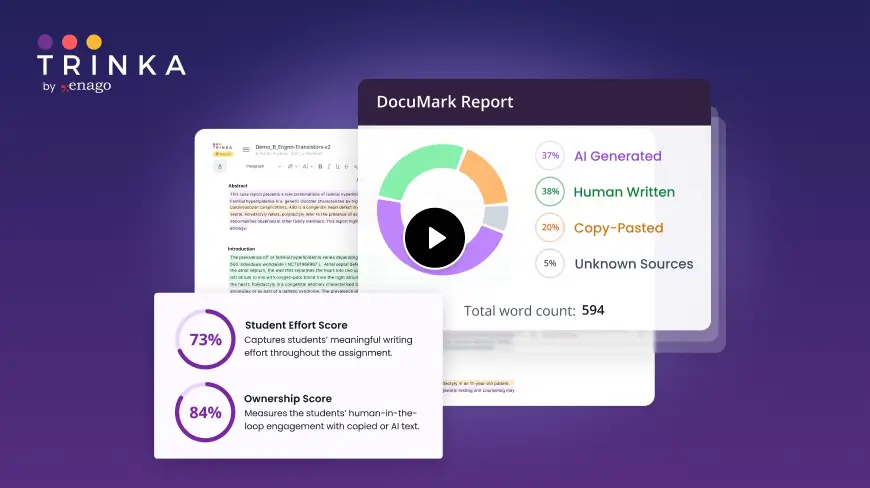
DocuMark: Responsible AI Use for Academic Integrity
Knowing your institution's AI policy is step one. DocuMark helps enforce it fairly by empowering universities to manage AI-generated content, prevent cheating, and support student writing through responsible AI use.
Common Questions About Arkansas at Pine Bluff, University of's AI Policies
Arkansas at Pine Bluff, University of has defined AI policies in 9 of 12 categories, with an overall coverage score of 75%.
Students must follow attribution and documentation requirements when using others’ words, ideas, or arguments. For AI use, the university does not set a standalone citation format in the verified sources, but it requires compliance with university policy, the course syllabus, and instructor directives.
The university prohibits academic dishonesty in any form and routes allegations through academic integrity and student conduct procedures. Instructors document and report violations and may impose sanctions, while students have appeal rights; sanctions escalate from an F on the assignment to course failure, suspension, and expulsion. The verified sources do not state a policy on AI detection tools specifically.
No explicit data protection or approved AI platform policy is currently defined in the available policy sources.