Teaching & Learning
- AI use in coursework is allowed only at faculty discretion
- Students may use AI for limited purposes such as reference, ideation, research assistance, translation, and tutoring if it is clearly acknowledged and cited, but using AI without instructor permission or submitting AI-generated work as one’s own violates academic integrity rules
AI Use in Coursework
The use of AI as a reference tool, for ideation, research assistance, translation, and tutoring purposes is permitted at faculty discretion, provided it is clearly acknowledged and cited in any work submitted. Students are strongly encouraged to check their course syllabi and with each instructor about the use of AI in specific courses.
Prohibited AI Use
ABU professors, under the leadership of department chairs and the Office of Academic Affairs, determine the acceptable level of AI use in each course. In accordance with ABU’s commitment to academic integrity, students are strictly prohibited from using AI tools to engage in academically dishonest practices, including but not limited to submitting work generated by AI as their own without appropriate citation (for example, “ChatGPT, 2025”). Students who engage in unauthorized or prohibited use of generative AI are subject to Academic Integrity policies. By default, students will violate Academic Integrity policies if they use AI without citation (as this constitutes plagiarism) or without instructor permission.
• Using generative artificial intelligence (AI) tools without prior permission to provide answers or text for any assigned task.
• Submitting AI-generated material as one’s work.
- This means AI use in exams or assessments is treated as unauthorized unless permission has been given
- AI use during assessments is not separately addressed in a dedicated AI exam policy, but the academic integrity rules prohibit using AI without prior permission on assigned tasks and prohibit unauthorized technology during assessments
• Using generative artificial intelligence (AI) tools without prior permission to provide answers or text for any assigned task.
• Copying or using unauthorized technology or print aids on any assigned task.
• Looking at answers on another student’s assessment, communicating with other students during an assessment, or working collaboratively with other students without prior permission.
- Outside coursework, students are directed to consult university personnel about appropriate use
- AI may be used for tutoring and similar study-support purposes only at faculty discretion in the context of coursework, and any submitted work using AI must acknowledge and cite that use
The use of AI as a reference tool, for ideation, research assistance, translation, and tutoring purposes is permitted at faculty discretion, provided it is clearly acknowledged and cited in any work submitted. Students are strongly encouraged to check their course syllabi and with each instructor about the use of AI in specific courses.
AI Use Outside of Coursework
In accordance with ABU’s commitment to academic excellence and producing graduates who are ready for the workplace, ABU recognizes that AI can be used in appropriate ways that facilitate innovation and creativity. When not explicitly used within a course (at which time AI policies fall under faculty discretion), students should consult with their supervisor, department chair, advisor, or the Office of Academic Affairs about appropriate use.
Research
- The policy does not provide a separate rule specifically about AI drafting or editing of manuscripts beyond these research-related expectations
- For student research involving AI, the university requires collaboration with a faculty advisor or relevant supervisor to follow best practices, and advises documenting methodology, data sources, and algorithms
AI Use in Research or Scholarship
Students conducting research involving AI should collaborate with their faculty advisor or relevant supervisor to ensure that best practices involving AI in their particular field are followed. The student is advised to document methodology, data sources, and algorithms.
- For student research using AI, students should work with a faculty advisor or relevant supervisor and are advised to document methodology, data sources, and algorithms
- The university also prohibits entering restricted data into generative AI tools, including FERPA- and HIPAA-protected information, private student and employee information, confidential review material, and some nonpublic intellectual property
AI Use in Research or Scholarship
Students conducting research involving AI should collaborate with their faculty advisor or relevant supervisor to ensure that best practices involving AI in their particular field are followed. The student is advised to document methodology, data sources, and algorithms.
Entering any restricted data into any generative AI tool or service is prohibited. This includes data protected by FERPA, HIPAA, other private student data, private information related to employees, material under confidential review and not written by the AI user, and possibly intellectual property not publicly available.
- It also prohibits fraudulent research and treats uncited or unpermitted AI use as an academic integrity violation
- The university sets student research expectations for AI use by requiring consultation with a faculty advisor or relevant supervisor and advising documentation of methods, data sources, and algorithms
AI Use in Research or Scholarship
Students conducting research involving AI should collaborate with their faculty advisor or relevant supervisor to ensure that best practices involving AI in their particular field are followed. The student is advised to document methodology, data sources, and algorithms.
The use of AI to create fake academic credentials, fraudulent research, or any other activities that may harm individuals or institutions is prohibited.
By default, students will violate Academic Integrity policies if they use AI without citation (as this constitutes plagiarism) or without instructor permission. Students will also violate Academic Integrity policies if they fail to verify that AI has provided correct and factual information.
Academic Integrity
- The policy gives an example citation format and states that using AI without citation is plagiarism
- When AI is used in coursework, the university requires that it be clearly acknowledged and cited in submitted work
The use of AI as a reference tool, for ideation, research assistance, translation, and tutoring purposes is permitted at faculty discretion, provided it is clearly acknowledged and cited in any work submitted.
ABU professors, under the leadership of department chairs and the Office of Academic Affairs, determine the acceptable level of AI use in each course. In accordance with ABU’s commitment to academic integrity, students are strictly prohibited from using AI tools to engage in academically dishonest practices, including but not limited to submitting work generated by AI as their own without appropriate citation (for example, “ChatGPT, 2025”).
By default, students will violate Academic Integrity policies if they use AI without citation (as this constitutes plagiarism) or without instructor permission.
- Undisclosed or unauthorized AI use is enforced through the university’s academic integrity process
- Suspected violations are investigated, all student work may be reviewed, students must comply with investigations, and sanctions can include grade penalties, redoing work, course failure, suspension, or dismissal
Students who engage in unauthorized or prohibited use of generative AI are subject to Academic Integrity policies.
All instances of suspected academic integrity infractions are investigated and referred to the Office of Academic Affairs. All student work is subject to review. A student must comply fully with an investigation, and failure to do so will result in a presumption of guilt and the most severe consequences. A student may not withdraw from a course while under investigation for, or found guilty of, academic dishonesty.
A student found guilty of an academic integrity violation will face consequences that could include dismissal from the university.
A violation of the Academic Policy begins with an observation of suspicious activity by a student or group of students. The faculty member must then investigate and inform the Office of Academic Affairs for support. Once an investigation is initiated, all work, both graded and ungraded, is subject to review and possible grade changes.
A student is expected to comply fully with the investigation of suspected academic honesty, and refusing to do so will result in a presumption of guilt and the most severe consequences. A student may not withdraw from a course while under investigation for, or found guilty of, academic dishonesty.
Institutional & Administrative
- It does state that faculty, under department chair and Office of Academic Affairs leadership, determine acceptable AI use in each course
- The AI policy expressly applies to faculty, staff, and students, but it does not set detailed operational rules for faculty or staff uses such as grading, feedback, lesson planning, recommendation letters, or administrative communications
This policy is designed to equip faculty, staff, and students with the framework for engaging in learning, scholarship, research, creative, and service activities that involve engagement with the developing AI technologies.
ABU professors, under the leadership of department chairs and the Office of Academic Affairs, determine the acceptable level of AI use in each course.
- The university prohibits entering restricted data into generative AI tools or services
- Protected categories expressly include FERPA and HIPAA data, private student and employee information, confidential review material not written by the AI user, and possibly nonpublic intellectual property; no approved-platform list is defined in the provided sources
Entering any restricted data into any generative AI tool or service is prohibited. This includes data protected by FERPA, HIPAA, other private student data, private information related to employees, material under confidential review and not written by the AI user, and possibly intellectual property not publicly available.
The use of AI tools or services to generate content that helps others break federal, state, or local laws, and to intentionally violate institutional policies, rules, guidelines, or licensing agreements or contracts is prohibited.
- The university states an overarching goal of promoting ethical and educational AI use while protecting the institution and its mission from AI-related risks
- The policy is framed as a university-wide framework for faculty, staff, and students, but the provided sources do not identify a dedicated AI committee, task force, or formal roadmap
This policy is designed to promote ethical and educational use of Artificial Intelligence (AI) technologies and foster learning and innovation while protecting against certain risks that AI poses to Arlington Baptist University (ABU) and its mission.
This policy is designed to equip faculty, staff, and students with the framework for engaging in learning, scholarship, research, creative, and service activities that involve engagement with the developing AI technologies.
As a contemporary institution of higher education, ABU desires to promote the ethical and educational use of Artificial Intelligence (AI) technologies and foster learning and innovation while protecting against certain risks that AI poses to ABU and its mission.
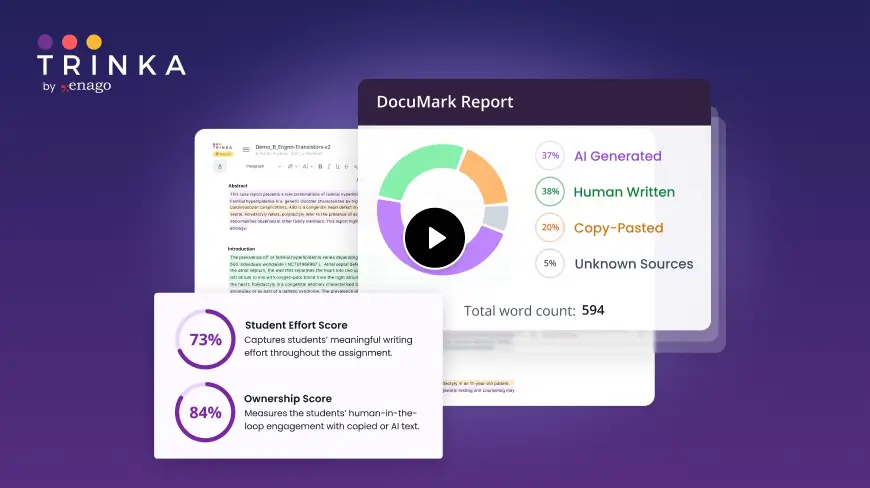
DocuMark: Responsible AI Use for Academic Integrity
Knowing your institution's AI policy is step one. DocuMark helps enforce it fairly by empowering universities to manage AI-generated content, prevent cheating, and support student writing through responsible AI use.
Common Questions About Arlington Baptist College's AI Policies
Arlington Baptist College has defined AI policies in 11 of 12 categories, with an overall coverage score of 92%.
When AI is used in coursework, the university requires that it be clearly acknowledged and cited in submitted work. The policy gives an example citation format and states that using AI without citation is plagiarism.
Undisclosed or unauthorized AI use is enforced through the university’s academic integrity process. Suspected violations are investigated, all student work may be reviewed, students must comply with investigations, and sanctions can include grade penalties, redoing work, course failure, suspension, or dismissal.
The university prohibits entering restricted data into generative AI tools or services. Protected categories expressly include FERPA and HIPAA data, private student and employee information, confidential review material not written by the AI user, and possibly nonpublic intellectual property; no approved-platform list is defined in the provided sources.