Teaching & Learning
- For student coursework, generative AI use is not uniformly permitted or prohibited across all classes
- Students must follow the specific instructor's directions for each assignment, and using AI in a way not authorized by the instructor can be treated as plagiarism
The use of generative artificial intelligence tools (GAITs), including ChatGPT, to complete assignments may be considered plagiarism or cheating. If your course instructor permits the use of GAITs for an assignment, then using a GAIT is not plagiarism.
The course instructor’s directions should indicate whether using a GAIT is or is not permitted for a specific assignment.
- The provided sources do not define a specific university policy on AI use during exams, quizzes, tests, or other formal assessments
not defined
- However, students are warned to verify outputs because these tools can be inaccurate and to avoid entering personal or sensitive information
- The university states that students may use generative AI as a study support tool for brainstorming, asking questions, and getting help understanding concepts
Students might use GAITs to help them learn about topics and better understand what they’re studying—for example, by asking questions and receiving answers, defining or explaining terms and concepts, and getting ideas for brainstorming.
There are some things students should know about using GAITs:
• Remember, they can be wrong. The responses they provide may not be entirely factual, so always double-check that the information you get from a GAIT is accurate.
• Remember, they can be biased and incomplete. The responses they provide may not represent all perspectives or information that would be relevant to your learning and knowledge.
• Remember, they do not know your assignment requirements. Whether and how using a GAIT is appropriate for an assignment can vary. Always check with your instructor and carefully review assignment instructions.
• Remember, they can’t keep secrets. It’s important to never enter personal and sensitive information into a GAIT, because data entered into GAITs can be used by the tool to continue to improve or “learn.”
- The provided sources do not define a specific policy on AI-assisted code generation, debugging, or programming assignments
not defined
Research
- The university's guidance on AI in writing says AI-generated text should not be copied into student papers because presenting it as one's own writing is plagiarism
- Students may use AI for prewriting support such as brainstorming or outlining if the instructor allows it, but they remain responsible for developing and writing the paper themselves
Can I use text generated by a GAIT in my paper?
Generally, no. This is because writing generated by GAITs is not your writing. If you copy language generated by a GAIT into your paper and present it as your own writing, then this is plagiarism, which is a form of cheating.
How can I use a GAIT to help me write or revise my paper without plagiarizing?
You can use a GAIT to assist with brainstorming, outlining, and prewriting. However, if using a GAIT is permitted by your instructor and if you use a GAIT to help you revise your own writing, be sure to review and revise carefully. Ultimately, while a GAIT can be a tool that helps with some aspects of writing, the writing should be your own and should represent your own understanding and perspective.
Students should not use AI-generated content or AI paraphrasing to avoid drafting and writing a paper. Instead, they should use a direct quotation from the source and cite it correctly, or they should read the source and write a paraphrase in their own words.
- The provided sources do not define a policy on AI use for research data collection, analysis, statistical processing, synthetic data, or interpretation of results
not defined
- The provided sources do not define a policy on AI use in grant proposals, IRB materials, research ethics declarations, or broader research-integrity requirements specific to research administration
not defined
Academic Integrity
- When students use ChatGPT or another generative AI tool, the university requires citation in APA style
- The guidance provides specific reference-list and in-text citation formats for AI outputs and indicates that disclosure should identify the software used and the date the content was generated
Do I need to cite ChatGPT or another GAIT if I use it in a paper?
Yes. If you include text generated by ChatGPT or another GAIT in your paper, or even if you use a GAIT as source of information while writing your paper, then you should cite that tool according to APA Style guidelines.
Because the content generated by AI is not retrievable by others and can vary from response to response, when citing AI-generated content, the citation should indicate the software used and the date the content was generated.
Reference list format:
OpenAI. (2023). ChatGPT (May 24 version) [Large language model]. https://chat.openai.com/chat
In-text citations:
The in-text citation consists of the author and year of the model.
Parenthetical: (OpenAI, 2023)
Narrative: OpenAI (2023)
- Undisclosed or unauthorized AI use can be handled as plagiarism or cheating under the university's academic integrity expectations
- The sources discuss plagiarism consequences and instructor permission, but they do not define a university policy on AI detection tools
The use of generative artificial intelligence tools (GAITs), including ChatGPT, to complete assignments may be considered plagiarism or cheating. If your course instructor permits the use of GAITs for an assignment, then using a GAIT is not plagiarism.
Plagiarism can have serious consequences. If a student is found to have plagiarized, they may fail the assignment, fail the course, be suspended, or even be expelled from the university.
Institutional & Administrative
- The provided sources do not define a policy governing faculty or staff use of AI for grading, feedback, lesson planning, recommendations, or administrative work
not defined
- The provided sources do not identify any university-approved AI platforms or a broader institutional data-classification policy
- The writing guidance warns users not to enter personal or sensitive information into generative AI tools because submitted data may be used by the tool for further learning
Remember, they can’t keep secrets. It’s important to never enter personal and sensitive information into a GAIT, because data entered into GAITs can be used by the tool to continue to improve or “learn.”
- The provided sources do not define an overarching university AI governance structure, strategy, task force, or institutional roadmap for AI adoption
not defined
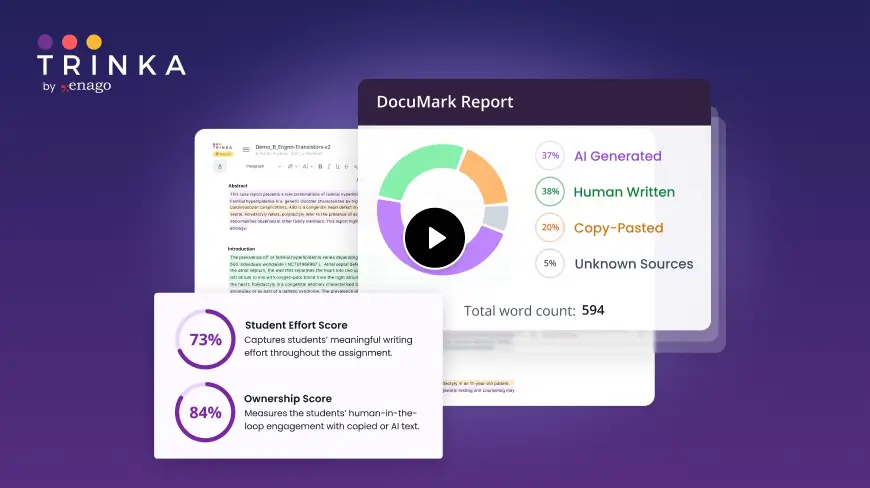
DocuMark: Responsible AI Use for Academic Integrity
Knowing your institution's AI policy is step one. DocuMark helps enforce it fairly by empowering universities to manage AI-generated content, prevent cheating, and support student writing through responsible AI use.
Common Questions About Ashford University's AI Policies
Ashford University has defined AI policies in 12 of 12 categories, with an overall coverage score of 100%.
When students use ChatGPT or another generative AI tool, the university requires citation in APA style. The guidance provides specific reference-list and in-text citation formats for AI outputs and indicates that disclosure should identify the software used and the date the content was generated.
Undisclosed or unauthorized AI use can be handled as plagiarism or cheating under the university's academic integrity expectations. The sources discuss plagiarism consequences and instructor permission, but they do not define a university policy on AI detection tools.
The writing guidance warns users not to enter personal or sensitive information into generative AI tools because submitted data may be used by the tool for further learning. The provided sources do not identify any university-approved AI platforms or a broader institutional data-classification policy.