Teaching & Learning
- Students are prohibited from submitting AI-generated content as their own, and they may not use AI to rephrase entire sentences or paragraphs
- Course-level rules may override the institutional default if the instructor states them in writing on the syllabus or assignment instructions
- Students may use AI in limited ways for coursework under the institutional policy, such as specific proofreading/editing suggestions and brainstorming or generating initial research resources
All output produced by generative AI tools is considered to be third-party content. As with any content taken from the internet or other media, students must acknowledge the use of this content when it is quoted, paraphrased, or otherwise incorporated in their work. Students are prohibited from submitting content generated by an AI platform as their own. Failure to disclose content taken from generative AI tools will be treated as a violation of the Academic Integrity Policy.
Proofreading and editing tools that utilize AI are permissible when used for specific editing suggestions. Students may not have an AI tool rephrase entire sentences or paragraphs of their writing. Doing so constitutes submitting work that is not the student’s own and violates the Academic Integrity Policy.
AI platforms may be used for brainstorming ideas on a topic or generating initial resources for research. However, students should remember that the output of these platforms can be limited, false, or misleading. Further independent research and brainstorming will be necessary.
Instructors are permitted to define how students utilize AI tools in their course or on specific assignments. If this policy differs from the institutional policy, the details must be stated in writing on the syllabus or assignment instructions. Otherwise, it is assumed that the institutional policy is in effect for the course and all course assignments.
- The university does not set a separate institution-wide AI rule specifically for exams, quizzes, or tests in the AI policy
- However, instructors may set course- or assignment-specific AI rules, and if AI misuse is suspected, the instructor may require the student to redo the assignment or complete an alternative assessment
Instructors are permitted to define how students utilize AI tools in their course or on specific assignments. If this policy differs from the institutional policy, the details must be stated in writing on the syllabus or assignment instructions. Otherwise, it is assumed that the institutional policy is in effect for the course and all course assignments.
If AI misuse is suspected, the instructor has the right to require the student to redo the assignment or to complete an alternative assessment. Depending on the scope and evidence of AI misuse, the instructor may issue a failing grade on the assignment, in accordance with the institutional Academic Integrity Policy.
- Students are permitted to use AI for brainstorming and to generate initial resources for research or learning support
- The university warns that AI outputs may be limited, false, or misleading, and requires students to do further independent research and brainstorming
AI platforms may be used for brainstorming ideas on a topic or generating initial resources for research. However, students should remember that the output of these platforms can be limited, false, or misleading. Further independent research and brainstorming will be necessary.
Research
- For student research writing, AI-generated output is treated as third-party content and must be acknowledged when quoted, paraphrased, or otherwise incorporated
- Students may use AI for initial research resources, but they may not submit AI-generated content as their own, and AI-based editing is limited to specific editing suggestions rather than rephrasing entire sentences or paragraphs
All output produced by generative AI tools is considered to be third-party content. As with any content taken from the internet or other media, students must acknowledge the use of this content when it is quoted, paraphrased, or otherwise incorporated in their work. Students are prohibited from submitting content generated by an AI platform as their own. Failure to disclose content taken from generative AI tools will be treated as a violation of the Academic Integrity Policy.
Proofreading and editing tools that utilize AI are permissible when used for specific editing suggestions. Students may not have an AI tool rephrase entire sentences or paragraphs of their writing. Doing so constitutes submitting work that is not the student’s own and violates the Academic Integrity Policy.
AI platforms may be used for brainstorming ideas on a topic or generating initial resources for research. However, students should remember that the output of these platforms can be limited, false, or misleading. Further independent research and brainstorming will be necessary.
- The provided sources do not state separate rules for grant proposals, IRB applications, or formal research ethics filings
- The university states that AI-generated output used in student work must be disclosed and that undisclosed use is treated as an academic integrity violation
All output produced by generative AI tools is considered to be third-party content. As with any content taken from the internet or other media, students must acknowledge the use of this content when it is quoted, paraphrased, or otherwise incorporated in their work. Students are prohibited from submitting content generated by an AI platform as their own. Failure to disclose content taken from generative AI tools will be treated as a violation of the Academic Integrity Policy.
Academic Integrity
- Disclosure is required when AI content is quoted, paraphrased, or otherwise incorporated into student work
- The university treats AI output as third-party content, so students must acknowledge its use and may not submit AI-generated content as their own
All output produced by generative AI tools is considered to be third-party content. As with any content taken from the internet or other media, students must acknowledge the use of this content when it is quoted, paraphrased, or otherwise incorporated in their work. Students are prohibited from submitting content generated by an AI platform as their own. Failure to disclose content taken from generative AI tools will be treated as a violation of the Academic Integrity Policy.
- If an instructor suspects undisclosed AI use, the instructor must follow the academic dishonesty process and confer with the student
- The university allows AI detectors as one basis for reasonable suspicion, and possible consequences include redoing the assignment, an alternative assessment, or a failing grade on the assignment
If an instructor suspects that a student has not disclosed the use of AI and has submitted AI-generated work as his/her own, the instructor will follow the Process for Dealing with Academic Dishonesty and confer with the student.
Reasonable suspicion of AI misuse can include, but is not limited to, the following:
High probability of AI-generated content identified through an AI detector
Substantial differences observed in the style or content of the student’s writing
Substantial overlap between student-submitted work and the typical AI-generated output for the assignment
If AI misuse is suspected, the instructor has the right to require the student to redo the assignment or to complete an alternative assessment. Depending on the scope and evidence of AI misuse, the instructor may issue a failing grade on the assignment, in accordance with the institutional Academic Integrity Policy.
Students are strongly encouraged to account for their work-in-progress by retaining drafts or saving the revision history of electronic documents. Doing so can help establish proper authorship and address academic integrity concerns.
Institutional & Administrative
- The sources do not provide broader rules for faculty or staff use of AI in grading, feedback, lesson planning, recommendation letters, or administration
- The provided sources only state that instructors may define how students use AI in their courses or assignments, and those rules must be stated in writing if they differ from institutional policy
Instructors are permitted to define how students utilize AI tools in their course or on specific assignments. If this policy differs from the institutional policy, the details must be stated in writing on the syllabus or assignment instructions. Otherwise, it is assumed that the institutional policy is in effect for the course and all course assignments.
- The sources do not identify any approved institutional AI platform
- Students are prohibited from entering sensitive or confidential personal or institutional information into AI platforms
- They also may not input course materials such as prompts, lectures, notes, or PDFs into AI platforms without the instructor's express permission
Students must not input any personal or institutional information that is sensitive or confidential into AI platforms. Additionally, students may not input any course material (including prompts, lectures and notes, pdfs, etc.) into AI platforms without the instructor’s express permission.
- The university has an institutional AI policy and allows instructors to set course-specific AI rules in writing
- The provided sources do not mention an AI committee, governance body, strategic roadmap, or broader institutional AI strategy beyond this policy framework
Artificial Intelligence (AI) Policy
Institutional policy
Course policy
Instructors are permitted to define how students utilize AI tools in their course or on specific assignments. If this policy differs from the institutional policy, the details must be stated in writing on the syllabus or assignment instructions. Otherwise, it is assumed that the institutional policy is in effect for the course and all course assignments.
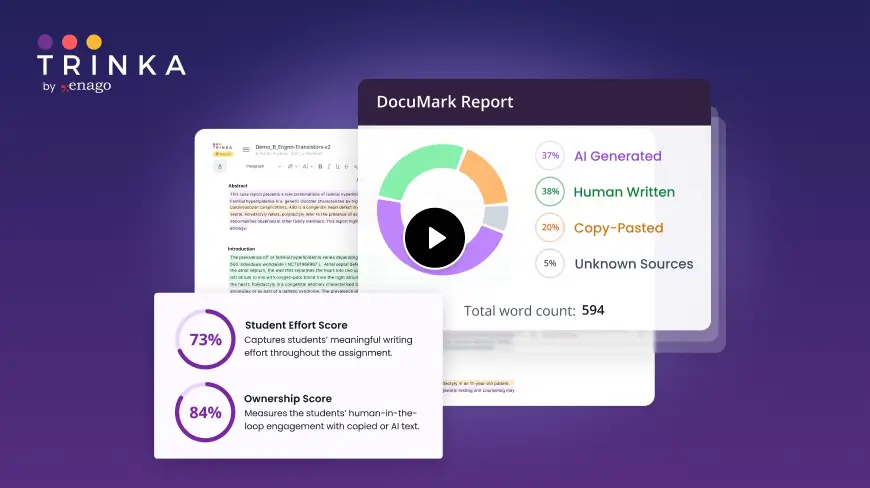
DocuMark: Responsible AI Use for Academic Integrity
Knowing your institution's AI policy is step one. DocuMark helps enforce it fairly by empowering universities to manage AI-generated content, prevent cheating, and support student writing through responsible AI use.
Common Questions About Athenaeum of Ohio's AI Policies
Athenaeum of Ohio has defined AI policies in 10 of 12 categories, with an overall coverage score of 83%.
Disclosure is required when AI content is quoted, paraphrased, or otherwise incorporated into student work. The university treats AI output as third-party content, so students must acknowledge its use and may not submit AI-generated content as their own.
If an instructor suspects undisclosed AI use, the instructor must follow the academic dishonesty process and confer with the student. The university allows AI detectors as one basis for reasonable suspicion, and possible consequences include redoing the assignment, an alternative assessment, or a failing grade on the assignment.
Students are prohibited from entering sensitive or confidential personal or institutional information into AI platforms. They also may not input course materials such as prompts, lectures, notes, or PDFs into AI platforms without the instructor's express permission. The sources do not identify any approved institutional AI platform.