Teaching & Learning
- For coursework and assignments, AI use is at the individual instructor’s discretion
- Students must not use AI for any coursework unless the instructor gives explicit permission; using AI without permission is treated as plagiarism/Academic Honesty Code violation
“Your instructor is the authority on whether you can use AI for their coursework, and in what ways. Do not use AI in any coursework without your instructors' explicit permission. If you use AI without permission, you violate the Academic Honesty Code...”
“Plagiarism includes, but is not limited to: ... submitting work in which portions were prepared by another student, person, or artificial intelligence device without the instructor’s permission.”
- Students are expected to complete examinations on their own unless the instructor directs otherwise
- Using AI on an exam/assessment without permission constitutes plagiarism under Auburn’s Academic Integrity Policy
“Students are expected to... complete all course assignments and examinations on their own, unless the instructor directs them to do otherwise...”
“Plagiarism includes, but is not limited to: ... submitting work in which portions were prepared by another student, person, or artificial intelligence device without the instructor’s permission.”
- Auburn encourages students to learn about AI, but use of AI for course-related learning support is still governed by the instructor
- Instructors may permit limited uses (e.g., brainstorming, grammar/syntax help, fact-checking, critiquing AI output), and students must follow the instructor’s directions
“Your instructor is the authority on whether you can use AI for their coursework, and in what ways...”
“Your instructor might ask you to: Use AI in specific and limited ways to brainstorm ideas... Correct grammar and syntax... Review and fact check AI-generated content... Critique AI-generated content...”
- For programming and code-related assignments, the same coursework rule applies: students must not use AI tools (including code generation) unless their instructor explicitly permits it; unauthorized AI use violates the Academic Honesty Code
“Your instructor is the authority on whether you can use AI for their coursework, and in what ways. Do not use AI in any coursework without your instructors' explicit permission. If you use AI without permission, you violate the Academic Honesty Code...”
Research
- When using generative AI for university work (including research writing/manuscript drafting), users should not rely on AI for factual accuracy and should review and edit AI-generated content for accuracy and bias before using it
“Do not rely on generative AI tools to produce accurate information. These tools produce content that may be outdated, inaccurate, or biased...”
“Review and edit any AI-generated content for accuracy and bias before use.”
- University personnel (including researchers) must not enter restricted/sensitive data into public generative AI services
- Examples of restricted data called out include PHI, student records (FERPA), export-controlled research (EAR/ITAR), CUI, and PII
“Users of generative AI should never enter any data classified as Restricted, such as Protected Health Information (PHI), student records (FERPA), Export-Controlled Research (EAR/ITAR), Controlled Unclassified Information (CUI), or Personally Identifiable Information (PII) into public generative AI services.”
- Auburn’s academic integrity rules and responsible-use guidance require ethical AI use: submitting work with AI-prepared portions without required permission is plagiarism, and users are responsible for reviewing and editing AI-generated content for accuracy and bias before use
“Plagiarism includes, but is not limited to: ... submitting work in which portions were prepared by another student, person, or artificial intelligence device without the instructor’s permission.”
“Review and edit any AI-generated content for accuracy and bias before use.”
Academic Integrity
- If AI use is allowed in a course, the instructor sets the requirements for how students should cite or attribute that AI use in assignments
“How should I cite my use of AI? Your instructor will provide you with specific instructions on how to cite any allowed use of AI in your assignments.”
- Using AI without an instructor’s permission is a violation of the Academic Honesty Code and is subject to the same penalties as other academic misconduct violations
“If you use AI without permission, you violate the Academic Honesty Code, and you will be subject to the same penalties as any other academic misconduct violation.”
Institutional & Administrative
- Faculty and staff using generative AI for university business should follow Auburn’s responsible-use guidance: do not rely on AI for accuracy, and review/edit AI-generated content for accuracy and bias before use
“The following guidelines are intended to govern the use of generative AIs by faculty, staff, and students when conducting University business...”
“Do not rely on generative AI tools to produce accurate information. These tools produce content that may be outdated, inaccurate, or biased.”
- Users must never input restricted or proprietary university information into public generative AI services
- If Auburn enters into an enterprise agreement with an AI provider, that approved platform should be considered the primary tool for work involving sensitive university data
“Users of generative AI should never enter any data classified as Restricted... into public generative AI services. This also includes any proprietary information that has not been publicly released...”
“To the extent the University enters into an enterprise agreement with an AI provider, that platform should be considered the primary tool for sensitive University data.”
- Auburn University has established a University AI Task Force (formed summer 2023) charged with developing a comprehensive, sustainable, and responsible approach to AI integration across instruction, research, and outreach
“University AI Task Force formed in summer 2023. Task Force Charge: Develop a comprehensive, sustainable, and responsible approach to AI integration across Auburn’s missions of instruction, research, and outreach.”
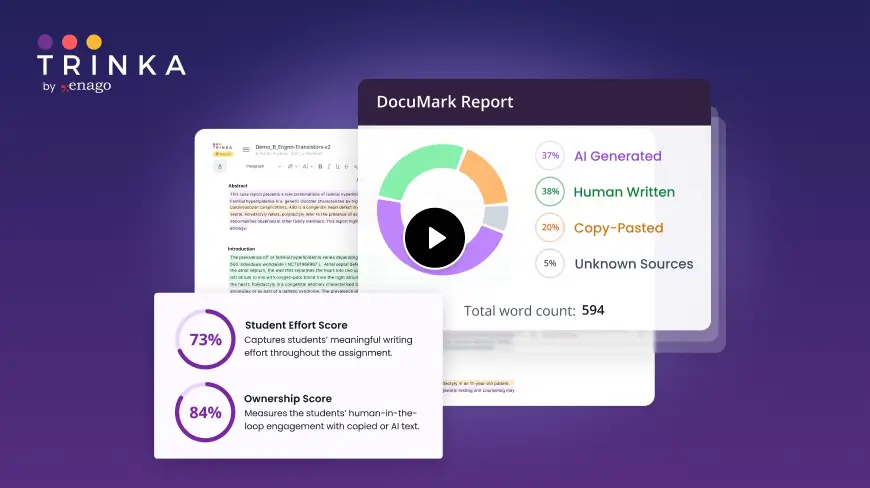
DocuMark: Responsible AI Use for Academic Integrity
Knowing your institution's AI policy is step one. DocuMark helps enforce it fairly by empowering universities to manage AI-generated content, prevent cheating, and support student writing through responsible AI use.
Common Questions About Auburn University's AI Policies
Auburn University has defined AI policies in 12 of 12 categories, with an overall coverage score of 100%.
If AI use is allowed in a course, the instructor sets the requirements for how students should cite or attribute that AI use in assignments.
Using AI without an instructor’s permission is a violation of the Academic Honesty Code and is subject to the same penalties as other academic misconduct violations.
Users must never input restricted or proprietary university information into public generative AI services. If Auburn enters into an enterprise agreement with an AI provider, that approved platform should be considered the primary tool for work involving sensitive university data.