Teaching & Learning
- Use of generative AI for academic work is not governed by a single blanket permission rule
- Instructors may further restrict student use of AI tools for academic work, and students are expected to follow the instructor’s stated expectations; unauthorized assistance on coursework submitted for credit is treated as an academic honesty violation
Instructors reserve the right to further restrict use of AI tools by students to complete academic work, in order to meet educational objectives. Students should be given clear and unambiguous expectations for use of AI tools, as well as awareness of disciplinary consequences of misuse.
A.The possession, receipt, transmission, or use of any material or assistance not authorized in the preparation of any academic exercises to be submitted for credit as a part of a course or to be submitted in fulfillment of a university requirement.
- Whether a tool is allowed depends on authorization, and violations are handled under the Student Academic Honesty Code
- AI use during exams or quizzes is not addressed by name, but the university prohibits any unauthorized assistance or unauthorized material during exams and quizzes
Actions that violate this code include, but are not limited to, plagiarism and receiving or supplying unauthorized assistance on a class exam or assignment.
B.The possession, receipt, transmission, or use of unauthorized material while an exam or quiz is in progress.
- The advisory guidance only states that AI output should be treated cautiously and as a source of ideas rather than facts
- The university does not define a specific policy for students using AI as a study aid or for personal learning outside graded work
Caution should be exercised when relying on generative AI output, and a good practice is to treat AI tools as sources of ideas, rather than facts.
- Student use for coding-related academic work is therefore subject to instructor restrictions and academic honesty rules on unauthorized assistance
- The advisory guidance identifies GitHub Copilot and similar tools as generative AI tools, but it does not set a separate university-wide rule for programming assignments
With the emergence and widespread availability of public generative AI tools (GPT-4, ChatGPT, AlphaCode, GitHub Copilot, Bard, DALL-E 2, to name a few), many members of our community are eager to explore their use in the university context (example uses could include student academic work, faculty research, admissions, employee recruitment, etc.).
Instructors reserve the right to further restrict use of AI tools by students to complete academic work, in order to meet educational objectives. Students should be given clear and unambiguous expectations for use of AI tools, as well as awareness of disciplinary consequences of misuse.
A.The possession, receipt, transmission, or use of any material or assistance not authorized in the preparation of any academic exercises to be submitted for credit as a part of a course or to be submitted in fulfillment of a university requirement.
Research
- The only explicit university-wide guidance in the provided sources concerns data protection, privacy, accuracy, and review of AI output
- The university acknowledges that AI tools may be explored in faculty research, but it does not define specific rules for using AI to draft, edit, or improve research manuscripts
With the emergence and widespread availability of public generative AI tools (GPT-4, ChatGPT, AlphaCode, GitHub Copilot, Bard, DALL-E 2, to name a few), many members of our community are eager to explore their use in the university context (example uses could include student academic work, faculty research, admissions, employee recruitment, etc.).
Accuracy: Output of a public generative AI tool can be based on an almost endless array of tools, datasets, learning algorithms, and user inputs. Therefore, these tools may not in all cases produce accurate (or fully accurate) results within the context of your particular task. Caution should be exercised when relying on generative AI output, and a good practice is to treat AI tools as sources of ideas, rather than facts.
- AUM prohibits using public generative AI tools with operational or confidential data unless specific legally binding protections and procedures are in place
- Public data may be used, but users are warned that there is no expectation of privacy and that outputs intended for non-public use should not be generated with public AI tools
Current Auburn University at Montgomery Environment: AUM currently does not deploy a private generative AI tool for institutional use.
1. Prohibited: Data defined as “operational data” or “confidential data” in the Data Classification Policy should never be shared with, submitted to, or used with a public generative AI tool in the absence of specific, legally binding data security protection agreements and procedures.
2. Allowable: “Public data” as defined in the Data Classification Policy may be used freely in public generative AI tools, subject to the following restrictions:
a. Users should have no expectation of privacy in data they input into public generative AI tools, or in output produced by the tool. In most cases, the tool retains the right to use any data you input or any output the tool produces. Accordingly, these tools should not be used to generate output intended for non-public use.
Academic Integrity
- The provided sources do not set a university-wide AI-specific disclosure or citation requirement
- They do require acknowledgment when another person’s ideas are used in academic work and place responsibility on instructors to communicate expectations for AI use in student academic work
Instructors reserve the right to further restrict use of AI tools by students to complete academic work, in order to meet educational objectives. Students should be given clear and unambiguous expectations for use of AI tools, as well as awareness of disciplinary consequences of misuse.
When the ideas of another are incorporated into an academic exercise, they must be appropriately acknowledged. In starkest terms, plagiarism is stealing using the words or ideas of another as if they were one’s own. For example, if another person’s complete sentence, syntax, key words or specific or unique ideas and information are used, one must give that person credit through proper documentation or recognition (e.g., through the use of footnotes).
- The university does not state a position on AI detection tools in the provided sources
- It does define enforcement procedures for academic dishonesty, including written notice, reporting to the Academic Honesty Committee, and sanctions ranging from a zero on the work to expulsion
A charge of violation of the academic honesty code can be made by any member of the university community. Sanctions can range from a zero on the assignment up to and including expulsion from the University.
The following sanctions may be imposed for violation of the Student Academic Honesty Code:
A. The instructor of a course in which a violation of the Student Academic Honesty Code occurs may assign the student(s) committing the violation a grade of F in the course. A copy of the student notification of this action shall be delivered to the dean of the school in which the class is taught and to the chair of the Academic Honesty Committee;
B. The instructor of a course in which a violation of the Student Academic Honesty Code occurs may assign a zero grade on the examination, project, paper, etc. with written notification to the dean of the school in which the class is taught;
C. Suspension from Auburn University at Montgomery for a stated period of time during which the student will not be allowed to take any courses at Auburn University at Montgomery either in residence or by any distance learning format.
If the faculty member believes there may have been cheating the faculty member/instructor should report to the Associate Provost. Once there has been evidence of cheating, the faculty member or instructor should report it to the Academic Honesty Committee. This is the only way sanctions can be consistent and the only way multiple offenders can be caught.
Institutional & Administrative
- Faculty and staff are included in the university community covered by the AI advisory guidance, and faculty research is expressly listed as a context where AI use may arise
- The provided sources do not define specific rules for grading, feedback, lesson planning, recommendation letters, or administrative communications, but they do require careful review of AI outputs and note that instructors may set student-facing limits on AI use
With the emergence and widespread availability of public generative AI tools (GPT-4, ChatGPT, AlphaCode, GitHub Copilot, Bard, DALL-E 2, to name a few), many members of our community are eager to explore their use in the university context (example uses could include student academic work, faculty research, admissions, employee recruitment, etc.).
Bias: Public generative AI tool output may unintentionally produce biased, discriminatory, offensive, or otherwise undesirable results, especially if used in the context of admissions, recruitment, or disciplinary decision making. Again, use of these tools should be carefully reviewed before relying on results.
Instructors reserve the right to further restrict use of AI tools by students to complete academic work, in order to meet educational objectives.
- AUM does not currently provide a private generative AI tool for institutional use
- Operational and confidential data must not be entered into public generative AI tools without specific legally binding protections, public data may be used subject to restrictions, and users are warned that public AI tools do not provide privacy protections; any AI tool purchase must follow the Software Acquisition Policy
Current Auburn University at Montgomery Environment: AUM currently does not deploy a private generative AI tool for institutional use.
1. Prohibited: Data defined as “operational data” or “confidential data” in the Data Classification Policy should never be shared with, submitted to, or used with a public generative AI tool in the absence of specific, legally binding data security protection agreements and procedures.
2. Allowable: “Public data” as defined in the Data Classification Policy may be used freely in public generative AI tools, subject to the following restrictions:
a. Users should have no expectation of privacy in data they input into public generative AI tools, or in output produced by the tool. In most cases, the tool retains the right to use any data you input or any output the tool produces. Accordingly, these tools should not be used to generate output intended for non-public use.
b. Any purchase or acquisition of an AI tool must comply with the Software Acquisition Policy
Privacy: Public generative AI tools are not designed to protect the privacy of your data; therefore, it is highly risky to input any confidential, proprietary, or otherwise sensitive information (PII, health information, ID numbers, financial information, etc.) into these tools.
- The guidance identifies the offices responsible for helping users manage AI-related risks and directs questions to those units
- AUM has advisory guidance on generative AI issued jointly by multiple offices, but the provided sources do not set out a broader institutional AI strategy or roadmap
The following guidelines have been established jointly by the Auburn Office of Information Technology, Auburn University at Montgomery Information Technology Services, the Office of the General Counsel, and the Office of Audit, Compliance & Privacy to help you identify and mitigate risks associated with the use of AI tools:
For questions regarding the appropriate use of AI tools, please contact the Auburn University at Montgomery Information Technology Services, the Office of the General Counsel, or the Office of Audit, Compliance & Privacy.
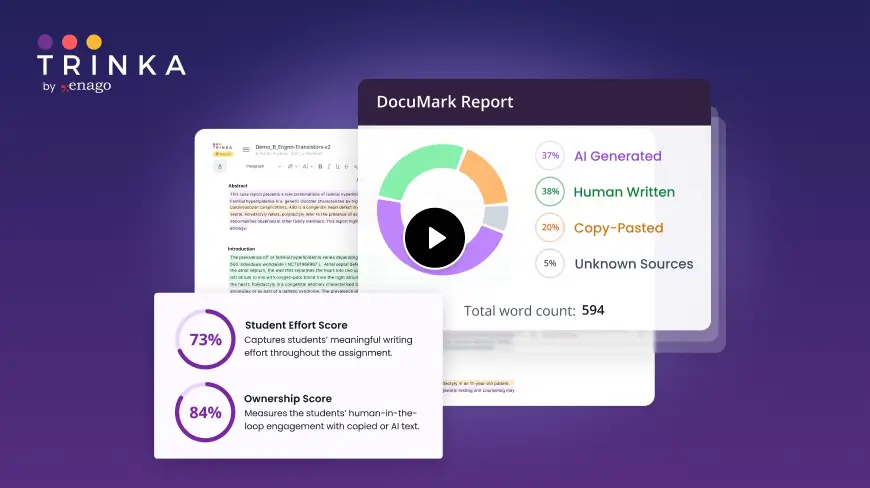
DocuMark: Responsible AI Use for Academic Integrity
Knowing your institution's AI policy is step one. DocuMark helps enforce it fairly by empowering universities to manage AI-generated content, prevent cheating, and support student writing through responsible AI use.
Common Questions About Auburn University at Montgomery's AI Policies
Auburn University at Montgomery has defined AI policies in 11 of 12 categories, with an overall coverage score of 92%.
The provided sources do not set a university-wide AI-specific disclosure or citation requirement. They do require acknowledgment when another person’s ideas are used in academic work and place responsibility on instructors to communicate expectations for AI use in student academic work.
The university does not state a position on AI detection tools in the provided sources. It does define enforcement procedures for academic dishonesty, including written notice, reporting to the Academic Honesty Committee, and sanctions ranging from a zero on the work to expulsion.
AUM does not currently provide a private generative AI tool for institutional use. Operational and confidential data must not be entered into public generative AI tools without specific legally binding protections, public data may be used subject to restrictions, and users are warned that public AI tools do not provide privacy protections; any AI tool purchase must follow the Software Acquisition Policy.