Teaching & Learning
- For student coursework, generative AI and similar technologies are prohibited by default unless an instructor specifically allows them
- Austin College also states that instructors set course-specific expectations, and each syllabus must explain how the academic integrity policy applies in that course
Unless specified otherwise by an instructor, students must avoid such technology as:
• Generative AI and Large Language Model (LLM) services, websites,
or apps exemplified by, but not limited to sites and services such as
ChatGPT, DALL-E, Bard, Magenta, MuseNet, Jasper, Writesonic,
Copysmith, Rytr, AI Writer, Copy AI, ClosersCopy, or Writecream.
Recognizing that
specifics of violations may be differently defined in different courses, the
college gives instructors the authority to determine expectations and provide
instructions for source-specific circumstances. The syllabus for each course
must include an academic integrity policy statement and an indication of how it
applies to the course.
Exercises - The student is expected to fulfill assignments without collaboration
on work submitted for a grade unless expressly instructed otherwise.
- AI use during tests is prohibited unless the instructor designates otherwise
- The college's default rule is that tests are closed-book and must be completed without electronic aids, and use of prohibited electronic devices during an exam is identified as cheating
Examples include, but are not limited to, using or
copying another person’s work and submitting it as original, the use of “crib
sheets” or prohibited electronic devices during an exam, and providing the
material or mechanism for another student to cheat.
Closed book tests – On all tests, students are expected to provide work that is
exclusively original, without the use of notes or other materials prepared before
the test. A test is assumed to be "closed-book" and must be completed without
electronic or other aids unless designated otherwise.
- AI may be used for study assistance only when the instructor permits it
- When allowed, the college says these tools may be used to generate study guides or as a research source, and the resulting source material should be cited using the instructor's specified method
When permitted by an instructor, such technology may be useful to students
as a tool to generate study guides or to use as a research source, which then
should be cited as source material by using a method specified by the
instructor.
- For coding-related student work, AI-assisted help is prohibited by default unless an instructor allows it
- The policy explicitly includes generative AI tools and coding-help websites among technologies students must avoid unless the instructor specifies otherwise
Unless specified
otherwise by an instructor, students must avoid such technology as:
• Generative AI and Large Language Model (LLM) services, websites,
or apps exemplified by, but not limited to sites and services such as
ChatGPT, DALL-E, Bard, Magenta, MuseNet, Jasper, Writesonic,
Copysmith, Rytr, AI Writer, Copy AI, ClosersCopy, or Writecream.
• Help or Cheat websites or apps exemplified by, but not limited to,
Chegg, Numerade, DoMyCoding, Photomath, CodingHomeworkHelp,
BookwormHub, or Course Hero.
Recognizing that
specifics of violations may be differently defined in different courses, the
college gives instructors the authority to determine expectations and provide
instructions for source-specific circumstances.
Research
- If an instructor allows the technology, it should be cited as source material using the instructor's specified method
- The university does not define a separate research-manuscript AI policy, but for student papers it requires attribution for sourced material and treats generative AI as something students must avoid unless an instructor permits it
Unless specified
otherwise by an instructor, students must avoid such technology as:
• Generative AI and Large Language Model (LLM) services, websites,
or apps exemplified by, but not limited to sites and services such as
ChatGPT, DALL-E, Bard, Magenta, MuseNet, Jasper, Writesonic,
Copysmith, Rytr, AI Writer, Copy AI, ClosersCopy, or Writecream.
When permitted by an instructor, such technology may be useful to students
as a tool to generate study guides or to use as a research source, which then
should be cited as source material by using a method specified by the
instructor.
Papers - When a paper includes direct or indirect quotations or an idea or
information taken from a source, that source must be acknowledged.
- The verified sources do not define any AI-specific rules for using AI in data collection, analysis, or interpretation
- Austin College requires students collecting information in research exercises to report accurate information and prohibits fabrication or falsification of information or results
Collection of information - The student is expected to collect and report
accurate information in a research exercise and must not fabricate or falsify
the information or results.
Academic Integrity
- Citation practices may vary by discipline, and instructors are responsible for guiding students on acceptable forms of citation
- Austin College requires attribution when source material is used in papers, and when AI use is permitted by an instructor, it should be cited as source material using the instructor's specified method
When permitted by an instructor, such technology may be useful to students
as a tool to generate study guides or to use as a research source, which then
should be cited as source material by using a method specified by the
instructor.
Papers - When a paper includes direct or indirect quotations or an idea or
information taken from a source, that source must be acknowledged. Because
conventions for citing sources vary by discipline and may differ for courses
within a discipline, instructors are obliged to guide students in the acceptable
forms of citation for each course.
- Austin College enforces AI-related misconduct through its academic integrity process rather than stating a separate AI-detection policy
- Instructors who suspect a violation must notify the student in writing and meet with them, may assess course penalties, and additional college penalties can include probation, suspension, or expulsion; records of violations are kept confidentially by the VPAA
Any instructor who suspects a violation of academic integrity must notify the
suspected violator(s) in writing as soon as the allegation is clearly defined.
The instructor must
then meet with the student(s) involved to discuss the allegation.
The instructor assesses an in-course penalty for the violation, ranging
from partial to complete failure on the assignment to failure in the
course, following the course syllabus. The instructor also informs the
VPAA of the violation and the assessed in-course penalty.
Council-assessed penalties for violations include probation for one or
two long semesters, suspension for one or two long semesters, or
expulsion.
In all instances, a record of academic integrity violations is
kept in the student's confidential file by the VPAA
Institutional & Administrative
- The verified sources do not define a faculty or staff AI-use policy for grading, feedback, lesson planning, recommendation letters, or administrative communications
- The handbook only states that faculty and administrators share responsibility for upholding academic integrity and that instructors must communicate course expectations
Upholding these
expectations of academic work is a cooperative effort between students,
faculty, and administrators.
Instructors will communicate to students
when and how course expectations differ from or add to the General
Guidelines for Student Work.
As stated in the Operational Guide, GM 15, every course
syllabus must contain a statement on academic integrity and how the general
guidelines given above apply to the particulars of the course.
- The library page is presented as a subject guide accompanying a workshop on generative AI
- The library guide shows Austin College has educational programming and informational resources on generative AI, but the verified sources do not define an institutional AI governance framework, committee, or strategy
This subject guide accompanies the workshop put on at Austin College by both Abell Library and the Scarbrough Center for Writing in regard to the topic of Generative Artificial Intelligence (AI).
Generative AI is one type of AI that uses user prompts to generate images, text, and other mediums.
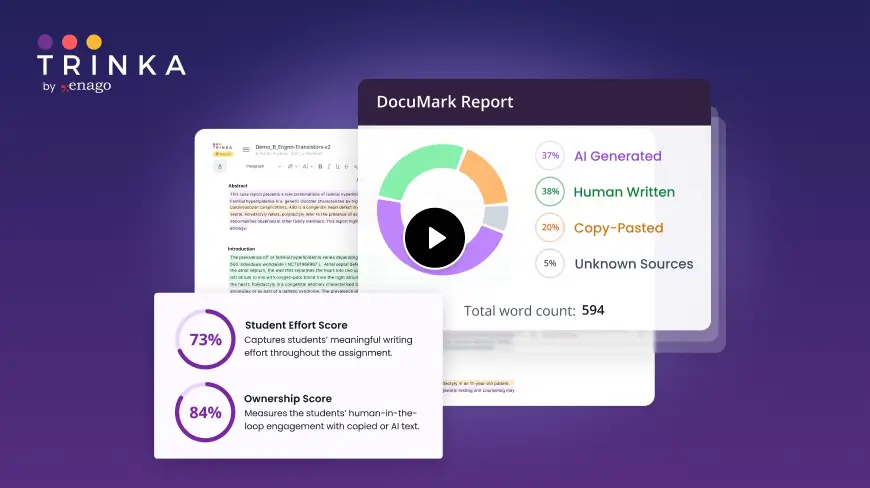
DocuMark: Responsible AI Use for Academic Integrity
Knowing your institution's AI policy is step one. DocuMark helps enforce it fairly by empowering universities to manage AI-generated content, prevent cheating, and support student writing through responsible AI use.
Common Questions About Austin College's AI Policies
Austin College has defined AI policies in 10 of 12 categories, with an overall coverage score of 83%.
Austin College requires attribution when source material is used in papers, and when AI use is permitted by an instructor, it should be cited as source material using the instructor's specified method. Citation practices may vary by discipline, and instructors are responsible for guiding students on acceptable forms of citation.
Austin College enforces AI-related misconduct through its academic integrity process rather than stating a separate AI-detection policy. Instructors who suspect a violation must notify the student in writing and meet with them, may assess course penalties, and additional college penalties can include probation, suspension, or expulsion; records of violations are kept confidentially by the VPAA.
No explicit data protection or approved AI platform policy is currently defined in the available policy sources.