Teaching & Learning
- When allowed, students must cite it according to course guidelines and are expected to disclose its use when in doubt
- For academic assignments, use of generative AI in any aspect of the writing process is prohibited unless the instructor explicitly permits it
- If the instructor does not clearly allow it, generative AI use is treated as assistance from another person, and failure to cite it constitutes academic plagiarism
Regarding academic assignments, violations of the Honor Code shall include representing another’s work or
any part thereof, be it published or unpublished, as one’s own. They shall also include presenting or submitting
any academic work in a manner that impairs the instructor’s ability to assess the student’s academic
performance. Plagiarism is the act of passing off as one’s own the ideas or writings of another. It can include
quoting, paraphrasing, summarizing, or utilizing the published or unpublished work of others without proper
acknowledgement (e.g., failure to use quotation marks or other conventional markings around material quoted
from any source, or failure to cite paraphrased ideas). Most frequently, it involves the unacknowledged use of
websites, whether as direct copying or as paraphrasing. Students are responsible for educating themselves
as to the proper mode of attributing credit in any course or field. Note that plagiarism can be said to have
occurred without any affirmative showing that a student’s use of another’s work was intentional. Academic
plagiarism may also include the use of generative AI or language translation software in any aspect of the
writing process without the explicit permission of the instructor. Generative AI refers to the use of artificial
intelligence to create original content based on patterns it has learned. Absent a clear statement from the
course instructor, use of or consultation with generative AI shall be treated as assistance from another person.
Failure to adequately cite its use will therefore constitute academic plagiarism. When generative AI is allowed
by the instructor, its use must be cited appropriately according to the course guidelines. Students should
acknowledge the use of generative AI and default to disclosing such assistance when in doubt. Adequately
citing the use of generative AI does not constitute a violation of the Honor Code. As autocomplete, spell-check,
and grammar-check are not generative AI, they are exempted from this policy.
- The university does not set a separate coding-specific AI policy in these catalogs
- The only explicit statement related to AI and coding appears in a course description that says students will use AI tools in a data management course, but it does not establish a general rule for programming assignments
DATA 220 DATA MANAGEMENT WITH ARTIFICIAL INTELLIGENCE
Creation of database schemata; practice loading and extracting information using SQL (relational databases) and
introduction into noSQL (which includes non-relational databases). The goal of the course is for students to understand the
challenges surrounding data storage and access and for students to be equipped with SQL skills to begin loading and pulling
data. A key element of the course is the judicious use of Artificial Intelligence tools to accelerate data management tasks.
Research
Academic Integrity
- If generative AI is used with instructor permission, students must cite it according to course guidelines
- The catalog also says students should acknowledge generative AI use and default to disclosing it when in doubt; failure to adequately cite it is treated as academic plagiarism
Absent a clear statement from the
course instructor, use of or consultation with generative AI shall be treated as assistance from another person.
Failure to adequately cite its use will therefore constitute academic plagiarism. When generative AI is allowed
by the instructor, its use must be cited appropriately according to the course guidelines. Students should
acknowledge the use of generative AI and default to disclosing such assistance when in doubt. Adequately
citing the use of generative AI does not constitute a violation of the Honor Code.
- Students are expected to report Honor Code violations to the instructor and/or the Dean of Faculty, but the catalogs do not mention AI detection software
- The university states that academic dishonesty will be dealt with seriously, and failure to adequately cite generative AI use constitutes academic plagiarism
Academic integrity requires all members of the academic community always to act honorably and responsibly. Every act of
academic dishonesty seriously undermines the mission of the AMU and will be dealt with seriously.
Failure to adequately cite its use will therefore constitute academic plagiarism.
2. Any student who violates the Honor Code is expected to report the violation to the instructor and/or the Dean of
Faculty.
Institutional & Administrative
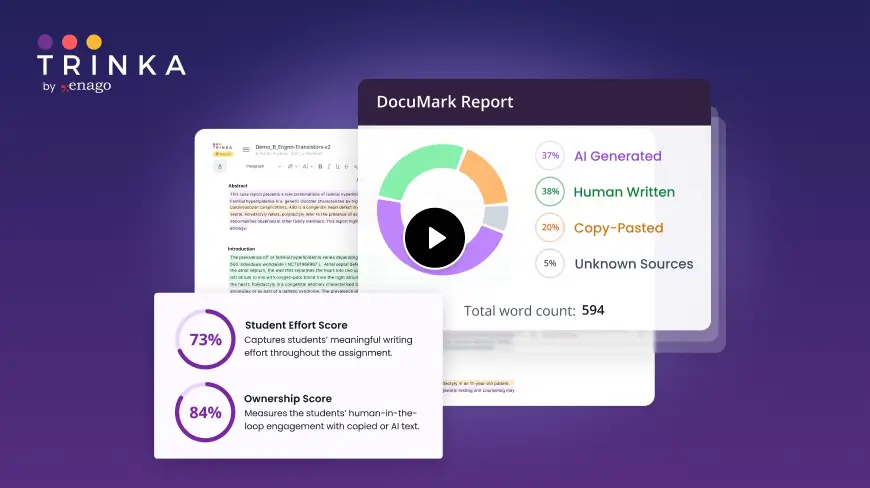
DocuMark: Responsible AI Use for Academic Integrity
Knowing your institution's AI policy is step one. DocuMark helps enforce it fairly by empowering universities to manage AI-generated content, prevent cheating, and support student writing through responsible AI use.
Common Questions About Ave Maria University's AI Policies
Ave Maria University has defined AI policies in 4 of 12 categories, with an overall coverage score of 33%.
If generative AI is used with instructor permission, students must cite it according to course guidelines. The catalog also says students should acknowledge generative AI use and default to disclosing it when in doubt; failure to adequately cite it is treated as academic plagiarism.
The university states that academic dishonesty will be dealt with seriously, and failure to adequately cite generative AI use constitutes academic plagiarism. Students are expected to report Honor Code violations to the instructor and/or the Dean of Faculty, but the catalogs do not mention AI detection software.
No explicit data protection or approved AI platform policy is currently defined in the available policy sources.