Teaching & Learning
- For students, AI use in graded coursework is generally prohibited unless the instructor gives prior or explicit permission
- When permitted, students must disclose and cite the AI use, and faculty may set course-specific AI rules through the syllabus or class guidance
Students may not use, without prior permission, generative artificial intelligence (AI) tools for work submitted for credit; any and all use of such tools must be acknowledged and cited in accordance with item (4) above.
Students may use AI for brainstorming, research support, grammar/style editing, study aids, and learning/exploration, only with explicit instructor permission and proper disclosure/citation.
Instructors set course-specific AI policies; students must follow these and seek clarification when questions arise.
All APU courses need to have a clear guideline about the use of artificial intelligence (AI) tools. The following document provides faculty with three suggested AI classroom use options to include in syllabi. Faculty can choose one of the statements and modify, if desire, to fit their course requirements.
- For students, AI use during tests is prohibited unless the professor explicitly approves it
- Exams are treated as the student's own work unless otherwise understood and approved by the professor
All work submitted for credit, including exams, is accepted as a student’s own work, unless otherwise understood and approved by the professor.
Students may not use notes or other forms of assistance on a test, such as videos, illustrations, artificial intelligence (AI) generated materials, and the like, unless explicitly approved by the professor, nor may they provide such aid to other students.
- The university also requires students to verify AI-generated information and treat AI as an assistant rather than a substitute for their own thinking
- APU permits students to use AI as a learning aid, including for brainstorming, study aids, and learning or exploration, but only with explicit instructor permission and with proper disclosure and citation when used in academic work
This policy upholds APU’s academic integrity, promotes responsible AI use (like Google Gemini and NotebookLM) as a learning aid, requires transparent disclosure, and fosters critical evaluation of AI-generated content.
Permitted Uses (with Instructor Permission and Transparency): Students may use AI for brainstorming, research support, grammar/style editing, study aids, and learning/exploration, only with explicit instructor permission and proper disclosure/citation.
Students are responsible for the originality, accuracy, and integrity of all submitted work. Always verify AI-generated information, critically evaluate output, and ensure the final work reflects your own critical thinking.
You can use Google AI as a learning partner, not a replacement for your own work.
- No programming-specific student policy is separately defined
- Code generation falls under the general student AI rule: use of generative AI for work submitted for credit requires prior instructor permission, and permitted use must be acknowledged and cited
Generative AI (Gen AI): AI tools capable of creating new content (e.g., text, images, code, audio) in response to prompts.
Students may not use, without prior permission, generative artificial intelligence (AI) tools for work submitted for credit; any and all use of such tools must be acknowledged and cited in accordance with item (4) above.
Research
- For graduate work, AI-generated materials may not be used in work submitted for credit without permission
- The graduate academic integrity policy also states that, in coursework, research, and publications, failing to acknowledge collaborative efforts is a violation, but it does not provide a research-writing-specific AI rule beyond those statements
d) Students may not use artificial intelligence (AI) generated materials for work submitted for credit without permission.
In courses, collaborating with another student or external person or entity beyond the extent specifically approved by the instructor is considered a violation. In coursework, research, and/or publications, the failure to acknowledge or misrepresent the collaborative efforts of others is also a violation.
- A general academic integrity rule prohibits falsifying data
- The university does not define a specific AI policy for research data collection, analysis, statistical processing, synthetic data, or interpretation of results
b) Falsifying data.
- APU addresses research integrity only at a general level in the graduate academic integrity policy
- It states that in coursework, research, and publications, misrepresenting or failing to acknowledge collaborative efforts is a violation, but it does not define AI-specific rules for grant proposals, IRB applications, or research ethics declarations
In courses, collaborating with another student or external person or entity beyond the extent specifically approved by the instructor is considered a violation. In coursework, research, and/or publications, the failure to acknowledge or misrepresent the collaborative efforts of others is also a violation.
Academic Integrity
- When AI use is permitted, students must clearly disclose and properly cite it
- APU states that AI use should be transparent, may need to be identified on the title page and in-text, and students must be ready to provide prompts and raw AI output if requested
When permitted, students must clearly disclose and properly cite AI tool use (e.g., on title page and in-text). They must also be prepared to provide prompts and raw AI output if requested.
Students may not use, without prior permission, generative artificial intelligence (AI) tools for work submitted for credit; any and all use of such tools must be acknowledged and cited in accordance with item (4) above.
Yes, if you use an AI tool to generate ideas, text, or images that you include in your academic work, you must cite it.
You should also include the prompt you used in the text or as an appendix.
- APU treats AI policy violations as academic integrity breaches subject to disciplinary action under the student handbook and academic integrity policy
- The university notes that AI detection tools exist but says they are not always reliable; instead, students may be required to reveal how and to what extent AI was used
Policy violations are academic integrity breaches, leading to disciplinary action as outlined in APU’s Student Handbook and according to the Academic Integrity Policy.
Many AI detection tools exist, but they are not always reliable and can sometimes flag original student work. The best practice is to be honest and transparent with your professor from the beginning. APU’s policy states that when requested, you must be able to reveal how and to what extent AI was used.
Institutional & Administrative
- Faculty are given discretion to set course-specific AI policies and are expected to include clear AI guidance in course syllabi
- APU also provides faculty guidance on Gemini for teaching-related uses and instructs faculty to emphasize critical evaluation of AI output
Instructors set course-specific AI policies; students must follow these and seek clarification when questions arise.
All APU courses need to have a clear guideline about the use of artificial intelligence (AI) tools. The following document provides faculty with three suggested AI classroom use options to include in syllabi. Faculty can choose one of the statements and modify, if desire, to fit their course requirements.
Gemini was rolled out to faculty in March along with training and guides to keep faculty informed of the benefits of AI while encouraging them to become familiar with the guidelines of the policy. While some disciplines are expected to use the system more than others, use of Gemini is at the discretion of the professor.
Faculty should emphasize to students that Gemini's output should be critically evaluated for accuracy and potential bias.
- APU provides institution-specific data protection guidance for its Google Gemini environment
- Users are instructed to log in with APU accounts, and the university states that data entered into APU Gemini is protected, not used to train the model, not publicly accessible, and isolated from other users
APU is committed to protecting the privacy and security of all data entered into the APU Google Gemini environment. To ensure confidentiality, it is essential that users log in with their APU accounts when accessing Google Gemini.
All data entered into APU’s Google Gemini is protected and secure.
User input is not used to train the AI model.
No data will ever be made publicly accessible.
APU’s Google Gemini environment enforces strict data isolation to ensure that user interactions remain private and independent.
No user’s input is accessible by or influences another user’s results.
- The university also identifies an AI Stewardship Group, a cross-campus committee of faculty and staff, as part of the policy's creation and rollout
- APU has a campus-wide AI policy and describes a broader institutional strategy centered on responsible and ethical use, academic integrity, and preparation for an AI-integrated world
This policy outlines the responsible and ethical use of Artificial Intelligence (AI) tools, including generative AI like Google Gemini and knowledge management tools like NotebookLM, for Azusa Pacific University (APU) students. It is designed to uphold APU’s commitment to academic integrity, foster critical thinking, and prepare students for an AI-integrated world, all within the framework of our Christ-centered mission.
In concurrence with the start of the fall semester, Azusa Pacific University rolled out a new campus wide AI policy.
The two co-chair the AI Stewardship Group (ASG), a cross campus, cross functional committee of faculty and staff from IT, cyber security, advancement, and student belonging behind the policy’s creation and roll out.
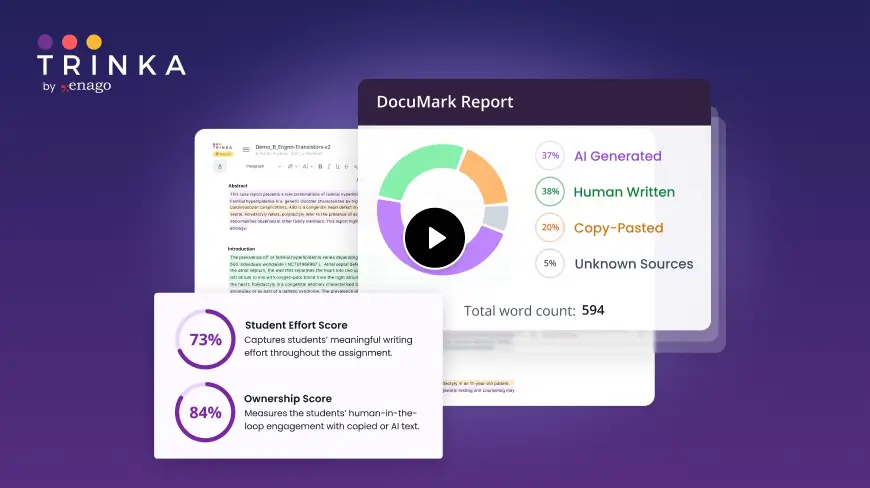
DocuMark: Responsible AI Use for Academic Integrity
Knowing your institution's AI policy is step one. DocuMark helps enforce it fairly by empowering universities to manage AI-generated content, prevent cheating, and support student writing through responsible AI use.
Common Questions About Azusa Pacific University's AI Policies
Azusa Pacific University has defined AI policies in 12 of 12 categories, with an overall coverage score of 100%.
When AI use is permitted, students must clearly disclose and properly cite it. APU states that AI use should be transparent, may need to be identified on the title page and in-text, and students must be ready to provide prompts and raw AI output if requested.
APU treats AI policy violations as academic integrity breaches subject to disciplinary action under the student handbook and academic integrity policy. The university notes that AI detection tools exist but says they are not always reliable; instead, students may be required to reveal how and to what extent AI was used.
APU provides institution-specific data protection guidance for its Google Gemini environment. Users are instructed to log in with APU accounts, and the university states that data entered into APU Gemini is protected, not used to train the model, not publicly accessible, and isolated from other users.