Teaching & Learning
- For enrolled students, submitting academic work obtained from AI platforms for an assignment is treated as cheating and is prohibited
- Separately, Bard College Berlin states in admissions guidance that applicants should write their own application responses and that generative AI undermines the purpose of the graded writing sample
4. Cheating: the attempt to deceive by gaining or providing unauthorized advantage or assistance in a College examination or assignment, including attempts to copy from other students in an examination, communicating answers with another student in an examination, the use of unauthorized materials or information and prepared answers in an examination, impersonation (taking an examination on behalf of another or having someone take an examination on one’s own behalf), and the submission of academic work acquired from another student, AI platforms, or via essay mills and other such commercial enterprises providing writing services
Bard College Berlin requests writing samples from applicants because we are interested in knowing how you engage with texts, develop your own analysis and arguments, and convey your thoughts on a particular topic or idea. Using generative AI undermines this process. The BCB Admissions Committee takes the time to read the writing in your application thoroughly - please take the time to reflect on the prompts in the application and write your own responses.
- Use of AI platforms to submit academic work in examinations is prohibited as cheating
- The handbook places AI platforms alongside other unauthorized means of gaining advantage in examinations and assignments
4. Cheating: the attempt to deceive by gaining or providing unauthorized advantage or assistance in a College examination or assignment, including attempts to copy from other students in an examination, communicating answers with another student in an examination, the use of unauthorized materials or information and prepared answers in an examination, impersonation (taking an examination on behalf of another or having someone take an examination on one’s own behalf), and the submission of academic work acquired from another student, AI platforms, or via essay mills and other such commercial enterprises providing writing services
- The university does not set a current binding rule here in the provided sources
- It states that it is working to establish informed guidelines and a nuanced policy on ethical AI use, including responsible use in the student handbook
Generative artificial intelligence is reshaping education and Bard College Berlin is working to address this growing influence through the AI Aware Universities project . Led by the Center for Information, Democracy, and Citizenship (CIDC) at the American University in Bulgaria , the initiative unites five European universities to examine AI’s impact on academia and establish informed guidelines for its use.
“The idea is to give students a chance to talk about how generative AI is being used in well-meaning ways. And then, to figure out how it can be ethically applied in our context,” explains Dr. Jeffrey Champlin , the coordinator of this project at BCB.
The discussion will focus on defining responsible AI use and drafting an updated AI policy for the student handbook. “The proposed policy is ultimately for the faculty to review. Our goal is to produce and propose something that is more nuanced than a blanket ban, and would likely include an appendix outlining acceptable uses of AI,” Champlin explained.
Research
Academic Integrity
- The provided sources do not give a specific AI citation format or AI-specific disclosure statement requirement
- The handbook requires appropriate attribution and citation for the words or work of others, and says students should consult advisors or instructors if unsure what counts as plagiarism or academic misconduct
1. Plagiarism: The presentation of the work or words of another as one’s own, without appropriate attribution and/or citation, whether intentional or not. Plagiarism includes:
a. The attempt to pass off the work of others as one’s own
b. Presenting the exact words of others as one’s own
c. Presenting the exact words or paraphrasing borrowings from other sources without appropriate attribution and/or citation
2. Collusion: The collaboration by two or more students on an assignment without appropriate attribution or authorisation. Providing one’s own work to someone else to copy or copying work provided by another, whether wholly or in part, is collusion
3. Resubmission of one’s own work: The re-use of one’s own work (whether wholly or in part) for another assignment without appropriate attribution. Work that a student has published or completed outwith their study at the College must also be appropriately cited
If a student is in any way uncertain about what constitutes plagiarism or any of the above acts of academic misconduct, they should consult their academic advisors or course instructors.
- No AI detection tool policy is stated in the provided sources
- Undisclosed submission of academic work acquired from AI platforms is handled through the academic misconduct process
- Any community member may report an alleged violation, faculty must file an Academic Integrity Incident Report even if they resolve the matter themselves, and the Academic Integrity Board can impose penalties up to failing grades and an FX on the transcript
Acts of academic misconduct, such as the following, will result in a disciplinary process and lead to outcomes:
4. Cheating: the attempt to deceive by gaining or providing unauthorized advantage or assistance in a College examination or assignment, including attempts to copy from other students in an examination, communicating answers with another student in an examination, the use of unauthorized materials or information and prepared answers in an examination, impersonation (taking an examination on behalf of another or having someone take an examination on one’s own behalf), and the submission of academic work acquired from another student, AI platforms, or via essay mills and other such commercial enterprises providing writing services
1. Incident Report
a. Any member of the Bard College Berlin community may submit a written report documenting a concern about a situation or student regarding an alleged violation of policy. Reports should be submitted electronically via the Academic Integrity Incident webpage. When possible, reports should be submitted within 30 days of the discovery of the alleged violation.
b. Faculty are required to submit an Academic Integrity Incident Report even if the matter is resolved by faculty themselves.
Outcomes:
1. Letter of Warning - A Letter of Warning is a written warning for a minor violation. A warning indicates that the offending behavior must cease and further violations may result in additional disciplinary measures.
2. F or Zero grade issued for the assignment.
3. F or Zero grade issued for the class.
4. An FX (Failure due to academic dishonesty) noted on the transcript.
Institutional & Administrative
- The sources also describe faculty participation in workshops about assignments and ethical AI use
- The provided sources do not set a current operational rule for faculty or staff use of AI, but they do state that faculty are involved in reviewing a proposed updated AI policy
The proposed policy is ultimately for the faculty to review. Our goal is to produce and propose something that is more nuanced than a blanket ban, and would likely include an appendix outlining acceptable uses of AI
In this workshop, we’ll think about the goals of coursework and grading and what ways, if any, they are different in light of advancements in AI. BCB faculty will give short presentations on their goals for assignments. Student-led groups will then develop an AI-aware assignment that reflects the shared values of the group on learning and assessment. We look forward to thinking about what an ethical use of AI would look like from both faculty and student sides.
- Bard College Berlin is developing an institutional AI approach through the AI Aware Universities project
- The stated strategy is to examine AI’s impact on academia, create informed guidelines, and draft an updated student-handbook policy that is intended to be more nuanced than a blanket ban and may include acceptable uses of AI
Generative artificial intelligence is reshaping education and Bard College Berlin is working to address this growing influence through the AI Aware Universities project . Led by the Center for Information, Democracy, and Citizenship (CIDC) at the American University in Bulgaria , the initiative unites five European universities to examine AI’s impact on academia and establish informed guidelines for its use.
Through collaborative events and thoughtful discussions, the AI Aware Universities initiative at BCB is set to play a meaningful role in ensuring that upcoming technological advancements support—rather than undermine—academic integrity and intellectual curiosity.
Together with the American University of Bulgaria and other partners, this fall Bard College Berlin hosts the program AI Aware Universities: Empowering University Communities for The Ethical Use of AI. This series of lectures and student-led discussions aims to create a common playbook for developing a strategy for the ethical use of Generative AI in academic spaces.
The discussion will focus on defining responsible AI use and drafting an updated AI policy for the student handbook. “The proposed policy is ultimately for the faculty to review. Our goal is to produce and propose something that is more nuanced than a blanket ban, and would likely include an appendix outlining acceptable uses of AI,” Champlin explained.
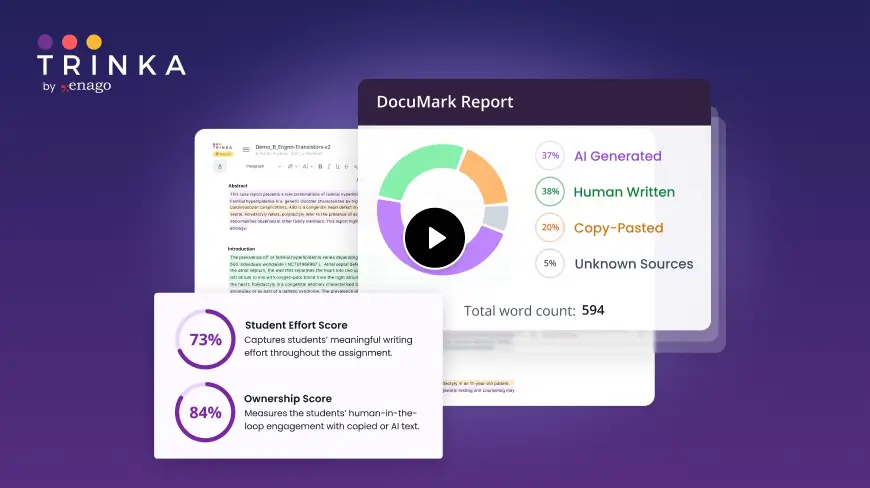
DocuMark: Responsible AI Use for Academic Integrity
Knowing your institution's AI policy is step one. DocuMark helps enforce it fairly by empowering universities to manage AI-generated content, prevent cheating, and support student writing through responsible AI use.
Common Questions About Bard College Berlin's AI Policies
Bard College Berlin has defined AI policies in 7 of 12 categories, with an overall coverage score of 58%.
The handbook requires appropriate attribution and citation for the words or work of others, and says students should consult advisors or instructors if unsure what counts as plagiarism or academic misconduct. The provided sources do not give a specific AI citation format or AI-specific disclosure statement requirement.
Undisclosed submission of academic work acquired from AI platforms is handled through the academic misconduct process. Any community member may report an alleged violation, faculty must file an Academic Integrity Incident Report even if they resolve the matter themselves, and the Academic Integrity Board can impose penalties up to failing grades and an FX on the transcript. No AI detection tool policy is stated in the provided sources.
No explicit data protection or approved AI platform policy is currently defined in the available policy sources.