Teaching & Learning
- Passing off AI-generated material as a student's own work is treated as plagiarism
- Use of generative AI in assessed coursework is set at module level rather than uniformly permitted or prohibited across the university
- Module leaders are expected to tell students whether AI may be used, how it may support assessments, and how any use must be acknowledged and referenced
"Students should be made aware that using information created with generative AI and passing it off as their own work is plagiarism. This is not acceptable in any academic or professional work as outlined in our academic misconduct policy."
"Modules Leaders should provide guidance for students on how they might use generative AI to inform or support their assessments, including if they may not use it and how this should be acknowledged and referenced in the student’s formal submission. An Assessment Brief Template is available which suggests appropriate wording for alternative scenarios."
"This 'assessment brief' template can be used by module leaders to clearly indicate whether or not GenAI may be used to help with assessments."
- The university states that module leaders should specify whether AI may be used in assessments, including cases where it may not be used
- For assessments, Bath Spa University says students must disclose AI use and consult module-level guidance about what is allowed in a specific assessment
"It's important you use generative artificial intelligence (AI) carefully and always disclose how you've used it in your assessments."
"You should also ask your module tutor if you have any queries or concerns regarding how to use AI in your assessments."
"Modules Leaders should provide guidance for students on how they might use generative AI to inform or support their assessments, including if they may not use it and how this should be acknowledged and referenced in the student’s formal submission."
- The guidance also requires students to use their own judgement and critical thinking when evaluating AI suggestions
- Bath Spa University permits students to use GenAI for study support when they have permission to use it, especially for planning, feedback, and understanding open-access readings
"If you have been given permission to use GenAI, it can be most helpful in the planning stages of your work."
"Rather than asking it for a list of topic ideas, you could provide a list of topics that you plan to cover and ask it for feedback or further suggestions."
"You can also ask GenAI for feedback on what you've written, and the more specific you can be the better."
"Remember that GenAI hasn’t studied your subject, at your university, with your lecturers. Use your own judgement and critical thinking skills to assess any recommendations it makes."
"You can cut and paste a section of open access text into Copilot and ask for a summary to help you understand the original."
Research
- The guidance also says researchers should keep records of prompts, tools, and outputs
- Research outputs must remain the authors' own work, with appropriate citation and referencing, and GenAI cannot be listed as an author
- Bath Spa University allows GenAI in research writing and literature review, but requires acknowledgement of its use and keeps accountability with the human authors
"- Be transparent—explain how and why you’re using it"
"- Keep records of prompts, tools used, and outputs"
"- Don’t list GenAI as an author on publications"
"• The use of GenAI tools in the writing of publications and/or literature review should always be acknowledged."
"• Authors are accountable for the accuracy, integrity and originality of their Research outputs, such as publications, including any use of GenAI."
"• Research outputs must be the authors’ own work, not presenting others’ work or output from GenAI tools without appropriate citation and referencing."
"• If you choose to copy and paste a large amount of text from GenAI, it is important to cite this correctly as outlined in Cite them Right."
"• GenAI does not meet the BSU determination for authorship, given the need for accountability, and so GenAI tools must not be listed as an author on any"
- The university also requires quality checking and warns about bias, hallucinations, and inaccurate analysis or results
- Researchers must document GenAI use in their Data Management Plan, include metadata about AI-generated data and methods, and complete data protection review where required
- Bath Spa University requires full ethical approval before research begins when GenAI is used in data collection or analysis, except when it is used solely for literature review or general productivity support
"• The University Ethics Committee (UEC) requires that all projects undertaken by BSU staff and students or involving BSU that involve the use of GenAI tools in data collection and/or analysis, or that are developing a GenAI tool must seek full ethical approval (Stage 2 ethics) before starting that Research."
"• The exception is when using a GenAI tool solely to undertake a Literature Review or as a general productivity aid"
"• Any use of GenAI tools within Literature Review should be in conjunction with a clear protocol in place for quality checking and utilised in conjunction with traditional"
"• Researchers must detail any use of GenAI in collecting, analysing or otherwise processing Research Data in their Data Management Plan (DMP) relating to the Research. Researchers should explain the reasons for using a particular GenAI tool(s), including an evaluation of the risks associated with using that tool via your DMP documentation."
"• Researchers must include information in the documentation and / or metadata that accompanies any Data that have been generated using processes involving GenAI tools."
"• Where practicable this should include naming the specific model(s) and software (including which version) used, when the tool was used, and specifying how content was generated, such as listing the prompt(s) used. This information must also be included in any publications or other outputs that report on such Data."
"A Data Protection Impact Assessment (DPIA) is required by law if you input Personal Data where the processing of the Personal Data is likely to result in a high risk to the rights and freedoms of individual data subjects. Even if you are not inputting Personal Data, the University requests a DPIA screening before you use an unapproved GenAI tool."
"• Unintended introduction of biases into Research analysis, affecting the scholarly record through Research outputs and publications including theses and dissertations."
"• Factually incorrect assessment of Research analysis and results."
- Bath Spa University applies its research integrity principles to GenAI use and requires transparency, accountability, and risk review
- Researchers must obtain tool approval, complete DPIA processes where needed, and secure full ethics approval for most GenAI use in research design
- For funding applications, the university directs researchers to check funder-specific rules and recommends transparency about GenAI use when explicit funder guidance is absent
"3. Transparency"
"5. Accountability"
"These apply to all research, including when using GenAI tools."
"What You Must Do"
"Before Using GenAI:"
"- Check if the tool is approved by BSU"
"- Complete a Data Protection Impact Assessment (DPIA) if needed"
"- Get ethical approval if GenAI is part of your research design"
"- Check funder policies on GenAI use"
"- Be transparent in funding applications"
"• Even if a funder does not provide specific guidance, we recommend that you are transparent where you have used GenAI tools in the development of your application, and that you adopt the principles of the UKRI policy to inform your approach in lieu of any funder-specific guidance"
"• Ethical and societal risks of GenAI Research can manifest at different stages of Research. GenAI Research has therefore moved the singular moment of ethics approval at BSU to a dynamic ethics review process, potentially requiring multiple amendment requests from the applicant(s)."
"• Prior to seeking BSU ethics review, Researchers must have the approval in place for the GenAI tool they are planning to use. As part of this, Researchers will need to have conducted a DPIA for the involvement of that GenAI tool."
"• Disclose AI use; ensure data quality and responsibility."
Academic Integrity
- The student guidance provides example acknowledgement statements and also requires translation-tool use in assessed work to be clearly acknowledged and referenced
- Bath Spa University requires students to disclose AI use in assessments and says module leaders should specify how AI use must be acknowledged and referenced in formal submissions
- In research, the university requires acknowledgement of GenAI in publications and literature reviews, with citation and, where practicable, details of the model, version, timing, and prompts used
"It's important you use generative artificial intelligence (AI) carefully and always disclose how you've used it in your assessments."
"Modules Leaders should provide guidance for students on how they might use generative AI to inform or support their assessments, including if they may not use it and how this should be acknowledged and referenced in the student’s formal submission."
"* I acknowledge the use of <insert name(s) and url> to generate information for background research."
"* I acknowledge the use of <insert name(s) and url> at the drafting stage of the writing process with the creation of an outline structure for this essay."
"* I acknowledge the use of <insert name(s) and url> to identify improvements in the writing style."
"Any use of translation tools in assessed work must be clearly acknowledged and referenced."
"• The use of GenAI tools in the writing of publications and/or literature review should always be acknowledged."
"• Research outputs must be the authors’ own work, not presenting others’ work or output from GenAI tools without appropriate citation and referencing."
"• Where practicable this should include naming the specific model(s) and software (including which version) used, when the tool was used, and specifying how content was generated, such as listing the prompt(s) used. This information must also be included in any publications or other outputs that report on such Data."
- The university also warns that substantial AI-enabled rewriting copied directly into work counts as academic misconduct
- Enforcement instead proceeds through existing academic integrity processes: suspected breaches can lead to reduced marks, meetings, or alleged academic misconduct reports
- Bath Spa University states that it is not currently using AI detection tools such as Turnitin's AI detector because they are not considered reliable enough to provide proof
"At present, Bath Spa University will not be using digital tools to detect the use of generative AI (such as Turnitin’s AI detector) as they have not proved to be suitably reliable. If an assignment looks suspicious, AI detection tools are currently unable to provide the proof or evidence to back this up; they present a significant number of false positives and negatives."
"Depending on the extent of the breach, your marks may be reduced in your assessment, you may be asked to attend a meeting to discuss the breach, and/or you may receive an alleged academic misconduct report."
"Tools with enhanced AI functionality like Grammarly or paraphrasing applications offer substantial text rewrites which if copied and pasted directly into your work would count as academic misconduct."
Institutional & Administrative
- For general AI use, managers are expected to oversee staff tasks carried out with AI
- Bath Spa University supports staff in the effective and appropriate use of generative AI and says it will develop staff capability for learning, teaching, and administration
- For teaching, module leaders are expected to give students guidance on AI use in assessments, and staff can use university tools such as assessment brief templates and review tools
"Bath Spa University acknowledges the opportunities and benefits afforded by generative AI and supports staff and students in its effective and appropriate use."
"Modules Leaders should provide guidance for students on how they might use generative AI to inform or support their assessments, including if they may not use it and how this should be acknowledged and referenced in the student’s formal submission."
"This 'assessment brief' template can be used by module leaders to clearly indicate whether or not GenAI may be used to help with assessments."
"This Generative AI & Assessment review tool can be used by programme and module leaders to review the use of GenAI within assessments, and to consider the risks and actions required"
"• We will ensure staff have the skills to maximise the value of AI, to help reduce workload and support effective learning, teaching and administration."
"* Ensure your manager has oversight over tasks you are using AI for"
- Bath Spa University restricts AI use to approved systems when sensitive, personal, intellectual property, or other restricted university information is involved
- The university states that Microsoft Copilot in Edge is its licensed AI tool of choice because it offers commercial data protection, and it also licenses Adobe Firefly
- Users must not access unapproved AI applications with university systems or credentials, and non-approved tools must not receive university intellectual property or third-party personal data
"Therefore, users of this technology should avoid entering any information into a tool which they do not want to be made public or is otherwise restricted by law or policy."
"The following guidelines must be adhered to in using Gen AI applications:"
"5.1 To maintain the security of our data and IT systems, you must not attempt to gain access to unapproved AI applications when using University systems or networks, conducting business on behalf of the University, or when using the University’s data."
"Do not use University credentials, email addresses, or telephone numbers as a login to unapproved versions of publicly available AI applications where no data protection arrangement exists."
"Do not install non-approved Application Programming Interfaces (APIs), plug-ins, connectors, or software related to AI systems."
"you must only share information with approved personnel and only input sensitive information into approved AI systems."
"Do not input, or provide as a reference, University intellectual property into non-approved generative AI applications."
"Do not enter personal information of employees, customers, or other third parties into any non-approved AI application."
"Never enter sensitive company data or personal information into an AI tool"
"At BSU we've currently got licenses for Microsoft Copilot within the Edge browser, as well as Adobe Firefly as part of Adobe Creative Campus."
"Copilot in Edge is BSU's AI tool of choice as it's currently the only one we have a license for that also offers commercial data protection."
- The university says it uses Data Protection Impact Assessments as part of governance for AI technologies
- The research guidance also frames GenAI use around institutional research integrity principles including transparency, care, and accountability
- Bath Spa University has an overarching AI policy and governance approach focused on lawful, safe, ethical, and responsible AI use, skill development, academic integrity, and access to needed tools
"3.3 Governance: The University uses a Data Protection Impact Assessment"
"• We will ensure staff have the skills to maximise the value of AI, to help reduce workload and support effective learning, teaching and administration."
"• We will ensure academic integrity is maintained, whilst allowing students/learners to develop the skills they need."
"• We will ensure the use of AI is lawful, safe, ethical and responsible."
"• We will aim to ensure all learners have access to the AI tools that they need."
"3. Transparency"
"4. Care and Respect"
"5. Accountability"
"These apply to all research, including when using GenAI tools."
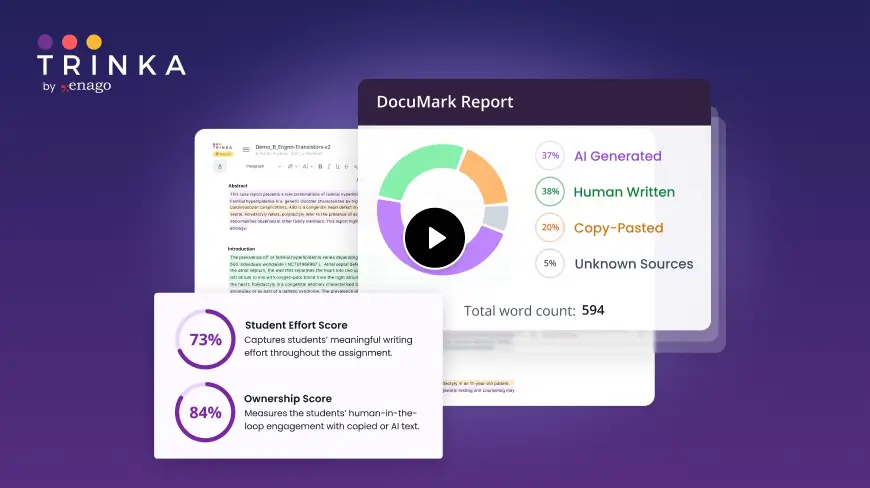
DocuMark: Responsible AI Use for Academic Integrity
Knowing your institution's AI policy is step one. DocuMark helps enforce it fairly by empowering universities to manage AI-generated content, prevent cheating, and support student writing through responsible AI use.
Common Questions About Bath Spa University's AI Policies
Bath Spa University has defined AI policies in 11 of 12 categories, with an overall coverage score of 92%.
Bath Spa University requires students to disclose AI use in assessments and says module leaders should specify how AI use must be acknowledged and referenced in formal submissions. The student guidance provides example acknowledgement statements and also requires translation-tool use in assessed work to be clearly acknowledged and referenced. In research, the university requires acknowledgement of GenAI in publications and literature reviews, with citation and, where practicable, details of the model, version, timing, and prompts used.
Bath Spa University states that it is not currently using AI detection tools such as Turnitin's AI detector because they are not considered reliable enough to provide proof. Enforcement instead proceeds through existing academic integrity processes: suspected breaches can lead to reduced marks, meetings, or alleged academic misconduct reports. The university also warns that substantial AI-enabled rewriting copied directly into work counts as academic misconduct.
Bath Spa University restricts AI use to approved systems when sensitive, personal, intellectual property, or other restricted university information is involved. Users must not access unapproved AI applications with university systems or credentials, and non-approved tools must not receive university intellectual property or third-party personal data. The university states that Microsoft Copilot in Edge is its licensed AI tool of choice because it offers commercial data protection, and it also licenses Adobe Firefly.