Teaching & Learning
- This is a program-specific prohibition rather than a university-wide coursework rule in the provided sources
- For the Creative Writing for the Stage application, AI-generated texts are prohibited and applicants must submit a signed declaration confirming they wrote the work independently and did not use AI
A signed declaration must be uploaded in campus management confirming that no text generating AI was used in the writing of the sample.
Ich versichere hiermit, dass ich den im Upload-Bereich hochgeladenen Text selbst und ohne Hilfe Dritter verfasst habe. Ich versichere weiterhin, dass ich keinen Text einer Künstlichen Intelligenz (KI), beispielsweise von ChatGPT, oder einer vergleichbaren Anwendung eingefügt habe.
I hereby affirm that I wrote the text uploaded in the upload section by myself and without the assistance of third parties. I further affirm that I did not insert any text generated by artificial intelligence (AI), for example ChatGPT or a comparable application.
Research
- AI may be used only as a tool under the responsibility of the author, and the user remains accountable for content and must verify correctness and originality
- The university's good academic practice guidance requires scholars to identify whether and how generative AI and AI-supported technologies were used in producing scientific findings
Researchers and scholars identify if and how Generative AI and AI-supported technologies have been used in the process of producing scientific findings.
The use of Generative AI and AI-supported technologies requires a critical and responsible approach from a scientific perspective. It must be viewed in terms of the use of a tool; the human user remains accountable and has responsibility for the scientific work and the use of data and cannot transfer this responsibility. This involves checking the generated output for correctness, plausibility and originality.
The use of text generated by AI and AI-supported technologies does not absolve the user of responsibility for plagiarism checks and proper source citation.
Researchers and scholars are fully accountable for the content of their manuscripts, including parts produced with the support of AI and AI-supported technologies, and are therefore liable for any breach of publication ethics.
- The provided sources do not set specific rules for using AI in data collection, analysis, or synthetic data generation
- The only explicit related statement is that researchers must disclose whether and how generative AI and AI-supported technologies were used in producing scientific findings
Researchers and scholars identify if and how Generative AI and AI-supported technologies have been used in the process of producing scientific findings.
- The guidance also states that AI systems cannot be credited as authors because they cannot bear responsibility
- The university treats AI use in research as an integrity issue: researchers must disclose AI use, remain fully responsible for the work, and ensure plagiarism checks and source citation are still performed
Researchers and scholars identify if and how Generative AI and AI-supported technologies have been used in the process of producing scientific findings.
The use of Generative AI and AI-supported technologies requires a critical and responsible approach from a scientific perspective. It must be viewed in terms of the use of a tool; the human user remains accountable and has responsibility for the scientific work and the use of data and cannot transfer this responsibility. This involves checking the generated output for correctness, plausibility and originality.
The use of text generated by AI and AI-supported technologies does not absolve the user of responsibility for plagiarism checks and proper source citation.
Researchers and scholars are fully accountable for the content of their manuscripts, including parts produced with the support of AI and AI-supported technologies, and are therefore liable for any breach of publication ethics.
Generative AI and AI-supported technologies cannot be named as co-authors in scientific publications because they cannot bear responsibility for the work.
Academic Integrity
- Disclosure of AI use is required in research contexts covered by the good academic practice page
- In the Creative Writing for the Stage application, applicants must submit a signed declaration stating that no AI-generated text was used
Researchers and scholars identify if and how Generative AI and AI-supported technologies have been used in the process of producing scientific findings.
The use of text generated by AI and AI-supported technologies does not absolve the user of responsibility for plagiarism checks and proper source citation.
A signed declaration must be uploaded in campus management confirming that no text generating AI was used in the writing of the sample.
Ich versichere hiermit, dass ich den im Upload-Bereich hochgeladenen Text selbst und ohne Hilfe Dritter verfasst habe. Ich versichere weiterhin, dass ich keinen Text einer Künstlichen Intelligenz (KI), beispielsweise von ChatGPT, oder einer vergleichbaren Anwendung eingefügt habe.
I hereby affirm that I wrote the text uploaded in the upload section by myself and without the assistance of third parties. I further affirm that I did not insert any text generated by artificial intelligence (AI), for example ChatGPT or a comparable application.
- The sources do not define AI detection tools or broader university penalties for undisclosed AI use
- The provided sources contain an enforcement mechanism for one admissions context: applicants must sign a declaration that no AI-generated text was used
A signed declaration must be uploaded in campus management confirming that no text generating AI was used in the writing of the sample.
Ich versichere hiermit, dass ich den im Upload-Bereich hochgeladenen Text selbst und ohne Hilfe Dritter verfasst habe. Ich versichere weiterhin, dass ich keinen Text einer Künstlichen Intelligenz (KI), beispielsweise von ChatGPT, oder einer vergleichbaren Anwendung eingefügt habe.
I hereby affirm that I wrote the text uploaded in the upload section by myself and without the assistance of third parties. I further affirm that I did not insert any text generated by artificial intelligence (AI), for example ChatGPT or a comparable application.
Institutional & Administrative
- The event source only establishes that the university is organizing discussion around AI
- The university is visibly engaging with AI at an institutional level through a dedicated AI event, but the provided sources do not set out a formal governance framework, strategy, or binding AI policy
KI-Tag der UdK Berlin
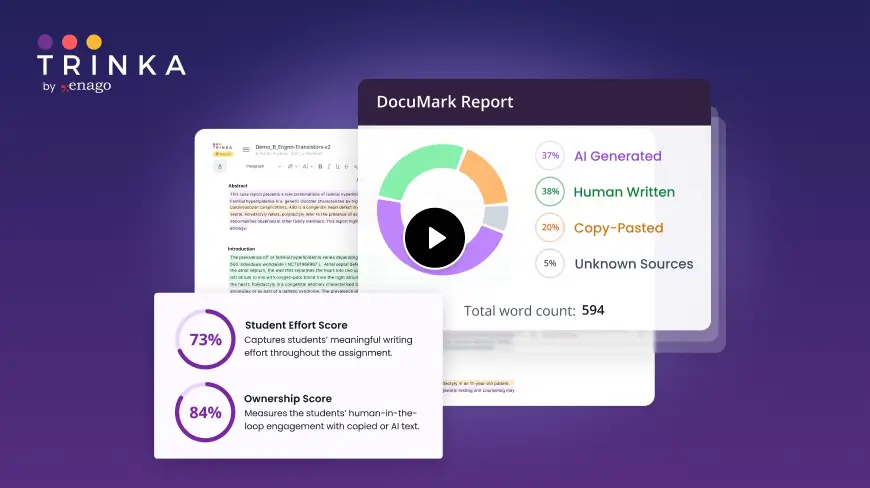
DocuMark: Responsible AI Use for Academic Integrity
Knowing your institution's AI policy is step one. DocuMark helps enforce it fairly by empowering universities to manage AI-generated content, prevent cheating, and support student writing through responsible AI use.
Common Questions About Berlin University of Psychology's AI Policies
Berlin University of Psychology has defined AI policies in 7 of 12 categories, with an overall coverage score of 58%.
Disclosure of AI use is required in research contexts covered by the good academic practice page. In the Creative Writing for the Stage application, applicants must submit a signed declaration stating that no AI-generated text was used.
The provided sources contain an enforcement mechanism for one admissions context: applicants must sign a declaration that no AI-generated text was used. The sources do not define AI detection tools or broader university penalties for undisclosed AI use.
No explicit data protection or approved AI platform policy is currently defined in the available policy sources.