Teaching & Learning
- The university allows students to use generative AI in academic work only when that use is transparent and properly referenced
- Students remain responsible for the accuracy of submitted work, and presenting AI-generated material as their own or using it in a misleading way is treated as academic misconduct
When using AI generated content in your assignments, make sure this is referenced correctly to acknowledge the source and to avoid plagiarism.
You are responsible for ensuring the originality, accuracy and integrity of your work. Don't rely solely on AI tools to produce final content.
Using AI-generated work without proper acknowledgement or in a misleading way can still count as plagiarism or academic misconduct.
- No university-wide AI rule specifically for exams or formal assessments is explicitly stated in the provided sources
- The materials discuss assignments and academic misconduct more generally, but do not define a separate exam-specific AI policy
not defined
- The university supports student use of AI as a study aid for understanding topics, revision, and related learning support
- It also warns students to use it critically because outputs may be inaccurate or biased and should not be relied on without checking
Useful for
Brainstorming ideas and creating outlines.
Summarising and helping understand complex concepts.
Providing feedback on grammar and language.
Creating content in alternative formats, for example, in a table.
Revision support, including practice questions and flashcards.
Translation of words, phrases and passages.
Bear in mind
AI isn't perfect and can make mistakes, provide false information or become biased, so always verify with trusted sources.
Research
- The university states that AI tools cannot be listed as authors on research outputs
- Researchers may use AI support in preparing manuscripts only if they transparently declare that use and take full human responsibility for the content, accuracy, and integrity of the work
The University recognises there may be occasions where researchers can use AI support tools to aid in the preparation of manuscripts and grant applications. However, AI support tools cannot be named as authors, and where they have been used, this should be declared and researchers must take responsibility for the content, accuracy and integrity of all aspects of the work and ensure all AI outputs have been reviewed and checked.
- This means any AI-assisted analytical output must be subject to human oversight
- The university does not prohibit AI use in research data or analysis, but it requires researchers to review and check all AI outputs and to remain responsible for the accuracy and integrity of the work
researchers must take responsibility for the content, accuracy and integrity of all aspects of the work and ensure all AI outputs have been reviewed and checked.
- The university explicitly addresses AI within research integrity guidance
- It permits AI support tools in manuscripts and grant applications only with declaration, bars AI tools from authorship, and requires researchers to retain responsibility for content, accuracy, and integrity with human review of outputs
The University recognises there may be occasions where researchers can use AI support tools to aid in the preparation of manuscripts and grant applications. However, AI support tools cannot be named as authors, and where they have been used, this should be declared and researchers must take responsibility for the content, accuracy and integrity of all aspects of the work and ensure all AI outputs have been reviewed and checked.
Academic Integrity
- The university requires students to acknowledge and reference AI-generated content used in assignments
- Its library guidance provides a specific Harvard-style approach for citing generative AI outputs, and research guidance also requires declaration of AI use in manuscripts and grant applications
When using AI generated content in your assignments, make sure this is referenced correctly to acknowledge the source and to avoid plagiarism.
As with any other source, use a Harvard style reference in your assignment and include details such as the prompt used, date generated and generated text in full.
In-text citation:
(OpenAI 2023)
Reference list:
OpenAI (2023) ChatGPT (3.5) [Large language model]. Available at: https://chat.openai.com/ (Accessed: 20 October 2023). Prompt: 'What are 3 key things all students should know to study effectively?'. Generated text: '1. Time management. 2. Active learning techniques. 3. Taking care of your physical and mental health'.
However, AI support tools cannot be named as authors, and where they have been used, this should be declared
- The university states that undisclosed or misleading AI use can constitute plagiarism or academic misconduct
- The provided sources do not define a specific AI detection-tool policy, but they do establish misconduct consequences through general integrity rules
Using AI-generated work without proper acknowledgement or in a misleading way can still count as plagiarism or academic misconduct.
Institutional & Administrative
- The guidance frames this as a data protection and privacy risk rather than naming approved platforms
- The university warns users not to upload sensitive or personal information into generative AI tools and notes that prompts may be retained and reused by the system
AI tools may store your prompts and use them to improve their systems. Avoid entering personal, sensitive or confidential information.
- However, the provided sources do not define a dedicated AI strategy, committee, or governance roadmap
- The university has published institution-level guidance that frames AI use around opportunities, risks, referencing, and responsible use, and it also embeds AI expectations within research integrity guidance
Generative artificial intelligence (AI) tools such as ChatGPT and Microsoft Copilot can support your studies and enhance your productivity when used responsibly.
The University recognises there may be occasions where researchers can use AI support tools to aid in the preparation of manuscripts and grant applications.
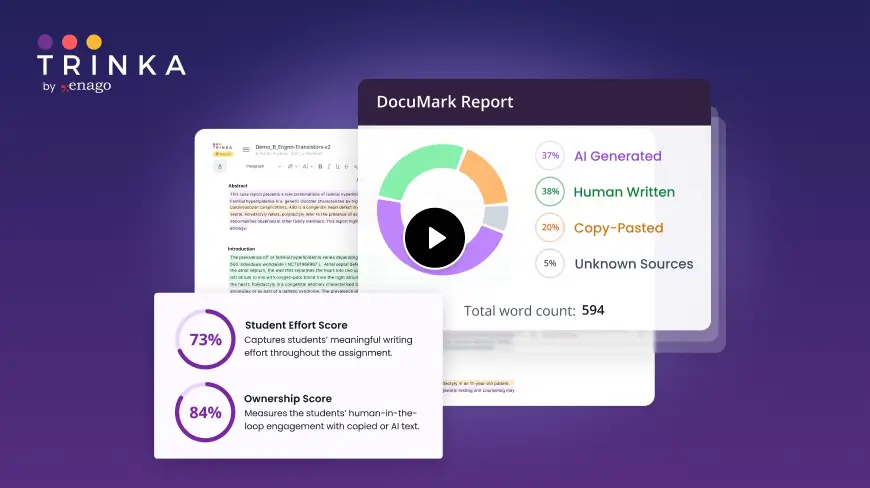
DocuMark: Responsible AI Use for Academic Integrity
Knowing your institution's AI policy is step one. DocuMark helps enforce it fairly by empowering universities to manage AI-generated content, prevent cheating, and support student writing through responsible AI use.
Common Questions About Birmingham City University's AI Policies
Birmingham City University has defined AI policies in 10 of 12 categories, with an overall coverage score of 83%.
The university requires students to acknowledge and reference AI-generated content used in assignments. Its library guidance provides a specific Harvard-style approach for citing generative AI outputs, and research guidance also requires declaration of AI use in manuscripts and grant applications.
The university states that undisclosed or misleading AI use can constitute plagiarism or academic misconduct. The provided sources do not define a specific AI detection-tool policy, but they do establish misconduct consequences through general integrity rules.
The university warns users not to upload sensitive or personal information into generative AI tools and notes that prompts may be retained and reused by the system. The guidance frames this as a data protection and privacy risk rather than naming approved platforms.