Teaching & Learning
- Use of AI in coursework is at instructor discretion rather than governed by a single university-wide permission rule
- Undisclosed or unauthorized AI use can fall under academic dishonesty when it misrepresents another source's work as the student's own
- The university states that faculty should communicate whether AI use is permitted, restricted, or prohibited in their classes, and students are expected to follow those course-specific expectations
Faculty who choose to permit the use of AI in their courses should communicate with students on the acceptable use of AI technologies in their classroom and assignments.
The use of AI should not violate BGSU's Academic Honesty policy.
Academic dishonesty is any activity or attempted activity which may result in creating an unfair academic advantage for oneself or an unfair academic advantage or disadvantage for any other member or members of the academic community.
Submitting substantial portions of the work of another person, including material generated by artificial intelligence, for credit in one or more courses, without consulting the instructor(s) concerning the appropriateness of such action.
- The university does not provide a specific AI rule for exams or quizzes in the cited sources
- However, exam-related AI use would still be subject to instructor directions and the academic honesty policy if it creates an unfair advantage or involves unauthorized assistance
Academic dishonesty is any activity or attempted activity which may result in creating an unfair academic advantage for oneself or an unfair academic advantage or disadvantage for any other member or members of the academic community.
Faculty who choose to permit the use of AI in their courses should communicate with students on the acceptable use of AI technologies in their classroom and assignments.
- Where AI is used in connection with course work, acceptable use is left to faculty guidance and course expectations
- The university provides AI literacy and learning resources for students, faculty, and staff, but it does not set a uniform policy specifically authorizing or restricting AI for personal studying or tutoring
This page serves as a one-stop-shop and includes resources that are available for students, faculty, and staff to support the use of AI.
BGSU offers free resources and trainings to help users understand and adapt to the use of AI in educational and professional settings.
Faculty who choose to permit the use of AI in their courses should communicate with students on the acceptable use of AI technologies in their classroom and assignments.
Research
- For theses and dissertations, generative AI use is permitted only in limited support roles and must be disclosed
- The graduate handbook also requires disclosure in the manuscript when AI use is more than minor editorial assistance
- Students may use AI for tasks such as editing, citation formatting, or image generation when the faculty advisor approves it, but AI cannot be listed as an author and cannot replace the student's own scholarly contributions
BGSU allows students to use generative AI tools for support in preparing theses and dissertations; however, because there are concerns related to transparency, bias, and reliability, there are guidelines and expectations around the ethical use of these tools.
Any use of generative AI tools must be approved by the student's faculty advisor.
Generative AI tools may be used in limited ways to support manuscript preparation, such as copy-editing, formatting citations, or generating images for illustrative purposes.
Generative AI tools may not be listed as an author or co-author on a thesis or dissertation.
Students are ultimately responsible for the originality, accuracy, and integrity of all submitted work, including any portions created or refined using AI.
Use of generative AI tools beyond copy-editing or minor editorial support must be disclosed in the thesis or dissertation. The disclosure should briefly describe the nature of the tool used and the specific assistance it provided. Disclosures should be included in the acknowledgments section or an appendix, as appropriate.
- The available thesis and dissertation guidance focuses on manuscript preparation rather than research data workflows
- The cited sources do not define a university-wide policy governing AI use for research data collection, analysis, statistics, synthetic data creation, or interpretation of results
not defined
- The cited sources do not provide specific AI rules for grant proposals, IRB submissions, or broader research ethics filings
- The university addresses research integrity for theses and dissertations by requiring advisor approval for AI use and holding students responsible for the originality, accuracy, and integrity of submitted work
Any use of generative AI tools must be approved by the student's faculty advisor.
Students are ultimately responsible for the originality, accuracy, and integrity of all submitted work, including any portions created or refined using AI.
Academic Integrity
- Disclosure is required for thesis and dissertation use of generative AI when the use goes beyond minor copy-editing or editorial support
- More broadly, the university's academic honesty policy requires students to consult the instructor before submitting substantial AI-generated material for credit, making transparency and instructor approval central expectations
Use of generative AI tools beyond copy-editing or minor editorial support must be disclosed in the thesis or dissertation. The disclosure should briefly describe the nature of the tool used and the specific assistance it provided. Disclosures should be included in the acknowledgments section or an appendix, as appropriate.
Submitting substantial portions of the work of another person, including material generated by artificial intelligence, for credit in one or more courses, without consulting the instructor(s) concerning the appropriateness of such action.
- The cited sources do not define a university policy on AI detection tools such as Turnitin AI detection or GPTZero
- The university treats unauthorized AI-generated work as a potential academic dishonesty matter and routes violations through its existing misconduct framework
The use of AI should not violate BGSU's Academic Honesty policy.
Academic dishonesty is any activity or attempted activity which may result in creating an unfair academic advantage for oneself or an unfair academic advantage or disadvantage for any other member or members of the academic community.
Submitting substantial portions of the work of another person, including material generated by artificial intelligence, for credit in one or more courses, without consulting the instructor(s) concerning the appropriateness of such action.
Institutional & Administrative
- The cited sources do not set a detailed university-wide rule for faculty use of AI in grading, recommendation letters, lesson planning, or administrative writing
- The university provides guidance and training resources for faculty and staff on AI use, and it expects faculty who permit AI in their courses to tell students what is acceptable
This page serves as a one-stop-shop and includes resources that are available for students, faculty, and staff to support the use of AI.
BGSU offers free resources and trainings to help users understand and adapt to the use of AI in educational and professional settings.
Faculty who choose to permit the use of AI in their courses should communicate with students on the acceptable use of AI technologies in their classroom and assignments.
- It distinguishes between restricted and sensitive data and warns that public-facing AI tools may store or reuse submitted information
- The university also indicates that Microsoft Copilot with commercial data protection is available as a supported option for the campus community
- The university requires users to avoid entering protected institutional data into public AI systems unless appropriate safeguards and approvals are in place
Do not enter restricted or sensitive data into public AI tools unless explicitly approved and secured.
Public-facing AI tools may retain, store, or use submitted data for training or other purposes.
Restricted data includes information protected by law or regulation, such as FERPA, HIPAA, or PCI-regulated data.
Sensitive data includes internal university data that is not public and could cause harm if disclosed.
Current students, faculty, and staff can access Microsoft Copilot with commercial data protection using their BGSU account.
- It presents AI resources for the campus community, offers workshops and a faculty learning community, and frames AI adoption as an area for ongoing educational development
- The university has an institution-level AI initiative centered on support, training, and AI literacy rather than a single formal governance policy document in the cited sources
This page serves as a one-stop-shop and includes resources that are available for students, faculty, and staff to support the use of AI.
BGSU offers free resources and trainings to help users understand and adapt to the use of AI in educational and professional settings.
The Center for Faculty Excellence is offering an AI workshop series to support faculty and instructors in learning more about the use of AI in higher education.
The AI Literacy Learning Community is intended to bring together faculty and instructors interested in exploring artificial intelligence in teaching and learning.
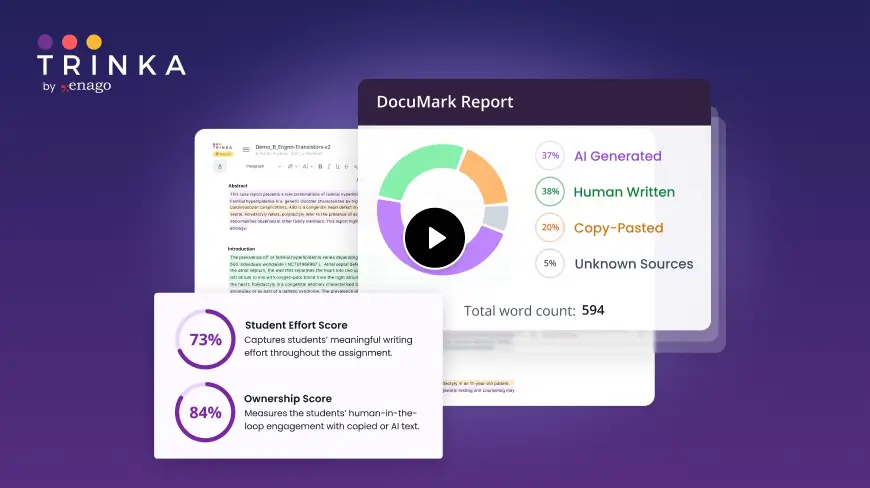
DocuMark: Responsible AI Use for Academic Integrity
Knowing your institution's AI policy is step one. DocuMark helps enforce it fairly by empowering universities to manage AI-generated content, prevent cheating, and support student writing through responsible AI use.
Common Questions About Bowling Green State University's AI Policies
Bowling Green State University has defined AI policies in 11 of 12 categories, with an overall coverage score of 92%.
Disclosure is required for thesis and dissertation use of generative AI when the use goes beyond minor copy-editing or editorial support. More broadly, the university's academic honesty policy requires students to consult the instructor before submitting substantial AI-generated material for credit, making transparency and instructor approval central expectations.
The university treats unauthorized AI-generated work as a potential academic dishonesty matter and routes violations through its existing misconduct framework. The cited sources do not define a university policy on AI detection tools such as Turnitin AI detection or GPTZero.
The university requires users to avoid entering protected institutional data into public AI systems unless appropriate safeguards and approvals are in place. It distinguishes between restricted and sensitive data and warns that public-facing AI tools may store or reuse submitted information. The university also indicates that Microsoft Copilot with commercial data protection is available as a supported option for the campus community.