Teaching & Learning
- Students are bound to the Honor Code for academic work generally
- No university-wide rule specifically governing AI use in regular coursework or graded assignments was found in the provided sources
- Separately, the Admissions Committee considers it unethical to use AI to outline, draft, or directly supply content for application essays, and reserves the right to deny candidates suspected of falsifying application materials
The Bryn Mawr community abides by an Honor Code that centers integrity and values the authentic ideas and opinions of its members. We invite our applicants to embody that same spirit in compiling their application materials – the Admissions Committee is interested in hearing your thoughts and voice as a means of understanding your potential for success here at Bryn Mawr.
While Artificial Intelligence (AI) tools can be valuable in researching the college application process, when used in preparing your application, they can dilute the unique expression and distinct perspectives that make a candidate stand out to the Admissions Committee. The following uses of AI will be considered unethical by the Committee, who reserve the right to deny candidates suspected of falsifying any component of their application:
Relying on AI-generated content to outline or draft an essay
Copying and pasting content directly from an AI generator
Translating an essay written in another language
- Violations are treated as Honor Code violations and are adjudicated by the Honor Board
- AI use on exams is prohibited unless the written exam instructions explicitly permit it
Any use of AI on exams, unless explicitly permitted in the written exam instructions, constitutes a violation of the Honor Code and will be addressed and adjudicated by the Honor Board.
- The university provides general guidance for responsible AI use rather than a specific rule about personal study assistance
- It tells users to use College-provided AI tools, avoid uploading private or sensitive information to other tools, and critically evaluate AI outputs because they can be biased or inaccurate
Use College-provided AI tools
Note: Their terms of use and security features are designed to protect the privacy and security of your files, data, and generated content. Data you upload to, or generate with, them will not be used to train AI models or answer AI queries made by others.
Other tools may lack these protections. Always review a tool's terms of service and privacy policies carefully, and avoid uploading any private or sensitive information.
Always critically evaluate any generative AI output. These tools make statistical predictions about the combination of words, sounds, or pixels that best fit a given prompt - based on the data they have been trained on.
They are vulnerable to biases with that training data and can predict things that are statistically plausible but have no factual basis. For instance, they may generate realistic citations for books and authors that do not exist!
Research
- The sources do not define how AI may be used for research analysis itself, but they regulate the handling of research data in AI tools
- According to the Data Handling and Storage Guidelines, Level 1 data must not be used with BMC-licensed or non-BMC-licensed generative AI tools
- Research data covered by formal agreements or contracts with the College and contracted research are classified as Level 1 (most sensitive) data
Research data covered by formal agreements or contracts with the College
Contracted research
[From the Data Handling and Storage Guidelines table, summarizing generative AI tool permissions by data level:]
BMC-licensed generative AI tools: Level 1 – NO, Level 2 – NO, Level 3 – NO, Level 4 – Yes, Level 5 – Yes, Level 6 – Yes
Non-BMC licensed generative AI tools: Level 1 – NO, Level 2 – NO, Level 3 – NO, Level 4 – NO, Level 5 – NO, Level 6 – NO
Academic Integrity
- The provided sources do not include an explicit university-wide disclosure or attribution requirement for AI use in academic work
- The general AI guidelines advise responsible and ethical use and reference the Honor Code, but no specific mandate to disclose AI assistance to instructors or cite AI tools in submitted work was identified in the extracted sources
This article outlines guidelines to support the responsible and ethical use of AI technology, while managing risk to the College's institutional data and systems.
Students are bound to the Honor Code for academic work.
[No explicit disclosure or attribution requirement for AI use was identified in the available sources.]
- The provided sources do not mention AI detection tools
- For exams, unauthorized AI use is an Honor Code violation and is adjudicated by the Honor Board
- In admissions, the Admissions Committee states that certain AI uses are unethical and reserves the right to deny candidates suspected of falsifying application materials
Any use of AI on exams, unless explicitly permitted in the written exam instructions, constitutes a violation of the Honor Code and will be addressed and adjudicated by the Honor Board.
The following uses of AI will be considered unethical by the Committee, who reserve the right to deny candidates suspected of falsifying any component of their application:
Relying on AI-generated content to outline or draft an essay
Copying and pasting content directly from an AI generator
Translating an essay written in another language
Institutional & Administrative
- Faculty and staff are covered by the College's institutional data rules when using AI tools
- The Zoom AI Companion guidance also says only a host or co-host can control AI Companion during meetings, participants are notified when it starts, and participants may ask hosts or co-hosts to stop it if they are uncomfortable
Members of the Bryn Mawr community working with or using institutional data or systems in any manner must comply with the Bryn Mawr College Acceptable Use Policy.
Before you start, you will need the following:
A Bryn Mawr College Zoom account
A host or co-host role
Attention: Only a host or co-host can start or stop AI Companion during a meeting. AI Companion cannot be disabled by participants.
Participants will receive an on-screen notification when AI Companion starts. If they are uncomfortable with their face, voice, or writing being used for AI-generated content, they can leave the meeting or request the host(s) and co-host(s) stop AI Companion.
- Adobe Firefly also prohibits use of sensitive data
- Copilot with a College account provides better data protections than similar free tools, but Copilot Chat cannot be used with Level 1 data
- The college directs users to use College-provided AI tools because their protections are designed to keep uploaded and generated content private and not used for model training
Use College-provided AI tools
Note: Their terms of use and security features are designed to protect the privacy and security of your files, data, and generated content. Data you upload to, or generate with, them will not be used to train AI models or answer AI queries made by others.
Other tools may lack these protections. Always review a tool's terms of service and privacy policies carefully, and avoid uploading any private or sensitive information.
Microsoft Copilot is a chat-based generative AI assistant built on OpenAI's ChatGPT model. It is a general-purpose generative AI tool and, when used with a College account, provides better data protections than similar free tools.
Files, data, and content that is input to, or generated from, Copilot are encrypted and remain siloed within your account in our Microsoft tenant. They are not used to train Copilot or for queries by other people.
Do not use Copilot Chat with Level 1 data
Warning: You are prohibited from using the following content, per Adobe's Acceptable Use Policy.
Copyrighted material you don't own
Sensitive data
BMC-licensed generative AI tools NO NO NO Yes Yes Yes
Non-BMC licensed generative AI tools NO NO NO NO NO NO
- The provided sources do not identify an AI committee, formal governance body, or long-term AI strategy roadmap
- Bryn Mawr states that its AI guidance is meant to support responsible and ethical AI use while managing institutional risk, and it ties AI use to existing College policies such as the Acceptable Use Policy, Data Handling Policy, and Honor Code
This article outlines guidelines to support the responsible and ethical use of AI technology, while managing risk to the College's institutional data and systems.
Follow all relevant College policies:
Acceptable Use Policy
Data Handling Policy
Students are bound to the Honor Code for academic work
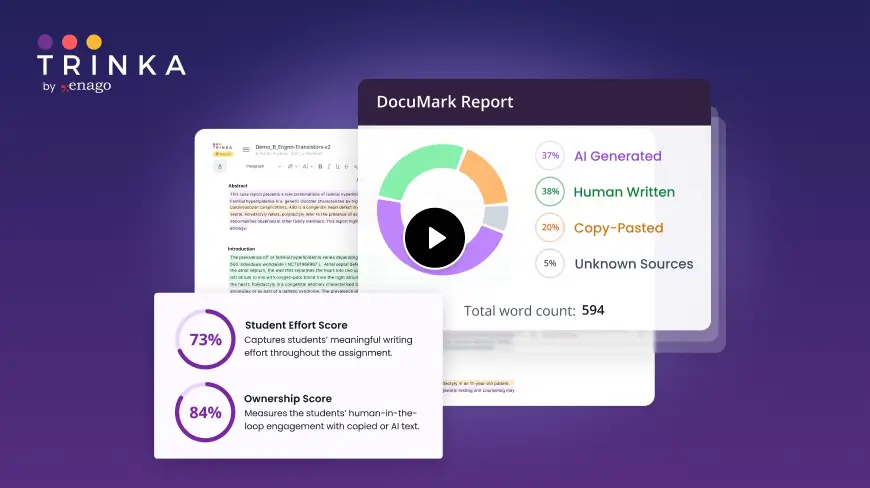
DocuMark: Responsible AI Use for Academic Integrity
Knowing your institution's AI policy is step one. DocuMark helps enforce it fairly by empowering universities to manage AI-generated content, prevent cheating, and support student writing through responsible AI use.
Common Questions About Bryn Mawr College's AI Policies
Bryn Mawr College has defined AI policies in 9 of 12 categories, with an overall coverage score of 75%.
The provided sources do not include an explicit university-wide disclosure or attribution requirement for AI use in academic work. The general AI guidelines advise responsible and ethical use and reference the Honor Code, but no specific mandate to disclose AI assistance to instructors or cite AI tools in submitted work was identified in the extracted sources.
For exams, unauthorized AI use is an Honor Code violation and is adjudicated by the Honor Board. In admissions, the Admissions Committee states that certain AI uses are unethical and reserves the right to deny candidates suspected of falsifying application materials. The provided sources do not mention AI detection tools.
The college directs users to use College-provided AI tools because their protections are designed to keep uploaded and generated content private and not used for model training. Copilot with a College account provides better data protections than similar free tools, but Copilot Chat cannot be used with Level 1 data. The file storage guidelines also distinguish between BMC-licensed and non-BMC-licensed generative AI tools: Level 2 internal data is allowed in BMC-licensed generative AI tools, while Level 1 data is not; non-BMC-licensed generative AI tools are disallowed for Levels 1 and 2. Adobe Firefly also prohibits use of sensitive data.