Teaching & Learning
- Cal Poly does not publish a single university-wide rule in these sources that uniformly permits or prohibits AI use for graded coursework
- Instead, the university indicates that course-level AI rules may be set in syllabi, while unauthorized submission of another source's work as one's own is treated as plagiarism and academic dishonesty
The Cal Poly AI Core Values and Syllabus Statements web page provides Cal Poly instructional faculty practical tools for integrating statements about AI usage into their course syllabi. It includes sample syllabus statements on core values and course policies on AI use.
Plagiarism is defined as the act of using intentionally or unintentionally the ideas or work of another person or persons as if they were one’s own without giving proper credit to the source.
Examples of plagiarism include, but are not limited to, the following: the submission of a work, either in part or in whole, completed by another; failure to give credit for ideas, statements, facts or conclusions which rightfully belong to another; failure to use quotation marks (or other means of setting apart, such as the use of indentation or a different font size) when quoting directly from another, whether it be a paragraph, a sentence, or even a part thereof; close and lengthy paraphrasing of another’s writing without credit or originality; and use of another’s project or computer programs or part thereof without giving credit.
- Cal Poly treats unauthorized use of information devices, notes, textbooks, or discussion of answers during exams and tests as cheating
- The sources do not state an AI-specific exam rule, but they do state that use of outside aids is only allowed when expressly permitted by the instructor or prescribed test conditions
Cheating includes, but is not limited to: lying; copying from another's test or examination; discussion at any time of questions or answers on an examination or test, unless such discussion is specifically authorized by the instructor; taking or receiving copies of an exam without the permission of the instructor; using or displaying notes, "cheat sheets," or other information devices inappropriate to the prescribed test conditions; allowing someone other than the officially enrolled student to represent same.
Using notes, textbooks or other information in examinations, tests and quizzes, except as expressly permitted;
- Cal Poly provides AI resources that support non-graded learning and study assistance
- The university describes ChatGPT as appropriate for brainstorming, learning support, and general explanations, and it promotes course-based custom GPTs for content clarification, study help, and course navigation
Use ChatGPT for brainstorming, learning support, and general explanations.
Participants learn how to turn their existing course materials into interactive AI assistants designed to support students with content clarification, study help, and course navigation.
Research
- The Academic Senate ad hoc committee is specifically charged with developing guidelines on responsible research and creative practice
- Cal Poly has governance work underway on responsible research practice with generative AI, but the provided sources do not establish a final university-wide research integrity rule
Provide guidelines to distinguish ethical and unethical uses of GAI by both faculty and students. These guidelines would address issues such as privacy, data security, bias, accessibility, copyright/IP, disclosure, and responsible research/creative practice.
Academic Integrity
- Cal Poly requires crediting sources when using others' ideas or work, and it is developing AI-related guidance that includes disclosure
- The teaching resources also direct faculty to syllabus statements that can set course policies on AI use, so disclosure expectations may be specified at the course level rather than through a single final university-wide AI disclosure rule in these sources
Plagiarism is defined as the act of using intentionally or unintentionally the ideas or work of another person or persons as if they were one’s own without giving proper credit to the source.
Acknowledgment of an original author or source must be made through appropriate references, i.e., quotation marks, footnotes, or commentary.
Provide guidelines to distinguish ethical and unethical uses of GAI by both faculty and students. These guidelines would address issues such as privacy, data security, bias, accessibility, copyright/IP, disclosure, and responsible research/creative practice.
The Cal Poly AI Core Values and Syllabus Statements web page provides Cal Poly instructional faculty practical tools for integrating statements about AI usage into their course syllabi. It includes sample syllabus statements on core values and course policies on AI use.
- Students may appeal, and OSRR confirms findings based on a preponderance of the evidence
- The provided sources do not state a university position on AI detection tools specifically
- Cal Poly states that academic dishonesty cases are handled by the instructor under established procedures, with mandatory reporting to Student Rights & Responsibilities and possible additional disciplinary review
Cal Poly will not tolerate academic cheating or plagiarism in any form. Academic dishonesty is addressed both as an academic issue and as a disciplinary incident under the CSU Standards for Student Conduct. Cases of class cheating or plagiarism shall be handled by the instructor under established procedures that include written notice to the student of the incident and the consequent grade.
The instructor shall then submit an online report to Student Rights & Responsibilities. This office will consider the reported incident and the academic response in the broader context of the student’s overall conduct, maintaining consistency and fairness across our processes.
Confirmation of the determined cheating and/or plagiarism by the OSRR will occur if the faculty member provides a preponderance of the evidence to show that the student performed an act of academic dishonesty. The Office of Student Rights & Responsibilities will assess if additional disciplinary action is required upon review of the incident.
Institutional & Administrative
- The university is also developing formal guidelines for faculty and student use
- Cal Poly supports faculty and staff use of AI through training resources, syllabus guidance, and tools for course and administrative applications
- An employee toolkit provides best practices, advising staff to use AI as a tool rather than a replacement, to fact-check AI-generated content, and to adhere to data security standards
The guidance and best practices below are intended to give you a starting point as you consider using AI in your work... Use AI as a tool, not a replacement for your own work... Fact-check and verify information provided by AI tools... Do not enter Level 1 data into any AI tool... The Cal Poly AI Core Values and Syllabus Statements web page provides Cal Poly instructional faculty practical tools for integrating statements about AI usage into their course syllabi... Yes! ChatGPT Edu allows for creating and sharing custom GPTs—such as tools tailored to specific courses or administrative needs. ... Provide guidelines to distinguish ethical and unethical uses of GAI by both faculty and students.
- The university also states that ChatGPT Edu data is encrypted and not used to train OpenAI models under the CSU agreement
- Cal Poly identifies ChatGPT Edu as an institutionally supported platform for eligible students, faculty, and staff, with specific data-handling limits
- ChatGPT Edu is approved for Cal Poly Level 2 and Level 3 data, but not for Level 1 or HIPAA-protected data; sharing custom GPTs outside the campus workspace is not allowed for data privacy reasons
For students, faculty, and staff, this service is made possible through the CSU AI initiative through July 2026.
Current CSU students, faculty, and staff, Cal Poly Partners and ASI staff (including Casual) are eligible.
Yes! ChatGPT Edu allows for creating and sharing custom GPTs—such as tools tailored to specific courses or administrative needs. Sharing within the campus workspace is supported. To preserve data privacy, sharing outside the workspace is not allowed. Third-party GPTs created by companies or users outside our campus workspace (ex. Canva or Scholar AI) have been approved for use.
ChatGPT Edu is approved for Cal Poly Level 2 and Level 3 data, but is not approved for Cal Poly level 1 data or HIPAA-protected data.
Yes. All data is encrypted at rest and in transit.
No. The CSU’s agreement with OpenAI includes specific language ensuring that user data from the ChatGPT Edu workspace is not used to train OpenAI’s models or improve their services.
- Cal Poly has active AI governance and strategy structures rather than a single finalized policy document in these sources
- The Academic Senate ad hoc committee is charged with formulating principles, guidelines, and recommendations for AI use, while the Provost's AI Convening frames AI around teaching, research, and innovation; the CSU GenAI Committee also provides systemwide guidance
By the end of AY 2025-26, the Ad Hoc Generative AI Task Force Committee at Cal Poly will
Formulate general principles of academic integrity with respect to GAI use, in consultation with the Instructional Committee, which should formulate specific policy recommendations and updates.
Provide guidelines to distinguish ethical and unethical uses of GAI by both faculty and students. These guidelines would address issues such as privacy, data security, bias, accessibility, copyright/IP, disclosure, and responsible research/creative practice.
Review and make some recommendations on the use of specific GAI technologies at Cal Poly (e.g., ChatGPT.edu).
AI Convening 2025 - Reimagining Teaching, Research, and Innovation at Cal Poly
CSU policies on privacy and ethical AI use are being refined to reflect new tools like ChatGPT. The CSU GenAI Committee—comprised of leaders and faculty—provides systemwide guidance on responsible AI integration.
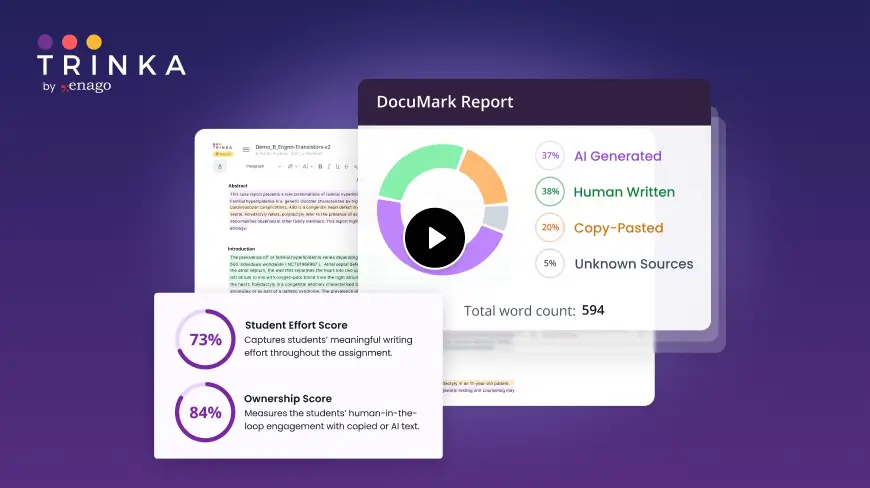
DocuMark: Responsible AI Use for Academic Integrity
Knowing your institution's AI policy is step one. DocuMark helps enforce it fairly by empowering universities to manage AI-generated content, prevent cheating, and support student writing through responsible AI use.
Common Questions About California Polytechnic State University (Cal Poly SLO)'s AI Policies
California Polytechnic State University (Cal Poly SLO) has defined AI policies in 9 of 12 categories, with an overall coverage score of 75%.
Cal Poly requires crediting sources when using others' ideas or work, and it is developing AI-related guidance that includes disclosure. The teaching resources also direct faculty to syllabus statements that can set course policies on AI use, so disclosure expectations may be specified at the course level rather than through a single final university-wide AI disclosure rule in these sources.
Cal Poly states that academic dishonesty cases are handled by the instructor under established procedures, with mandatory reporting to Student Rights & Responsibilities and possible additional disciplinary review. Students may appeal, and OSRR confirms findings based on a preponderance of the evidence. The provided sources do not state a university position on AI detection tools specifically.
Cal Poly identifies ChatGPT Edu as an institutionally supported platform for eligible students, faculty, and staff, with specific data-handling limits. ChatGPT Edu is approved for Cal Poly Level 2 and Level 3 data, but not for Level 1 or HIPAA-protected data; sharing custom GPTs outside the campus workspace is not allowed for data privacy reasons. The university also states that ChatGPT Edu data is encrypted and not used to train OpenAI models under the CSU agreement.