Teaching & Learning
- The guidance also says instructors decide and communicate what counts as appropriate use in their courses, in conjunction with academic honesty policies
- For student assignments, AI use is treated as academic dishonesty when it is used without being assigned, and the university frames this as falling under its academic honesty rules on using tools without proper citation
It is considered academic dishonesty when students use AI generative tools when not assigned. As written at this time, the university’s academic honesty policy includes using tools without proper citation, which covers AI tools.
In consultation with your Dean or Chair, you can add learning goals to help your students develop skills in using AI tools responsibly and effectively. You need to determine what constitutes appropriate use of AI, how you want your students to cite AI-generated writing, at what point the student can claim ownership, etc., in conjunction with academic honesty policies.
- This means exam-related tool use is governed by general cheating rules and professor-designated restrictions rather than a separate AI policy
- The university does not state an AI-specific exam rule in the provided sources, but its academic dishonesty policy prohibits using electronic equipment or information during examinations when unauthorized, and it also allows professors to set special exam rules
Cheating is the act of deceiving, which includes such acts as receiving or communicating or receiving information from another during an examination, looking at another's examination (during the exam), using notes when prohibited during examinations, using electronic equipment to receive or communicate information during examinations, using any unauthorized electronic equipment during examinations, obtaining information about the questions or answers for an examination prior to the administering of the examination or whatever else is deemed contrary to the rules of fairness, including special rules designated by the professor in the course.
- It also emphasizes that AI cannot replace student thinking and that instructors decide whether and how to incorporate AI into teaching
- The teaching guidance encourages instructors to help students use AI responsibly and gives examples of permitted learning support uses such as brainstorming, gathering information, and supporting writing processes
Consider teaching students that there is an appropriate use of AI tools so they do not focus on inappropriate use. For example, AI can support the early stages of research when brainstorming ideas. You can concurrently work with students by having checkpoints throughout the process to understand students' thinking and keep them accountable.
While AI tools can aid in brainstorming ideas and generating content, AI tools cannot replace critical thinking, argumentation, and analysis. If you choose to use AI as a resource in your classroom, emphasize the importance of students developing their own thinking.
In consultation with your Dean or Chair, you can add learning goals to help your students develop skills in using AI tools responsibly and effectively.
As AI becomes more prevalent in various aspects of society, it is important for instructors to address the ethical and responsible use of AI tools in their teaching. This may involve discussing issues such as bias, privacy, plagiarism, and the limitations of AI with students. As an instructor, you will ultimately decide whether and how you incorporate AI into your teaching.
Research
- The AI FAQ notes that AI may support early-stage research brainstorming, and a 2025 university article says faculty will be able to edit proposals, objectives, and progress reports in an AI-powered research platform
- For research-related writing, the university's graduate academic integrity policy applies to the preparation of theses and dissertations, but the provided sources do not set an AI-specific rule for drafting or editing manuscripts
This policy applies to all academic conduct in the broadest sense, including submitted drafts and final coursework, research, comprehensive examinations and the preparation of theses or dissertations.
Consider teaching students that there is an appropriate use of AI tools so they do not focus on inappropriate use. For example, AI can support the early stages of research when brainstorming ideas.
Faculty will be able to edit proposals, objectives, and progress reports, while at the same time, the Research office can centralize submission of proposals and progress reports to funding entities.
- The only AI-related guidance for research notes that AI can be used to support early-stage brainstorming
- The university's academic dishonesty policies cover fabrication of data, which applies to research, but the provided sources do not contain an AI-specific policy for research data analysis or synthetic data
Fabrication is the act of artificially contriving or making up material, data or other information and submitting this as fact.
This policy [on academic integrity] applies to all academic conduct in the broadest sense, including submitted drafts and final coursework, research, comprehensive examinations and the preparation of theses or dissertations.
Consider teaching students that there is an appropriate use of AI tools so they do not focus on inappropriate use. For example, AI can support the early stages of research when brainstorming ideas.
- The provided sources do not contain an AI-specific research ethics policy for grant proposals, IRB materials, or ethics declarations
- They do show that university academic honesty standards apply broadly to research, theses, and dissertations, and that sanctions can be imposed for violations
This policy applies to all academic conduct in the broadest sense, including submitted drafts and final coursework, research, comprehensive examinations and the preparation of theses or dissertations.
Accompanying this policy are procedures that set forth a system for enforcement of these standards, including the application of sanctions where violations have been found. Sanctions are necessary to demonstrate that the university treats violations of academic honesty seriously and will act aggressively, when necessary, to deter wrongdoing.
Academic Integrity
- At the course level, instructors are told to determine what appropriate AI use is and how students should cite AI-generated writing
- The university requires proper acknowledgment under its academic dishonesty policy, and the AI FAQ states that this requirement covers AI tools
It is considered academic dishonesty when students use AI generative tools when not assigned. As written at this time, the university’s academic honesty policy includes using tools without proper citation, which covers AI tools.
In consultation with your Dean or Chair, you can add learning goals to help your students develop skills in using AI tools responsibly and effectively. You need to determine what constitutes appropriate use of AI, how you want your students to cite AI-generated writing, at what point the student can claim ownership, etc., in conjunction with academic honesty policies.
A. Plagiarism is the act of presenting the work or methodology of another as if it were one's own. It includes quoting, paraphrasing, summarizing or utilizing the published work of others without proper acknowledgment, and, where appropriate, quotation marks.
However, any unacknowledged use of another's words, ideas or electronic processes constitutes plagiarism, including the use of papers written by other students, oral presentations, interviews, radio or TV broadcasts, any published or unpublished materials (including Web-based materials, letters, pamphlets, leaflets, notes or other electronic or print documents), and any unauthorized or inadequately credited use of foreign language, scientific and/or mathematical calculation and/or modeling programs or online services.
- The university says AI-detection and plagiarism-detection tools such as Turnitin are not fully reliable and only indicate probability, not proof
- Enforcement is handled through the academic dishonesty process: instructors initiate cases, report them to the dean, and sanctions can include course failure for undergraduates and more severe penalties, including expulsion, for graduate students
Turnitin and other plagiarism detection tools are actively developing mechanisms to detect AI-generated content. However, these systems are not completely reliable as AI writing tools continue to change and evolve. Plagiarism detection software can only provide a probability that a text was generated by AI and not definite proof.
As an instructor, you are responsible for clearly communicating academic honesty expectations to students and addressing any issues that may arise in your classroom. If you identify an instance of academic dishonesty, the first step is to inform the student and schedule a one-on-one meeting with them. Document the meeting in detail. If you determine that the assignment was knowingly plagiarized, fabricated, or completed dishonestly, you should follow the consequences outlined in your syllabus.
Finally, report the issue to the dean of your school, providing as much detail as possible. The dean will maintain a record of students who have violated the Student Academic Dishonesty Policy and will address any concerning behavior patterns.
The presumed sanction for undergraduate students for academic dishonesty will be failure for the course. There may be circumstances, however, where, perhaps because of an undergraduate student's past record, a more serious sanction, such as suspension or expulsion, would be appropriate.
In the context of graduate studies, the expectations for academic honesty are greater, and therefore the presumed sanction for dishonesty is likely to be more severe, e.g., expulsion.
Institutional & Administrative
- Faculty are not required to use AI, but those who choose to do so may seek guidance from the Center for Teaching Excellence
- The university allows instructors to use AI to help create syllabi and instructional materials, but it requires human oversight and judgment, and it says instructor expertise is crucial in aligning AI-generated materials to standards and student needs
Although instructors are not expected to use AI in their courses, those who choose to do so can contact the CTE for guidance using our Service Request Form.
AI can assist in generating learning objectives, instructional activities, and syllabi. However, it is essential to incorporate human oversight and judgment, especially when professional schools, departments, or external certifications mandate specific standards and objectives. As the instructor, your expertise is crucial in aligning AI-generated materials with external requirements while considering the unique needs of your students and the context of your course.
- One university article identifies IgniteHub as an AI-powered research management platform for faculty research administration
- The provided sources mention data privacy and security as concerns about AI use, but they do not define a university AI data-classification scheme, approved platform list, or prohibited tools
Some concerns include data privacy and security issues, bias and fairness in AI algorithms, ethical implications of using AI for decision-making, and the potential for students to misuse AI for academic dishonesty.
The first portal to be revealed is called IgniteHub. This is a centralized research management tool that facilitates faculty networking and collaborations, identifies new extramural funding opportunities, serves as a platform for both intramural and extramural grant competitions, and helps manage grants that are obtained.
- The university has published centralized AI teaching guidance that it describes as a living document and says it will continue updating as guidance evolves
- It also describes institutional AI development efforts, including AI-related programming through the Center for Teaching Excellence and AI-powered campus platforms developed with the Office of the Senior Vice Provost for Research, but the provided sources do not set out a formal university-wide AI governance framework
This page provides guidance on frequently asked questions submitted by instructional staff at The Catholic University of America. Click on a question to reveal the answer below it.
The FAQ was last updated on 2/14/24. It is intended to be a living document, and will be updated as new questions come in and new guidance becomes available.
The Center for Teaching Excellence will be offering programming related to AI in collaboration with our Fall 2023 Faculty Fellows:
Faculty and students from the School of Engineering, in collaboration with the Office of the Senior Vice Provost for Research (SVPR), have been busy creating AI-powered platforms to enhance our connections on campus.
He and his team have been working on three AI-powered platform tools to assist with everything from research grants to course credits to scheduling classes.
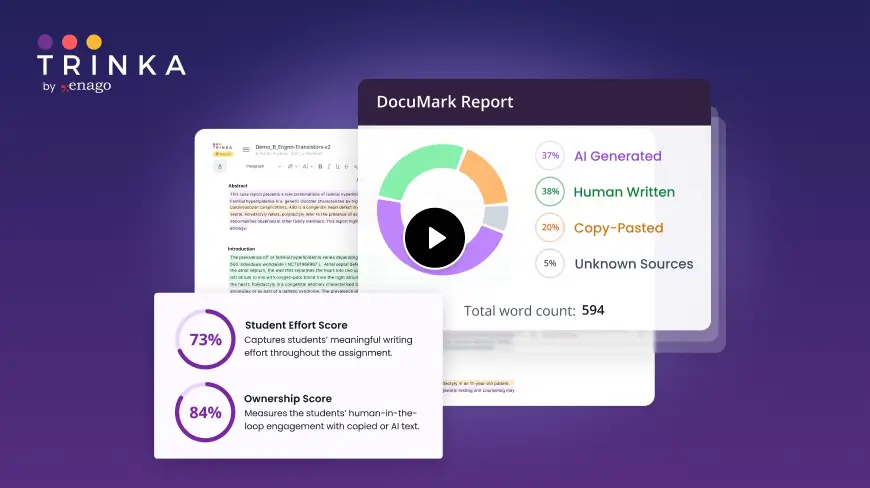
DocuMark: Responsible AI Use for Academic Integrity
Knowing your institution's AI policy is step one. DocuMark helps enforce it fairly by empowering universities to manage AI-generated content, prevent cheating, and support student writing through responsible AI use.
Common Questions About Catholic University of America's AI Policies
Catholic University of America has defined AI policies in 11 of 12 categories, with an overall coverage score of 92%.
The university requires proper acknowledgment under its academic dishonesty policy, and the AI FAQ states that this requirement covers AI tools. At the course level, instructors are told to determine what appropriate AI use is and how students should cite AI-generated writing.
The university says AI-detection and plagiarism-detection tools such as Turnitin are not fully reliable and only indicate probability, not proof. Enforcement is handled through the academic dishonesty process: instructors initiate cases, report them to the dean, and sanctions can include course failure for undergraduates and more severe penalties, including expulsion, for graduate students.
The provided sources mention data privacy and security as concerns about AI use, but they do not define a university AI data-classification scheme, approved platform list, or prohibited tools. One university article identifies IgniteHub as an AI-powered research management platform for faculty research administration.