Teaching & Learning
- For regular coursework, the college-level material provided does not set one uniform student AI rule
- Instead, faculty are told to set clear course policies and expectations, and the sample language shows that course policies may prohibit AI-generated text, require disclosure of AI help, or allow limited use with attribution
Discuss AI tools with your students and be clear about your rules and expectations
You should consider addressing AI tools in your course policies. When it comes to AI tools, how do you
define appropriate use in the context of your course(s)? When and how should students disclose their
usage of AI tools?
Accordingly, students are prohibited from submitting papers
that include text generated from a large-scale language model (LLM) such as ChatGPT. Students are
expected to know and respect the boundary between using these technologies to generate text and using them for editing or polishing original text that the student has personally authored.
• If you receive help on your writing from any outside source including friends, tutors, or AI tools,
you should acknowledge the nature and extent of the help in a separate note to be submitted
along with the assignment
Purposeful Usage: ChatGPT may be used as a tool for brainstorming, structuring thoughts, improving
language, and enhancing understanding of complex concepts. However, the content generated by
ChatGPT should not replace your own original thoughts and ideas.
- The material does not state a single university-wide AI rule for exams
- It gives faculty assessment design guidance, including the option to use in-class writing and institutional devices with Wi‑Fi disabled for writing exercises or assessments
Strategize about how your students will be writing and submitting their work
o Make use of in-class writing, either by hand or on an institutional device (e.g. with wifi
disabled).
▪ If you would like to use one of CMC’s technology classrooms (Kravis 165 and
Roberts North 12) for some kind of writing exercise or assessment, you can
book a time using the room reservation request form.
- The same sample also says AI should not replace students' own original thinking
- The faculty guidance states that AI can be incorporated into learning on the instructor's terms, and sample syllabus language allows use for brainstorming, structuring thoughts, improving language, and understanding complex concepts
● Incorporate AI tools on your own terms
o Shape students’ use of AI tools by making them part of the assignment
ChatGPT and similar AI technologies offer exciting possibilities for learning and discovery. They can serve
as valuable tools in our academic pursuits, particularly for writing assistance and idea generation.
Purposeful Usage: ChatGPT may be used as a tool for brainstorming, structuring thoughts, improving
language, and enhancing understanding of complex concepts. However, the content generated by
ChatGPT should not replace your own original thoughts and ideas. Instead, use it as a catalyst to spur
your own creativity and critical thinking.
Research
- The thesis syllabus does not establish any AI-specific policy for research writing or manuscript preparation; it states only that students are responsible for investigation of sources, accumulation of data, and preparation of the thesis with their reader's advice
- The separate faculty classroom guidance document provides sample course-language options — prohibition of LLM-generated text, acknowledgment of AI assistance, or attribution of incorporated AI text — but these are course-level samples not specifically directed at thesis or research writing
The thesis is a research paper and students are responsible, with the advice of their reader, for the investigation of sources, the accumulation of data, the selection of pertinent material, and the preparation of the thesis in acceptable form.
[From generative_ai_and_the_classroom.pdf — sample course language, not thesis-specific]
Accordingly, students are prohibited from submitting papers that include text generated from a large-scale language model (LLM) such as ChatGPT.
• If you receive help on your writing from any outside source including friends, tutors, or AI tools, you should acknowledge the nature and extent of the help in a separate note to be submitted along with the assignment
Attribution: If you incorporate text generated by ChatGPT into your assignments, you must appropriately attribute the source.
- The provided sources do not give an AI-specific rule for using AI in research data collection, analysis, or interpretation
- The thesis syllabus states generally that students are responsible for the accumulation of data, and research involving human subjects requires IRB approval
The thesis is a research paper and students are responsible, with the advice of their reader, for the investigation of
sources, the accumulation of data, the selection of pertinent material, and the preparation of the thesis in acceptable
form.
Students doing research that involves working with living human beings may need to get permission from the
Institutional Review Board (IRB) before beginning research. Research that involves interviewing other people,
distributing surveys, conducting experiments on people, or even observing particular people in their daily lives is
normally what we call "research on human subjects," and all such research requires some level of approval from the IRB.
- The provided sources do not define AI-specific rules for research ethics or integrity declarations
- The thesis syllabus addresses research ethics only in the context of human-subjects research, requiring students to obtain IRB approval before conducting interviews, surveys, experiments, or observational research involving living people
Students doing research that involves working with living human beings may need to get permission from the Institutional Review Board (IRB) before beginning research. Research that involves interviewing other people, distributing surveys, conducting experiments on people, or even observing particular people in their daily lives is normally what we call "research on human subjects," and all such research requires some level of approval from the IRB. See the IRB website for instructions on how to apply for IRB approval of research.
Academic Integrity
- Disclosure and attribution are addressed through faculty guidance and sample syllabus language rather than one single mandatory university-wide AI rule
- Faculty are encouraged to specify when and how students should disclose AI use, and sample policies require either a separate note acknowledging AI assistance or attribution when AI-generated text is incorporated
When and how should students disclose their
usage of AI tools?
Set clear expectations about citation and attribution
• If you receive help on your writing from any outside source including friends, tutors, or AI tools,
you should acknowledge the nature and extent of the help in a separate note to be submitted
along with the assignment
Attribution: If you incorporate text generated by ChatGPT into your assignments, you must
appropriately attribute the source. Just as you would cite a book or website that you paraphrased or
quoted, you should acknowledge the contribution of AI tools.
- CMC says AI detectors are unreliable and cannot provide definitive proof, though the college has a Turnitin license with AI detection
- When faculty suspect inappropriate AI use, they should report the matter to the Academic Standards Committee, which may compare detector scores during an investigation, and CMC's cross-campus case-management document states that faculty must report to ASC
● Things to consider about AI detectors:
o AI detectors are unreliable. No AI detector can provide definitive proof.
o CMC maintains an institutional license to Turnitin.com, which now includes AI detection.
When you suspect that a student has committed an academic integrity violation by making
inappropriate use of AI tools, you should report it to the ASC. The ASC may consult and compare AI
detector scores as part of an investigation, but faculty should also provide additional evidence when possible (e.g. other examples of the student’s writing, for comparison). You should also provide insight
into what led you to suspect the inappropriate use of AI tools.
Reporting Faculty must
report to ASC
Institutional & Administrative
- The materials also say faculty may use AI detectors, but should do so consistently and with awareness of false positives and limits
- Faculty are encouraged to address AI in course policies, redesign assignments with AI in mind, and shape student use of AI on their own terms
You should consider addressing AI tools in your course policies. When it comes to AI tools, how do you
define appropriate use in the context of your course(s)?
Consider how you might adjust your assignments, taking AI tools into account:
● Incorporate AI tools on your own terms
o Shape students’ use of AI tools by making them part of the assignment
If you plan to use detectors, it’s important to use them in consistent ways. Consider
using them on everyone’s writing, or on a random sampling.
- No additional data protection or platform approval framework was identified in the available sources
- The only institutionally licensed AI-adjacent tool identified is Turnitin (including its AI detection feature), referenced in the faculty classroom guidance
- The provided sources do not define a broader institutional AI data-classification, privacy, or approved-platform policy governing what data may be entered into AI systems
CMC maintains an institutional license to Turnitin.com, which now includes AI detection.
[Note: No broader institutional data protection, data classification, or approved AI platform policy was identified in the available CMC sources.]
- The faculty resources page lists the AI guidance document, and the classroom document says sample syllabus language was developed by members of the ASC and the ChatGPT working group
- The provided materials show that CMC has faculty-facing AI guidance and references a ChatGPT working group, but they do not define an overarching institutional AI strategy or governance framework
* Generative AI and the Classroom: Tips and Ideas
Below are samples of
syllabus language developed by members of the ChatGPT working group and the ASC.
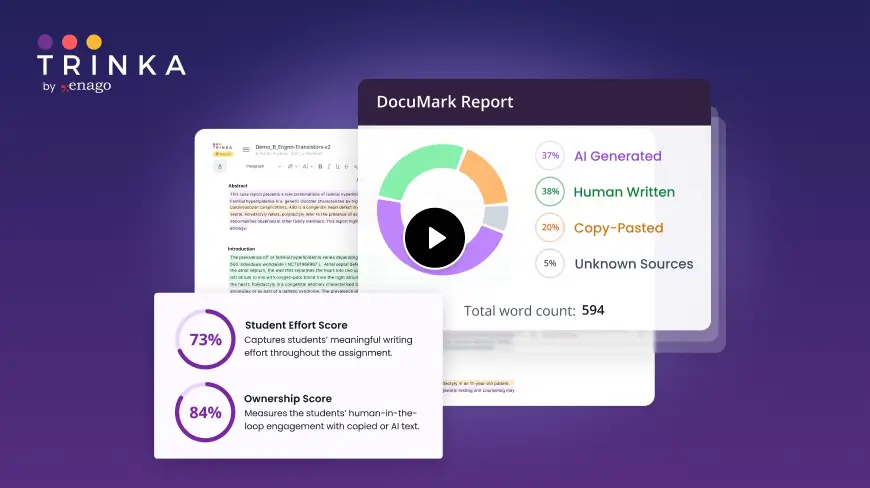
DocuMark: Responsible AI Use for Academic Integrity
Knowing your institution's AI policy is step one. DocuMark helps enforce it fairly by empowering universities to manage AI-generated content, prevent cheating, and support student writing through responsible AI use.
Common Questions About Claremont McKenna College's AI Policies
Claremont McKenna College has defined AI policies in 11 of 12 categories, with an overall coverage score of 92%.
Disclosure and attribution are addressed through faculty guidance and sample syllabus language rather than one single mandatory university-wide AI rule. Faculty are encouraged to specify when and how students should disclose AI use, and sample policies require either a separate note acknowledging AI assistance or attribution when AI-generated text is incorporated.
CMC says AI detectors are unreliable and cannot provide definitive proof, though the college has a Turnitin license with AI detection. When faculty suspect inappropriate AI use, they should report the matter to the Academic Standards Committee, which may compare detector scores during an investigation, and CMC's cross-campus case-management document states that faculty must report to ASC.
The provided sources do not define a broader institutional AI data-classification, privacy, or approved-platform policy governing what data may be entered into AI systems. The only institutionally licensed AI-adjacent tool identified is Turnitin (including its AI detection feature), referenced in the faculty classroom guidance. No additional data protection or platform approval framework was identified in the available sources.