Teaching & Learning
- Where AI is allowed, students may use it only within the stated limits and must not undermine learning outcomes or misrepresent authorship
- The School of Business states a stricter student rule that AI-generated content in coursework is prohibited unless the professor says otherwise
- Clark University sets a university-wide framework in which faculty define whether AI use in coursework is no use, limited use, or extensive use, and students must follow the course or assignment rules
Syllabi and assignment guidelines should be transparent about when and how AI can or cannot be used. To maximize clarity for students, these expectations should be standardized in a three-tier system across the university to provide a simple, easy to follow guide for students. These tiers are referred to as: no use, limited use, and extensive use. If an assignment or course is designated no use, then AI tools are not allowed to be used in completing that assignment or at all in the course. Limited use denotes that AI may be used in a specific way for the assignment. For example, AI may be used to brainstorm ideas for a paper but cannot be used to write the paper. Finally, extensive use denotes there are no restrictions on AI use for that assignment or course, though this policy must still be followed, including but not limited to appropriate disclosure, labeling, and attribution.
Where permitted, students are invited to leverage AI for creative inquiry, responsible collaboration, and academic advancement, provided its contribution is properly disclosed and does not undermine learning outcomes or misrepresent authorship.
Some disciplines or instructors may choose to minimize or avoid AI use altogether. These choices are fully supported.
Simply stated, using AI tools to generate content in your coursework is prohibited, unless your professor states otherwise.
Unless otherwise noted by your professor in a course, use of any AI tool is prohibited.
- Clark University does not provide a separate university-wide rule specifically for exams or quizzes in the sources reviewed
- AI use in assessed work is left to course or assignment rules under the no use, limited use, and extensive use framework, and some instructors may prohibit it entirely
Syllabi and assignment guidelines should be transparent about when and how AI can or cannot be used. To maximize clarity for students, these expectations should be standardized in a three-tier system across the university to provide a simple, easy to follow guide for students. These tiers are referred to as: no use, limited use, and extensive use. If an assignment or course is designated no use, then AI tools are not allowed to be used in completing that assignment or at all in the course.
Some disciplines or instructors may choose to minimize or avoid AI use altogether. These choices are fully supported.
- Clark University encourages students to use AI to support learning rather than replace it, but students must check course-specific rules first
- The student guidance expressly allows that one professor may permit brainstorming while another may ban AI completely, and students are expected to verify facts, retain their own voice, protect private or unpublished information, and continue doing the underlying learning themselves
Artificial intelligence is changing how we study, brainstorm, and solve problems. This page is designed to help you navigate AI responsibly and effectively as a student at Clark and help you use AI to support your learning, rather than replace it.
Check the Rules First: Every class is different. One professor might let you use AI to brainstorm, while another might ban it completely. Always read the syllabus for each assignment before you start. If in doubt, talk to your faculty member.
Double-Check the Facts: AI makes mistakes and sometimes invents fake information. Never take its answers at face value. You are the one who needs to read over, check, and confirm that everything it gives you is actually true.
Keep It in Your Own Voice: AI is great for fixing grammar, but the final project should still sound like you. Don’t let the tool replace your own thoughts, opinions, and writing style.
Watch What You Share: Be careful about what you type into an AI. Never upload private personal info or important, unpublished research. Assume the AI will remember and use whatever you give it.
Make Sure You are Still Learning: Skipping the hard part of an assignment might save time today, but it can hurt you later. Ask yourself: If the AI does this for me, am I missing out on a skill I actually need to learn?
- Student guidance specifically notes that if AI helps write code, students need to credit it
- Clark University permits AI-assisted code generation only where a course or assignment allows it; faculty may classify assignments as no use, limited use, or extensive use
- The university also lists Claude as providing coding support, but no separate university-wide programming assignment rule is stated beyond course-level control and disclosure requirements
These tiers are referred to as: no use, limited use, and extensive use. If an assignment or course is designated no use, then AI tools are not allowed to be used in completing that assignment or at all in the course. Limited use denotes that AI may be used in a specific way for the assignment.
Know How to Cite It: If AI helps you build an outline, write code, or fix your paragraphs, you will need to credit it. Make sure you know how your instructor wants you to show that AI was used.
Anthropic Claude Anthropic Claude is a versatile AI assistant specializing in advanced text analysis, data parsing, and robust coding support.
Research
- Clark University allows AI use in scholarly writing only if it follows integrity, ethical authorship, and attribution requirements
- The general policy requires disclosure of AI use in scholarly work and says academic AI use must be cited or otherwise acknowledged under disciplinary norms and course or publication guidelines, including describing how the tool was used and identifying the tool or service
Research activities using AI must adhere to principles of integrity, ethical authorship, and appropriate attribution.
When artificial intelligence tools are used in administrative, academic, or scholarly work, their use must be disclosed in a clear and appropriate manner. In academic contexts, AI tools must be cited or otherwise acknowledged in accordance with disciplinary norms and course or publication guidelines, including a brief description of how the tool was used (e.g., brainstorming, editing, data analysis) and identification of the tool or service.
- Clark data may not be used to train external models unless expressly authorized
- Clark University allows AI use for research-related data analysis only under data protection and review requirements
- The policy explicitly treats data analysis as a use case that must be disclosed in academic contexts, requires critical validation of outputs, and restricts sensitive data to institutionally approved, contractually vetted, security-reviewed tools
Users are solely responsible for how they use, interpret and act upon AI-generated content. Users are expected to apply critical judgment and appropriate validation when using AI outputs in academic, research, or operational contexts.
Sensitive data may only be used with institutionally approved, contractually vetted, and security-reviewed AI tools. AI tools may not be used to train external models using Clark data unless explicitly authorized.
In academic contexts, AI tools must be cited or otherwise acknowledged in accordance with disciplinary norms and course or publication guidelines, including a brief description of how the tool was used (e.g., brainstorming, editing, data analysis) and identification of the tool or service.
- Clark University requires research uses of AI to follow integrity, ethical authorship, attribution, and transparency requirements
- The sources do not provide specific separate rules for grant proposals, IRB applications, or ethics declarations, but they do state that scholarly AI use must be disclosed and that users remain responsible for the accuracy, integrity, and ethical use of AI-assisted content
Research activities using AI must adhere to principles of integrity, ethical authorship, and appropriate attribution.
Transparency and disclosure: Users should openly communicate when AI is used, especially in scholarly and operational contexts.
In all cases, individuals remain responsible for the accuracy, integrity, and ethical use of AI-assisted content.
Academic Integrity
- Clark University requires disclosure of AI use in academic and scholarly work
- Student-facing guidance also says that if AI helps with outlining, code, or paragraph revision, students need to credit it and follow the instructor’s preferred method
- In academic contexts, AI tools must be cited or otherwise acknowledged according to disciplinary norms and course or publication guidelines, and the disclosure must include how the tool was used and which tool or service was used
Transparency and disclosure: Users should openly communicate when AI is used, especially in scholarly and operational contexts.
Academic integrity and originality: AI is a catalyst for new thinking, but its use must be properly attributed and not misrepresent human authorship.
When artificial intelligence tools are used in administrative, academic, or scholarly work, their use must be disclosed in a clear and appropriate manner. In academic contexts, AI tools must be cited or otherwise acknowledged in accordance with disciplinary norms and course or publication guidelines, including a brief description of how the tool was used (e.g., brainstorming, editing, data analysis) and identification of the tool or service.
Know How to Cite It: If AI helps you build an outline, write code, or fix your paragraphs, you will need to credit it. Make sure you know how your instructor wants you to show that AI was used.
- The School of Business student policy explicitly notes that instructors may use AI detection tools and says any generative AI use will be treated as plagiarism unless faculty authorize it
- Clark University states that violations of its AI policy may lead to corrective action under existing university procedures and that the policy works alongside existing academic integrity, data classification, and information security rules
Violations of this policy may result in corrective action according to existing University procedures. The policy operates alongside, and does not replace, other University policies governing academic integrity, data classification, and information security. Clark University reserves the right to intervene or restrict access to AI tools used in violation of institutional standards.
There are many AI detection tools an instructor could use to see if submitted work was generated by AI.
Any use of generative AI tools will be treated as plagiarism, unless your faculty
Institutional & Administrative
- Faculty guidance recommends uses such as drafting rubrics, generating feedback templates, building quizzes, and designing classroom materials
- Clark University encourages faculty to explore AI in curricula and scholarly activities and expects them to set clear syllabus and assignment expectations
- For staff and administrators, AI is encouraged for administrative functions, but high-impact automated decisions and materially affecting outputs must receive human review and validation rather than serving as the sole basis for decisions
Faculty are encouraged to explore AI’s potential in their curricula and scholarly activities, setting clear expectations for its use. Syllabi and assignment guidelines should be transparent about when and how AI can or cannot be used.
Draft Rubrics and Feedback Templates: Feed your assignment prompt into an AI and ask it to draft a detailed scoring rubric based on your specific criteria. You can also use it to generate structured template responses for common student mistakes to speed up grading.
Create Low-Stakes Retrieval Quizzes: Drop your lecture notes or a course reading into an AI and instruct it to generate multiple-choice questions or short-answer prompts. It can instantly build quick, active-learning checks complete with an answer key.
Clark University promotes the responsible and transparent use of AI in administrative functions to enhance efficiency, analytics, decision support, and service delivery. All high-impact automated decisions must include human review to ensure fairness and accuracy.
AI-generated outputs should not be used as the sole basis for decisions that materially affect individuals or University operations and must be subject to appropriate human review and validation.
- Clark data may not be used to train external models unless explicitly authorized
- Clark University requires AI use to protect university data and privacy, and it restricts sensitive data to institutionally approved, contractually vetted, and security-reviewed tools
- The university identifies Microsoft Copilot Chat as Clark’s approved AI agent for all students, faculty, and staff, states that Copilot Chat and Google Gemini are safe for confidential and restricted Clark data when used with a Clark account, and says third-party platforms are not approved for confidential or restricted university data
While Clark University encourages the use of AI, all such activities must strictly protect University data and individual privacy.
Sensitive data may only be used with institutionally approved, contractually vetted, and security-reviewed AI tools. AI tools may not be used to train external models using Clark data unless explicitly authorized.
Copilot Chat As Clark’s approved AI agent, Microsoft Copilot Chat is available to all students, faculty, and staff. When you’re logged in with your Clark account, Copilot Chat is available to use with confidential and restricted Clark data.
Google Gemini Google Gemini is available for faculty and staff and is safe for confidential and restricted Clark data, provided you log in with your university account.
Please note that these third-party platforms are not approved for use with confidential and restricted university data; any experimentation should be limited to public, non-confidential information.
Protect private information: Never put confidential or restricted data, student grades, IDs, or sensitive institutional info into public AI tools. Treat it with the same privacy you would any official student record. Microsoft Copilot and Google Gemini, when used with your Clark account, is approved for use with Restricted Clark data.
- Oversight is shared by ITS, the Academic Technology Committee, university leadership, the Provost, library, legal, and related academic technology groups
- Clark University has a formal AI governance structure and strategy centered on responsible, ethical, transparent, and secure AI use across academic, research, and administrative purposes
- The AI Hub also states that a presidentially created AI Taskforce was convened in January 2026 for one year to evaluate current AI use, address policy needs, create a central resource guide, and transition to a permanent AI Steering Committee in early 2027
Clark University’s Artificial Intelligence Use Policy is designed to support the responsible and informed use of AI technologies within the University community.
This policy promotes the responsible, ethical, transparent, and secure deployment of AI for academic, research, and administrative purposes.
Clark University’s Information Technology Services (ITS) in conjunction with the Academic Technology Committee, and University leadership provides ongoing guidance, oversight, and evaluation of AI practices. The Provost oversees academic standards for AI use; administrative leaders guide operational adoption; ITS approves tooling and data protections; the library serves as consultative partners in matters related to information ethics, scholarly communication, licensed content, and research practices; and legal ensures adherence to regulatory requirements. ITS in conjunction with CETAL, the Socr-AI-tic Lab for Collaborative Pedagogy, and the Academic Technology Committee will monitor AI technology developments, review significant initiatives, and support the community in ethical, effective AI adoption.
The AI Taskforce is a one-year task force created by Clark’s President, David Fithian.
Convened in January 2026, our one-year mission is to evaluate Clark’s current use of AI, identify and address AI-specific policy needs, and create a central resource guide to help all members of the Clark community consider their use of AI.
We will transition the Task Force to a more permanent AI Steering Committee in early 2027.
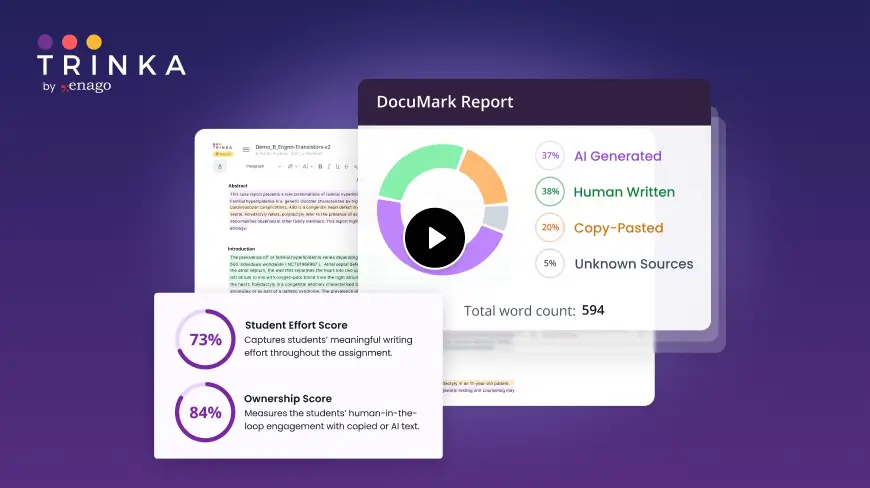
DocuMark: Responsible AI Use for Academic Integrity
Knowing your institution's AI policy is step one. DocuMark helps enforce it fairly by empowering universities to manage AI-generated content, prevent cheating, and support student writing through responsible AI use.
Common Questions About Clark University's AI Policies
Clark University has defined AI policies in 12 of 12 categories, with an overall coverage score of 100%.
Clark University requires disclosure of AI use in academic and scholarly work. In academic contexts, AI tools must be cited or otherwise acknowledged according to disciplinary norms and course or publication guidelines, and the disclosure must include how the tool was used and which tool or service was used. Student-facing guidance also says that if AI helps with outlining, code, or paragraph revision, students need to credit it and follow the instructor’s preferred method.
Clark University states that violations of its AI policy may lead to corrective action under existing university procedures and that the policy works alongside existing academic integrity, data classification, and information security rules. The School of Business student policy explicitly notes that instructors may use AI detection tools and says any generative AI use will be treated as plagiarism unless faculty authorize it.
Clark University requires AI use to protect university data and privacy, and it restricts sensitive data to institutionally approved, contractually vetted, and security-reviewed tools. Clark data may not be used to train external models unless explicitly authorized. The university identifies Microsoft Copilot Chat as Clark’s approved AI agent for all students, faculty, and staff, states that Copilot Chat and Google Gemini are safe for confidential and restricted Clark data when used with a Clark account, and says third-party platforms are not approved for confidential or restricted university data.