Teaching & Learning
- Instructors are responsible for setting and communicating course/assignment-specific expectations for AI use
- Use of generative AI for coursework is treated as plagiarism/academic dishonesty by default unless an instructor explicitly approves its use for a specific assignment
“Plagiarism includes, but is not limited to: … Submitting work created, in whole or in part, by an artificial intelligence (AI) platform, unless explicitly approved by the instructor for a specific assignment.”
“Unless your instructor has provided express guidance to the contrary, the use of generative AI in completing coursework may be considered an act of academic dishonesty. It is your professional responsibility to know what an individual instructor expects concerning the use of AI on any given assignment.”
- Using generative AI for examinations or other assessments is prohibited as plagiarism/academic dishonesty unless the instructor explicitly approves its use for a specific assessment
“Plagiarism includes, but is not limited to: … Submitting work created, in whole or in part, by an artificial intelligence (AI) platform, unless explicitly approved by the instructor for a specific assignment.”
- Use of AI for graded work remains subject to instructor expectations and academic integrity rules
- AI may be used for learning/study support in non-graded contexts (e.g., bringing AI-generated text to Writing Center tutoring to learn how to evaluate and incorporate information ethically)
“AI and Writing Tutors: Can I bring AI-generated text to a tutoring session? Yes. Similar to how a tutor can help you brainstorm or work with a source, a writing tutor can help you analyze the AI output and strategize how to incorporate the information into your own writing ethically and effectively.”
- Submitting code created wholly or partially by a generative AI platform is treated as plagiarism unless the instructor explicitly approves its use for a specific assignment
“Plagiarism includes, but is not limited to: … Submitting work created, in whole or in part, by an artificial intelligence (AI) platform, unless explicitly approved by the instructor for a specific assignment.”
Research
- If AI tools are used to generate text/images/code for a publication or presentation, AI use must be disclosed according to publisher or conference guidelines
- Faculty using generative AI for research writing/manuscript preparation must preserve research integrity and are responsible for the accuracy of AI-generated language and citations
“Faculty who use generative AI tools in their research should do so in ways that preserve research integrity… In particular, faculty are responsible for the accuracy of any language, citations, or data analysis generated through the use of an AI tool.”
“‘If you use an AI tool to generate text, images, or code for a publication or presentation, you must disclose your use of the tool in accordance with the publisher’s or conference’s guidelines.’”
- Researchers are responsible for the accuracy of any AI-generated data analysis
- Generative AI tools must not be used to analyze or process institutional data classified as Restricted, and Confidential institutional data should only be input with extreme caution
“Do not use generative AI tools to analyze or process institutional data classified as Restricted. Be extremely cautious when inputting institutional data classified as Confidential into generative AI tools.”
“In particular, faculty are responsible for the accuracy of any language, citations, or data analysis generated through the use of an AI tool.”
- Researchers remain accountable for the accuracy and integrity of AI-assisted outputs
- Generative AI use in research must preserve research integrity, including respecting intellectual property and maintaining confidentiality of research data (e.g., human-subjects or proprietary data)
“Faculty who use generative AI tools in their research should do so in ways that preserve research integrity. This includes respecting intellectual property rights and ensuring the confidentiality of research data (such as data from human subjects research or proprietary data).”
Academic Integrity
- For publications/presentations, AI use must be disclosed according to publisher or conference guidelines
- AI contributions must be acknowledged/cited when used for ideas, information, or content, consistent with instructor directions and applicable standards
“When you use ideas, information, or content generated by an AI tool, you need to provide a citation that acknowledges the tool’s contribution.”
“If you use an AI tool to generate text, images, or code for a publication or presentation, you must disclose your use of the tool in accordance with the publisher’s or conference’s guidelines.”
- Unauthorized AI use is classified as plagiarism under Clemson’s Academic Integrity Policy and is handled through the existing academic integrity enforcement process and sanctions framework
“The Academic Integrity Policy has been updated for the 2023-24 Academic Year to include the following as a form of plagiarism: Plagiarism includes, but is not limited to: … Submitting work created, in whole or in part, by an artificial intelligence (AI) platform, unless explicitly approved by the instructor for a specific assignment.”
Institutional & Administrative
- Faculty and staff using generative AI for non-academic purposes must follow Clemson guidelines: do not input Restricted institutional data; verify and edit AI outputs for accuracy and completeness; and accept responsibility for the final output
“The following guidelines apply to all Clemson University faculty and staff members using generative AI tools for non-academic purposes.”
“Do not input any institutional data classified as Restricted into a generative AI tool…”
“Always verify the accuracy of any information generated by an AI tool and edit the content to ensure that it is accurate, complete, and up-to-date…”
“The individual using the AI tool is ultimately responsible for the final output.”
- Generative AI use is governed by Clemson’s data-classification approach
- Institutional data classified as Restricted must not be analyzed/processed or input into generative AI tools
- Confidential data requires extreme caution, with users directed to Clemson’s Data Classification and Handling Guidelines for definitions and handling requirements
“Do not use generative AI tools to analyze or process institutional data classified as Restricted. Be extremely cautious when inputting institutional data classified as Confidential into generative AI tools. Refer to Clemson University’s Data Classification and Handling Guidelines for definitions of these data classifications.”
- Clemson has an institution-level AI strategy (AI R.I.S.E Initiative) described in a university white paper and promoted via a dedicated Clemson AI site
- Clemson states it is investing more than $60M toward becoming an international leader in AI, and the white paper proposes a comprehensive plan to leverage AI to transform education and research
“Clemson is leading the way, investing more than $60M toward its goal of becoming an international leader in AI.”
“This white paper proposes a bold initiative to position Clemson University as a national leader in AI-empowered education and research. The Clemson AI R.I.S.E Initiative (Research, Innovation, Scholarship, and Education) is a comprehensive plan to leverage AI to transform our university and the world.”
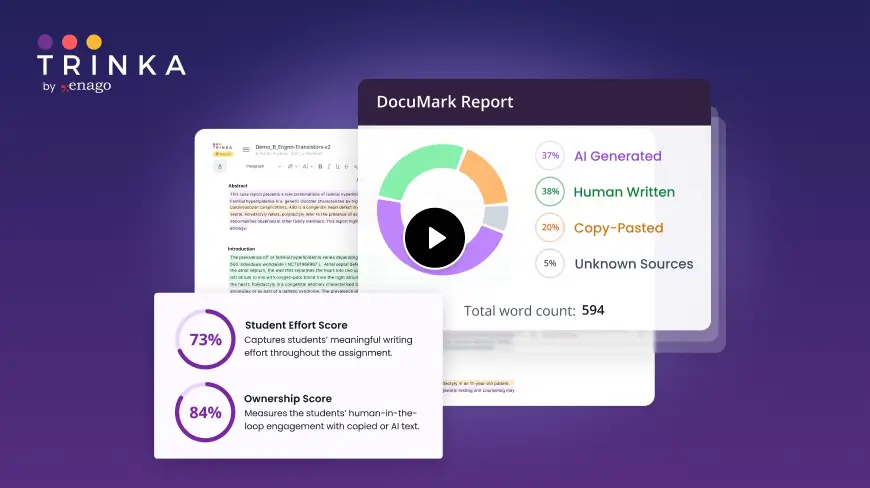
DocuMark: Responsible AI Use for Academic Integrity
Knowing your institution's AI policy is step one. DocuMark helps enforce it fairly by empowering universities to manage AI-generated content, prevent cheating, and support student writing through responsible AI use.
Common Questions About Clemson University's AI Policies
Clemson University has defined AI policies in 12 of 12 categories, with an overall coverage score of 100%.
AI contributions must be acknowledged/cited when used for ideas, information, or content, consistent with instructor directions and applicable standards. For publications/presentations, AI use must be disclosed according to publisher or conference guidelines.
Unauthorized AI use is classified as plagiarism under Clemson’s Academic Integrity Policy and is handled through the existing academic integrity enforcement process and sanctions framework.
Generative AI use is governed by Clemson’s data-classification approach. Institutional data classified as Restricted must not be analyzed/processed or input into generative AI tools. Confidential data requires extreme caution, with users directed to Clemson’s Data Classification and Handling Guidelines for definitions and handling requirements.