Teaching & Learning
- Cleveland State University does not set a university-wide AI rule for coursework and assignments in the provided sources
- Instead, the university indicates that faculty should communicate expectations in syllabi and on individual assignments, and student-facing AI guidance tells students to honor class policies when deciding whether to use AI
Communicate and reiterate your expectations regarding academic integrity throughout the semester. For example, include an academic honesty statement for every assignment and exam.
This session explores the crucial inflection point, the moment you decide whether or not to use AI. We’ll dive into how students can integrate AI responsibly while maintaining critical thinking, honoring class policies, navigating ethical dilemmas, and protecting personal privacy.
- The provided sources do not contain an AI-specific exam-use rule
- For exams generally, instructors are advised to include academic honesty statements for every exam, and suggested syllabus language states that students must display their ears for the duration of any exam to prevent cheating involving headphones or earpieces
Communicate and reiterate your expectations regarding academic integrity throughout the semester. For example, include an academic honesty statement for every assignment and exam.
As part of the University’s ongoing efforts to prevent cheating, and based on evidence of increased use of headphones and ear piece devices to permit cheating on exams, all students are required to display their ears for the duration of any exam. The policy may require adjustment to hair or clothing. Any student not complying with this policy will, after a warning, be issued a zero on the exam.
- CSU provides student training and workshops that encourage responsible AI use for learning support rather than replacing thinking
- The university describes workshops on using free AI tools, framing prompts, assessing outputs, citing properly, and integrating AI responsibly while maintaining critical thinking and following class policies
This session explores the crucial inflection point, the moment you decide whether or not to use AI. We’ll dive into how students can integrate AI responsibly while maintaining critical thinking, honoring class policies, navigating ethical dilemmas, and protecting personal privacy.
This interactive workshop will give you a variety of currently free AI options to think about using, how to frame prompts, assess the outputs, and use ethically with an end focus on proper citing.
Research
- The provided sources do not give AI-specific rules for drafting or editing research manuscripts
- The university does state that academic research misconduct includes plagiarism and other serious deviations from accepted standards in proposing, conducting, or reporting research, and it frames research integrity as a topic for AI-related research discussion
“Academic research misconduct,” herein, sometimes referred to as “misconduct,” means fabrication, falsification, plagiarism, undisclosed conflicts of interest as defined in the policy for managing conflict of interest, or other practices that seriously deviate from those that are commonly accepted within the academic community for proposing, conducting, or reporting research. It does not include honest error or honest differences in interpretations or judgments of data.
Organized by Dr. Adam Voight and Dr. Kelle Foust, the Office of Research hosted the AI & Research Forum on December 1. Panelists included Brittany Barron (Office of General Counsel), John Jeziorowski (Professor and IRB Chair), Anthony Mansoor (IS&T), and Benjamin Ward (Office of Research), and discussion topics included research integrity, IRB and confidentiality requirements, legal and privacy considerations, and information security.
- The university does not publish an AI-specific rule on using AI for research data analysis in the provided sources
- However, CSU frames AI research use as subject to research integrity, confidentiality, privacy, information security, and accepted research standards, and it tells users to use caution with sensitive information
Organized by Dr. Adam Voight and Dr. Kelle Foust, the Office of Research hosted the AI & Research Forum on December 1. Panelists included Brittany Barron (Office of General Counsel), John Jeziorowski (Professor and IRB Chair), Anthony Mansoor (IS&T), and Benjamin Ward (Office of Research), and discussion topics included research integrity, IRB and confidentiality requirements, legal and privacy considerations, and information security.
“Academic research misconduct,” herein, sometimes referred to as “misconduct,” means fabrication, falsification, plagiarism, undisclosed conflicts of interest as defined in the policy for managing conflict of interest, or other practices that seriously deviate from those that are commonly accepted within the academic community for proposing, conducting, or reporting research. It does not include honest error or honest differences in interpretations or judgments of data.
Users are urged to use caution in the storage of any sensitive information. Users are urged to keep their personally identifiable information secure.
- CSU has a university research-integrity framework that applies to all individuals engaged in academic research, including students and staff
- In the AI context, the university highlights research integrity, IRB and confidentiality requirements, legal and privacy considerations, and information security as relevant topics for responsible use
This policy and the associated procedures apply to all individuals engaged in academic research at Cleveland state university including faculty members, professional staff, scientists, trainees, technicians and other staff members, students, fellows, volunteers, gust researchers, or collaborators.
“Academic research misconduct,” herein, sometimes referred to as “misconduct,” means fabrication, falsification, plagiarism, undisclosed conflicts of interest as defined in the policy for managing conflict of interest, or other practices that seriously deviate from those that are commonly accepted within the academic community for proposing, conducting, or reporting research. It does not include honest error or honest differences in interpretations or judgments of data.
Organized by Dr. Adam Voight and Dr. Kelle Foust, the Office of Research hosted the AI & Research Forum on December 1. Panelists included Brittany Barron (Office of General Counsel), John Jeziorowski (Professor and IRB Chair), Anthony Mansoor (IS&T), and Benjamin Ward (Office of Research), and discussion topics included research integrity, IRB and confidentiality requirements, legal and privacy considerations, and information security.
Academic Integrity
- While CSU does not have a formal university-wide AI disclosure policy, its guidance emphasizes instructor-led rules
- Student-facing materials state they may need to cite AI use and that it is their responsibility to ask for clarification if guidelines are not provided, while faculty are advised to provide guidance on citing AI
You may also need to cite your use of a generative AI tool depending on the assignment... If your instructor has not provided specific guidelines for a course or assignment, it is your responsibility to ask for clarification on the acceptable use of generative AI for your coursework.
Provide guidance on citing and documenting the use of generative AI, if applicable. Acknowledge that citation standards for generative AI are still evolving and consult with your department and colleagues to determine the best approach for your discipline.
- CSU applies its general academic misconduct and technology use policies for enforcement
- While the university does not state a formal AI-specific detection policy, it makes faculty aware of tools like Turnitin and SafeAssign, but also provides specific guidance cautioning that AI detection tools have limitations and should be used with caution as they are not always accurate
Be aware of AI detection tools and their limitations. While these tools may be helpful, they are not always accurate and should be used with caution.
* SafeAssign
* Turnitin
* Online Test Proctoring Resources
In those cases that warrant disciplinary action, the Security Administrator will refer the matter to the appropriate authorities... the Office of Judicial Affairs for violations by students...
Institutional & Administrative
- CSU actively supports faculty and staff AI use through centralized training, workshops, and a faculty AI literacy certificate
- For teaching practice, instructors are told to set and reiterate academic integrity expectations, and the university offers resources on authentic assessment and integrating AI into teaching and research
This website helps faculty, staff, and students with centralized information on AI-related training, events, research, and resources. We are connecting the campus community to workshops, events, tools, and best practices for integrating AI into teaching and research.
The Office of Instructional Excellence and Michael Schwartz Library have partnered to develop a certificate course for faculty to help understand Generative AI and its use. This course is completely asynchronous and can be completed at the faculty member's own pace.
Exploring authentic assessments that align well with the presence and use of generative AI and crafting meaningful learning experiences that remain relevant and effective in an AI-enhanced classroom.
Include a statement on academic integrity in your syllabus.
Communicate and reiterate your expectations regarding academic integrity throughout the semester.
- This is situated within broader cautions about handling sensitive information
- CSU does not list approved AI platforms, but applies its general technology and data security policies to AI use
- The university explicitly warns users not to enter personal or private information into generative AI tools, as the data can be stored and used by the company providing the tool
When you use generative AI, you enter a contract with the company that owns the tool. Any text or information you enter into the tool can be stored and used by the company... It is recommended that you do not enter any personal or private information into a generative AI tool.
Users are urged to use caution in the storage of any sensitive information. Users are urged to keep their personally identifiable information secure.
- The university presents workshops, a symposium, faculty certificate training, and research forums as part of its approach to responsible AI integration in teaching and research
- CSU has an institutional AI initiative that centralizes AI training, events, research, and resources for the campus community, but the provided sources do not set out a formal governance policy or roadmap
This website helps faculty, staff, and students with centralized information on AI-related training, events, research, and resources. We are connecting the campus community to workshops, events, tools, and best practices for integrating AI into teaching and research.
The Cleveland State University AI Symposium is returning in 2026! The AI Symposium is a one-day event bringing together educators, researchers, industry leaders and students to explore the transformative impact of artificial intelligence in higher education.
The Office of Instructional Excellence and Michael Schwartz Library have partnered to develop a certificate course for faculty to help understand Generative AI and its use.
Organized by Dr. Adam Voight and Dr. Kelle Foust, the Office of Research hosted the AI & Research Forum on December 1.
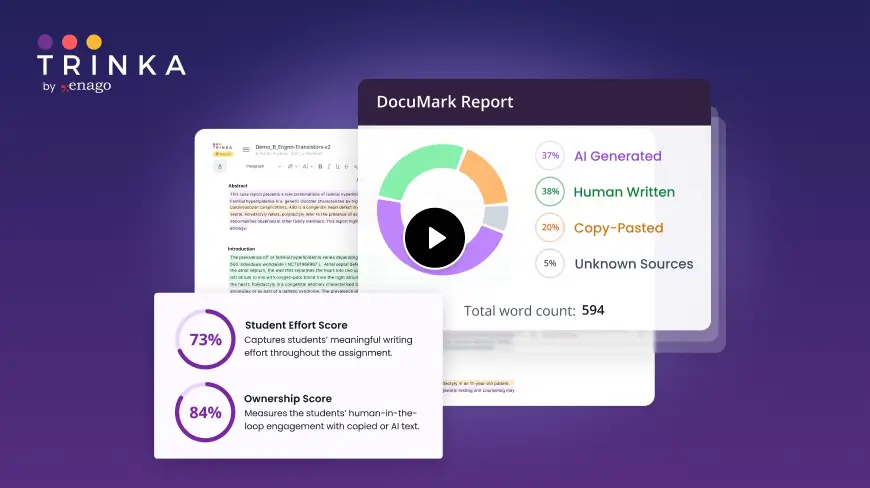
DocuMark: Responsible AI Use for Academic Integrity
Knowing your institution's AI policy is step one. DocuMark helps enforce it fairly by empowering universities to manage AI-generated content, prevent cheating, and support student writing through responsible AI use.
Common Questions About Cleveland State University's AI Policies
Cleveland State University has defined AI policies in 11 of 12 categories, with an overall coverage score of 92%.
While CSU does not have a formal university-wide AI disclosure policy, its guidance emphasizes instructor-led rules. Student-facing materials state they may need to cite AI use and that it is their responsibility to ask for clarification if guidelines are not provided, while faculty are advised to provide guidance on citing AI.
CSU applies its general academic misconduct and technology use policies for enforcement. While the university does not state a formal AI-specific detection policy, it makes faculty aware of tools like Turnitin and SafeAssign, but also provides specific guidance cautioning that AI detection tools have limitations and should be used with caution as they are not always accurate.
CSU does not list approved AI platforms, but applies its general technology and data security policies to AI use. The university explicitly warns users not to enter personal or private information into generative AI tools, as the data can be stored and used by the company providing the tool. This is situated within broader cautions about handling sensitive information.