Teaching & Learning
- For student work submitted for evaluation, AI use is prohibited by default unless an instructor explicitly permits it
- The university sets a baseline rule that student work must be generated by students themselves, but individual faculty may allow limited AI use for specific assignments or purposes if that permission is clearly stated in the syllabus or assignment prompt and defines the scope of allowed use
Colgate University expects that all student work — whether it involves brainstorming, outlining, drafting, or final submission — will be generated by students themselves, working individually or in groups, as directed by the course instructor, syllabus, or assignment prompt instructions.
Unless explicitly permitted by the instructor, the use of AI tools for any part of any academic exercise submitted for evaluation constitutes Academic Dishonesty (cheating).
Individual faculty members may choose to permit the use of generative AI tools for specific assignments or purposes. Such permissions:
* Must be clearly stated in the course syllabus or on the assignment prompt;
* Must define the extent and nature of permitted use (e.g., brainstorming only, coding assistance, citation help);
* May differ from one assignment to another within the same course.
In the absence of a clear statement granting permission, the default assumption is that AI is not permitted.
- Exam-related AI use is governed by instructor rules and the university’s baseline student-work policy
- Faculty are expected to state their policies for examinations and other academic exercises in advance, and students must assume external assistance is prohibited on in-class and take-home exams unless the instructor specifically authorizes it
Faculty members should state, in advance, their policies and procedures concerning examinations and other academic exercises. Students should request such information if a faculty member neglects to offer it. For questions regarding the use Generative Artificial Intelligence (“AI”), refer to the Baseline Policy on Generative Artificial Intelligence Use in Student Work above.
It is especially important that clear guidelines be established and followed concerning the use of “take-home” examinations.
Students completing an “in-class” or “take-home” examination should assume that any external assistance (e.g., books, notes, calculators, conversations with others) is prohibited unless specifically authorized by the instructor.
- The university promotes guided, critical engagement with AI in learning, but course-level permission controls student use in coursework
- Colgate states that students are introduced to AI intentionally and are guided in using it to research, analyze, create, and iterate, while faculty are asked to clearly communicate expectations about permitted or prohibited use in their courses
Students learn to think without AI before they rely on it, and to use it critically once they do.
AI is introduced intentionally to deepen—not shortcut—understanding.
Students are guided in the use of AI to research, analyze, create, and iterate.
As you think about the possible use of generative AI in your courses, it is important to clearly communicate guidelines for appropriate use to your students, and whether or not you’ll permit students to use generative AI tools.
- AI use for coding tasks in evaluated student work is prohibited unless an instructor explicitly allows it
- The policy also recognizes that faculty may authorize coding assistance for specific assignments if that permission is clearly stated and scoped
Generative Artificial Intelligence (“AI”) refers to any technologies that can autonomously produce text, images, code, media, translations, or other content. Examples include but are not limited to Grammarly, ChatGPT, Claude, Gemini, DALL·E, GitHub Copilot, and Slidesgo.
Unless explicitly permitted by the instructor, the use of AI tools for any part of any academic exercise submitted for evaluation constitutes Academic Dishonesty (cheating).
This includes, but is not limited to:
* Using AI to complete problem sets, coding tasks, or data analysis;
Individual faculty members may choose to permit the use of generative AI tools for specific assignments or purposes. Such permissions:
* Must define the extent and nature of permitted use (e.g., brainstorming only, coding assistance, citation help);
Research
- The general disclosure, attribution, and data-protection guidance applies in this context
- Colgate does not publish a standalone policy specifically governing AI use in research writing or manuscript preparation
- However, the university's research AI resources identify AI tools that assist with literature reviews, summarizing papers, and writing-related tasks, and faculty are individually responsible for determining how AI integrates into their scholarship
Our faculty are exploring AI from many angles ranging from the ethics of AI, and developing their own AI-driven language instructional systems to integrating AI systems to more efficiently gather data sets.
Analyze research papers using and automate time-consuming research tasks like literature reviews, summarizing papers, and extracting data.
At Colgate, the role of artificial intelligence in faculty teaching, scholarship, and creative work is a faculty member's individual choice.
Avoid entering confidential data, per the University's Data Categorization Policy, into AI tools.
- However, the materials provided do not set a specific compliance rule for research data and analysis beyond general data-protection guidance
- Colgate states that faculty are using AI in research, including for gathering datasets, and its resource pages identify AI tools that can help summarize papers, extract data, answer questions about data, perform analysis, generate visualizations, and provide code
Our faculty are exploring AI from many angles ranging from the ethics of AI, and developing their own AI-driven language instructional systems to integrating AI systems to more efficiently gather data sets.
This category of genAI tools can assist with research / reading related tasks. These tools can summarize articles, and permit conversational queries within uploaded files.
Analyze research papers using and automate time-consuming research tasks like literature reviews, summarizing papers, and extracting data.
Julius can answer questions about data, perform analysis, and generate visualizations from uploaded files. It can also provide the needed python code to complete these tasks.
- These constitute baseline research integrity expectations applicable to AI-assisted research
- Colgate does not publish a dedicated research ethics policy specific to AI, but its AI guidance addresses ethical dimensions of AI use in research
- The university notes that faculty are exploring the ethics of AI, warns against entering confidential or sensitive data into AI tools, cautions that AI-generated content may contain bias or inaccuracies, and requires human review before publishing AI-generated content
Our faculty are exploring AI from many angles ranging from the ethics of AI, and developing their own AI-driven language instructional systems to integrating AI systems to more efficiently gather data sets.
Carefully examine any generated content for accuracy, bias, or copyrighted content before publishing. Don't assume all generative AI services are safe, unbiased in their results, or completely accurate.
Avoid entering confidential data, per the University's Data Categorization Policy, into AI tools. This includes but is not limited to non-public finance, human resources and medical information, and student records.
Generative AI tools using default settings may not be private and could expose sensitive data to unauthorized parties.
Academic Integrity
- When AI use is explicitly allowed, students must disclose and attribute it
- They must cite the AI tool, describe how it was used, and follow any course-specific citation rules or accepted academic citation formats; failure to do so is treated as a breach of academic honesty
When the use of generative AI is explicitly allowed, students must:
* Clearly cite and attribute the AI tool used;
* Describe the nature of its use (e.g., “used ChatGPT to generate initial outline”);
* Follow any course-specific citation guidelines or use an accepted academic citation format (e.g., APA, MLA).
Failure to properly attribute AI use — even when permitted — constitutes a breach of academic honesty. When permitted but improperly cited, AI use may, depending on the circumstances, constitute plagiarism, fabrication, or cheating. When not permitted, it is cheating (and depending upon circumstances, may include fabrication as well).
- Colgate says AI detection tools are imperfect and should not be treated as definitive proof of academic dishonesty; they may only prompt further inquiry
- Undisclosed or unauthorized AI use in student work is treated as academic dishonesty, and the handbook states that conduct board penalties for academic dishonesty infractions are significant
It is important to be aware that detection tools are imperfect - and currently - no software is able to determine AI-generated text with 100% accuracy. Within academic contexts, AI detection tools might be used to identify situations where further inquiry into the use of AI-generated text may be needed. They should not be considered as a definitive measure in situations considering academic dishonesty.
Unless explicitly permitted by the instructor, the use of AI tools for any part of any academic exercise submitted for evaluation constitutes Academic Dishonesty (cheating).
Any instance in which a student allows another person or entity — including an AI system — to assist with their work, without authorization, is treated as academic dishonesty (and in the case of knowingly using AI when prohibited, it is cheating).
At Colgate University, academic honesty is assumed to be the norm, and there is no evidence that acts of academic dishonesty are commonplace. Nevertheless, in recognition of the importance the Academic Honor Code places on academic integrity, University Student Conduct Board penalties for infractions are significant.
Institutional & Administrative
- Faculty teaching use of AI is left to individual choice, and instructors are expected to clearly communicate course-specific AI expectations to students
- For staff and workplace use, Colgate encourages exploration of AI tools for productivity, but requires human review of generated content before publishing and consultation with ITS before purchasing AI tools for use on Colgate systems
At Colgate, the role of artificial intelligence in faculty teaching, scholarship, and creative work is a faculty member's individual choice.
As teachers, faculty are empowered to create educational experiences that best serve our diverse student body and enhance our rich curricular offerings. Individual faculty approaches as to whether AI is incorporated into their pedagogy vary considerably, given course goals, content, levels, and instructor preference.
Faculty are asked to be very clear with their students about any expectations regarding the use or prohibition of digital tools, including generative AI tools.
Carefully examine any generated content for accuracy, bias, or copyrighted content before publishing. Don’t assume all generative AI services are safe, unbiased in their results, or completely accurate.
To ensure the safety and protection of Colgate’s data, consult with ITS before procuring internal or external AI tools for use on the Colgate network or Colgate devices. ITS will ensure the tool meets appropriate privacy and security protections.
- ITS must be consulted before procuring AI tools for use on Colgate devices or networks
- Colgate prohibits entering confidential data into AI tools and warns that default tool settings may expose sensitive information
- The university does not endorse specific AI tools, but it identifies institutionally accessible options with stronger protections, including Gemini through a Colgate Google account and Microsoft Copilot through Colgate credentials; ChatGPT free and Claude free are described as having no data protection
Avoid entering confidential data, per the University’s Data Categorization Policy, into AI tools. This includes but is not limited to non-public finance, human resources and medical information, and student records.
Generative AI tools using default settings may not be private and could expose sensitive data to unauthorized parties.
Please note: When using generative AI tools, it is important to avoid entering sensitive information to protect privacy and ensure data security. Please note that these tools have their own terms of service, a mix of free and paid subscription models, and may not ensure the confidentiality of the information shared. Colgate University does not endorse any specific AI tools.
Gemini is Google’s AI chatbot, combining machine learning and Natural Language Processing (NLP). It is currently available with data protection through your Colgate Google account.
Copilot is Microsoft’s chatbot, built on OpenAI’s models. It offers enterprise-level data compliance and is accessible through your Colgate credentials.
Developed by OpenAI, ChatGPT uses NLP to answer questions, generate content, summarize information, and more. The free version has usage constraints and no data protection, access to the latest models (ChatGPT Plus) is subscription-based with monthly fees.
Anthropic’s chatbot, Claude, also employs NLP to address prompts and analyze certain document types. The free version has usage constraints and no data protection, access to the latest models (Pro) is subscription-based with monthly fees.
To ensure the safety and protection of Colgate’s data, consult with ITS before procuring internal or external AI tools for use on the Colgate network or Colgate devices. ITS will ensure the tool meets appropriate privacy and security protections.
- Colgate presents a campus-wide AI strategy centered on human-centered learning, curricular integration, research and innovation, and applied learning beyond the classroom
- Its materials describe a coordinated institutional approach with shared tools, frameworks, and guidance rather than a single formal committee policy in the provided sources
Explore our approach, tools, and guidelines for using AI in the classroom, in research, and at work.
Human learning comes first. AI strengthens—not replaces—the liberal arts education that defines Colgate.
#### 1. Human-Centered Learning Comes First
#### 2. AI Within the Curriculum
#### 3. AI in Research & Innovation
#### 4. AI Beyond the Classroom
A coordinated, campus-wide commitment to responsible innovation.
Shared tools and institutional frameworks that support teaching and research.
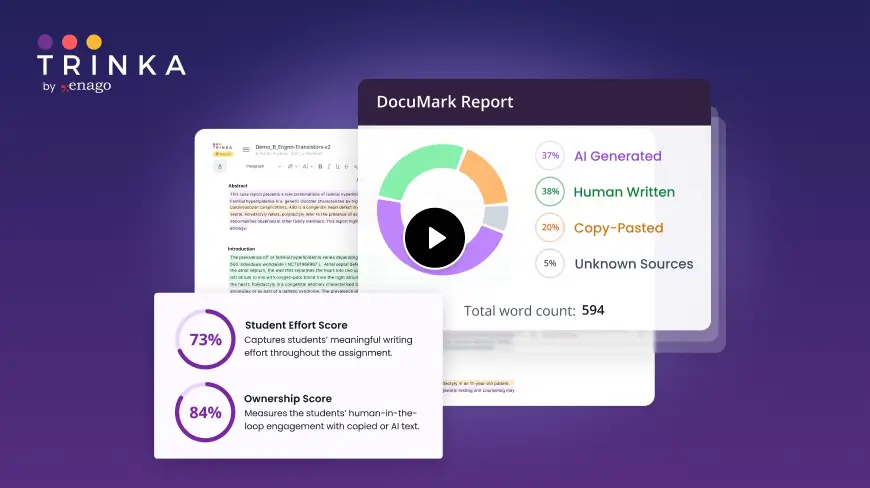
DocuMark: Responsible AI Use for Academic Integrity
Knowing your institution's AI policy is step one. DocuMark helps enforce it fairly by empowering universities to manage AI-generated content, prevent cheating, and support student writing through responsible AI use.
Common Questions About Colgate University's AI Policies
Colgate University has defined AI policies in 12 of 12 categories, with an overall coverage score of 100%.
When AI use is explicitly allowed, students must disclose and attribute it. They must cite the AI tool, describe how it was used, and follow any course-specific citation rules or accepted academic citation formats; failure to do so is treated as a breach of academic honesty.
Colgate says AI detection tools are imperfect and should not be treated as definitive proof of academic dishonesty; they may only prompt further inquiry. Undisclosed or unauthorized AI use in student work is treated as academic dishonesty, and the handbook states that conduct board penalties for academic dishonesty infractions are significant.
Colgate prohibits entering confidential data into AI tools and warns that default tool settings may expose sensitive information. The university does not endorse specific AI tools, but it identifies institutionally accessible options with stronger protections, including Gemini through a Colgate Google account and Microsoft Copilot through Colgate credentials; ChatGPT free and Claude free are described as having no data protection. ITS must be consulted before procuring AI tools for use on Colgate devices or networks.