Teaching & Learning
- The School of Integrative Health states that using AI to complete assignments is cheating unless the instructor expressly permits it
- AI use for coursework is not governed by a single university-wide rule in the provided sources, but several school/program policies prohibit it unless faculty permission is given
- Nursing handbooks also require original student work and state that tools such as ChatGPT should not be used for specified assignments, with MSN students required to consult faculty first if they want to use AI for any part of an assignment
The use of AI software to complete assignments or take exams is considered cheating and is a violation of the Academic Policy unless there is expressed permission from the instructor.
Students are required to submit their own, original work when an assignment is being evaluated by faculty for academic credit. Resources such as ChatGPT should not be used to formulate nursing care plans, write clinical reflections, or provide language for research papers.
Students are required to submit their own, original work when an assignment is being evaluated by faculty for academic credit. Resources such as ChatGPT should not be used to formulate care plans, write clinical reflections, or provide language for research papers.
If a student would like to use AI technology to aid in any part of an assignment, they must first meet with the faculty to discuss appropriate use.
- The School of Integrative Health explicitly prohibits AI use on exams unless the instructor gives expressed permission
- More generally, the university academic integrity policy treats the use of prohibited information during tests, quizzes, or examinations as cheating, and SOIH classifies AI use to take exams as cheating under that framework
The use of AI software to complete assignments or take exams is considered cheating and is a violation of the Academic Policy unless there is expressed permission from the instructor.
giving or using prohibited written and/or oral information during tests, quizzes, or examinations;
- Outside of health-program handbooks, no standalone guidance on AI-assisted studying is provided
- No explicit university-wide policy on AI for learning and study assistance is defined in the provided sources
- However, the SOIH AI in Courses policy implicitly permits AI use when the instructor expressly authorizes it, and MSN students must consult faculty before using AI in any part of an assignment
The use of AI software to complete assignments or take exams is considered cheating and is a violation of the Academic Policy unless there is expressed permission from the instructor.
If a student would like to use AI technology to aid in any part of an assignment, they must first meet with the faculty to discuss appropriate use.
Research
- Beyond that, the provided university-wide sources do not set a broader standalone rule for theses, dissertations, or manuscripts
- Program-level nursing policies prohibit using ChatGPT to provide language for research papers, and the MSN handbook requires prior faculty discussion before any AI use in an assignment
Resources such as ChatGPT should not be used to formulate nursing care plans, write clinical reflections, or provide language for research papers.
Resources such as ChatGPT should not be used to formulate care plans, write clinical reflections, or provide language for research papers.
If a student would like to use AI technology to aid in any part of an assignment, they must first meet with the faculty to discuss appropriate use.
- The provided sources do not establish an AI-specific rule for research data collection or analysis
- However, the university academic integrity policy prohibits fabrication or falsification of research data, methods, results, and conclusions across all academic endeavors including research settings
Each student shall adhere to ethical principles in all of their academic endeavors in class, in clinic, in internships, in research, and in the presentation of class assignments, tests, and all written work.
Fabrication and/or falsifying laboratory and clinical experiences, internship records, attendance records, research data, survey results, research methods, research results, research conclusions, or any other information and/or process used in the collection and presentation of academic, scientific, or professional materials.
- The provided sources do not contain AI-specific rules for grant proposals, IRB applications, or ethics declarations
- The university's academic integrity policy broadly requires students to follow ethical principles in all research endeavors, and prohibits fabrication or falsification of any research-related materials
Each student shall adhere to ethical principles in all of their academic endeavors in class, in clinic, in internships, in research, and in the presentation of class assignments, tests, and all written work.
Fabrication and/or falsifying laboratory and clinical experiences, internship records, attendance records, research data, survey results, research methods, research results, research conclusions, or any other information and/or process used in the collection and presentation of academic, scientific, or professional materials.
Academic Integrity
- The provided sources do not supply a university-wide AI citation format or standard disclosure statement
- The MSN handbook also requires students to meet with faculty first if they want to use AI in any part of an assignment
- The university plagiarism guidance requires acknowledgment of borrowed material and says students should refer to NDMU SOP guidelines for academic honesty when using AI
Sources must be acknowledged using the systematic documentation method required by the instructor for specific assignments and courses.
As a general rule, when in doubt, provide acknowledgment for all borrowed material.
Refer to the Guidelines for AI Use at NDMU SOP for academic honesty when using AI.
If a student would like to use AI technology to aid in any part of an assignment, they must first meet with the faculty to discuss appropriate use.
- The university and nursing program sources explicitly use Turnitin for plagiarism detection and state that it can recognize AI language
- In SOIH, suspected AI-policy violations are investigated by faculty and/or academic leadership under the university academic integrity procedures
- Enforcement can include assignment resubmission, grade penalties, a zero on the assignment, referral to the Honor Board, and broader academic-integrity sanctions up to suspension or expulsion
Turnitin is an Internet-based plagiarism-detection service that allows both students and instructors to check written work for originality of text. The purpose of Turnitin is to aid in the detection and monitoring of plagiarism.
Plagiarism-detection services such as Turnitin can recognize AI language. Students who submit assignments with any percentage of recognized AI language risk a grade of zero on the assignment at the discretion of the faculty.
After close review of the originality report, faculty may request that a student resubmit an assignment. A similarity index of > 15% will likely need to be revised and resubmitted. Grade deductions for plagiarized work or high similarly indices are at the discretion of the course faculty. Should course faculty request resubmission of an assignment, it must be completed within 72 hours of notification. Failure to do so may result in a grade of “0”on the assignment. A similarity index of greater than 50% is subject to an automatic grade of zero and referral to the Honor Board.
Students suspecting someone of violating this policy should report it to their faculty member or the Academic Department Chair or Program Director. All charges of academic dishonesty will be investigated and resolved by the faculty and/or Academic Department Chair or Program Director through the procedures outlined in the university’s Academic Integrity Policy
Violations of Academic Integrity/Misconduct Policy can lead to severe penalties, up to expulsion from the University.
For instances of repeated academic integrity violations or an egregious academic integrity violation, the student may be considered for additional sanction beyond those imposed by the faculty member. In such instances, the Office of Community Standards may refer the case to the Honor Board to consider additional sanctions, such as 1) placement on disciplinary probation, 2) suspension from the University, or 3) expulsion from the University.
Institutional & Administrative
- No explicit faculty/staff AI-use framework is defined in the supplied materials
- The provided sources mention faculty use of Turnitin to review originality reports and request resubmissions, but they do not set an AI policy for faculty or staff use in grading, feedback, lesson planning, recommendation letters, or administrative work
After close review of the originality report, faculty may request that a student resubmit an assignment.
Turnitin is an Internet-based plagiarism-detection service that allows both students and instructors to check written work for originality of text.
- At the school level, the School of Integrative Health has a named AI in Courses policy approved by its dean
- No overarching university-wide AI governance strategy, committee, or roadmap is defined in the supplied materials
- The university plagiarism guidance page cross-references 'Guidelines for AI Use at NDMU SOP' for academic honesty, indicating that additional institutional guidance may exist but was not available in the provided sources
Subject: Artificial Intelligence (AI) in Courses Policy
Approved by Dean, School of Integrative Health, Christina Sax, PhD (August 2025).
Refer to the Guidelines for AI Use at NDMU SOP for academic honesty when using AI.
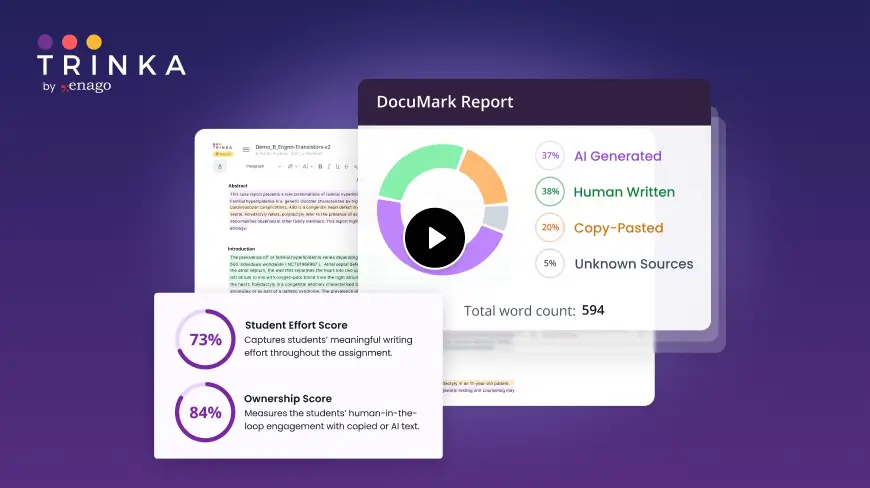
DocuMark: Responsible AI Use for Academic Integrity
Knowing your institution's AI policy is step one. DocuMark helps enforce it fairly by empowering universities to manage AI-generated content, prevent cheating, and support student writing through responsible AI use.
Common Questions About College of Notre Dame of Maryland's AI Policies
College of Notre Dame of Maryland has defined AI policies in 10 of 12 categories, with an overall coverage score of 83%.
The university plagiarism guidance requires acknowledgment of borrowed material and says students should refer to NDMU SOP guidelines for academic honesty when using AI. The MSN handbook also requires students to meet with faculty first if they want to use AI in any part of an assignment. The provided sources do not supply a university-wide AI citation format or standard disclosure statement.
The university and nursing program sources explicitly use Turnitin for plagiarism detection and state that it can recognize AI language. Enforcement can include assignment resubmission, grade penalties, a zero on the assignment, referral to the Honor Board, and broader academic-integrity sanctions up to suspension or expulsion. In SOIH, suspected AI-policy violations are investigated by faculty and/or academic leadership under the university academic integrity procedures.
No explicit data protection or approved AI platform policy is currently defined in the available policy sources.